Showing posts with label conclusions. Show all posts

Sunday, March 29, 2015

Teaching Students How to Write Conclusions

    Writing conclusions is tough for young writers. Actually--who am I kidding? I don't think anyone likes to write conclusions. This makes teaching conclusion-writing intimidating for many teachers. "I know they shouldn't just recopy their introduction, but what else can I tell them to do?" one teacher said to me.

   There are lots of ways to teach conclusion-writing! In fact, my favorite way is to invite Nicola Davies to do it for me.

   Well, of course I can't actually invite her. (Wouldn't that be amazing?) But having a huge collection of her books is the next-best thing. Davies has a gift for conclusion writing. Not only are her conclusions musical and just beautiful to read aloud, but they are simple enough to help young writers think, "I can do this!" 

Revisit Main Points

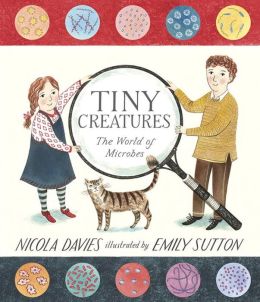
Over the winter I bought Tiny Creatures: The World of Microbes for science class. It is a beautiful read-aloud for teaching about microbes and their role in decomposition. However, I found double purpose for it by using the conclusion as an example of writing a conclusion by revisiting main points. 

The conclusion also engages the reader in thinking about what microbes are doing "right now"...which works well as a model for young writers.  The entire book is a quick read-aloud, perfect for a 15-minute conclusion mini-lesson.

End with the Title

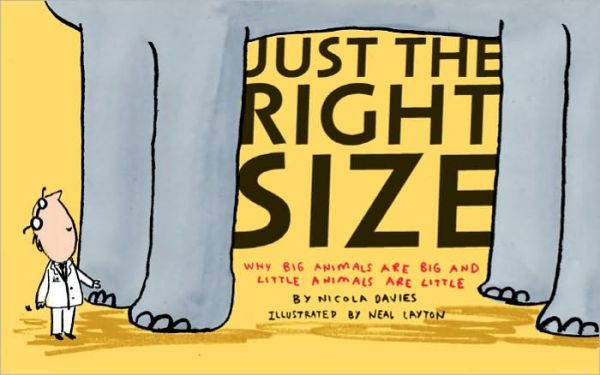
I love Just the Right Size. While I have successfully learned how to like spiders, the idea of giant spiders still makes me shudder. Thankfully, Just the Right Size explains why giant spiders can't exist. Whew! 

This book is a little more complex than Tiny Creatures, and is a longer read aloud. I used it with a fluency group before we read a series of math texts. We were talking about how authors signal big math concepts in math texts, and this book is a great example.

In this book, the conclusion also revisits main points from the text, but Davies structures it so that the conclusion ends with the title of the book. Young writers love this strategy. In the passage-based essays that students wrote this week, students had to explain how the text supported that wood frogs are "tiny forest survivors". Ending the essay with this same phrase was a natural kind of conclusion, and Just the Right Size models how this can be done.

Connect the Introduction to the Conclusion

I have to admit that this is my favorite technique for introductions and conclusions. When authors use this technique well, the entire piece of writing is neatly tied up and the conclusion feels wonderfully satisfying.

My guess is that Davies likes this technique, too! My two favorite examples of hers are Surprising Sharks and Big Blue Whale

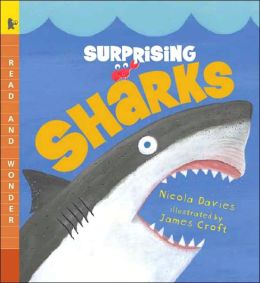
In Surprising Sharks, Davies starts out by imagining a reader swimming in the deep blue sea, only to be frightened by hearing the word "Shark!" By the end, after explaining the amazing adaptations of sharks, their behavior, and the dangers they face due to humans, she turns this introduction completely around. It's clever, it's fun, and it totally supports her thesis...all things that we want to teach students how to do!

In conclusion...

Writing conclusions is tough for everyone. Giving young writers a formula keeps them from engaging with the challenge of writing conclusions. Instead, showing them how an author confronts the challenge, again and again, across different topics, can help them see a pathway toward writing a powerful conclusion. And it just might help the process of teaching conclusion-writing to be less intimidating for teachers.

Friday, November 13, 2009

Mentor Text: Surprising Sharks


One of my favorite writing techniques is the linked introduction and conclusion. The book Surprising Sharks by Nicola Davies has a kid-friendly, engaging example of this. Since my fourth graders are writing essays about fish they have created, Surprising Sharks seemed to be the perfect mentor text.

So I showed them the book, the students said, "Oh!" and wrote great introductions and conclusions.

Well...not really! It wasn't quite that easy. But because I teach writing to three different classes, I was able to try out and refine the lesson until it worked pretty well. Here's an outline.

1. We started by thinking of times when we watched someone else to learn how to do something. Students thought for a moment, and then shared with their partners. Soccer, cooking, and sewing were some of the things that students shared.

2. "Just like you can watch someone to learn how to do something, we can read a book to learn about being a better writer. When we read a book this way, we are looking at how the author writes so that we can try out new ways of writing." I showed students the book. "Today we'll be reading this book to see how Nicola Davies can make an informational book interesting. We're going to look especially carefully at her introductions and conclusions."

3. In two classes, students looked through the text in small groups; in the other, we did it as a class. I think that the small groups worked best. This page helped to give students a framework for looking at the text.

4. As the students worked, I circulated among the groups. Some students didn't recognize the book as informational, because it had paintings instead of real photographs. (This came up in multiple classes!) I directed students to take a look at the diagrams...this helped them to see the informative aspect of the book. At first, many of them just said, "She made it exciting" as an answer for how Nicola Davies starts the book. It took some probing to get them to go deeper...how did she make it exciting? How was this introduction different from "I'm going to tell you about..."? Students did pick up on her use of "you" and how it puts the reader in the action. One student also said, "Oh! It's like a guessing game!"

5. When they got to the conclusion, I could hear laughs and exclamations from the different groups. Nicola Davies turns her introduction around in the conclusion, with a memorable result. And they got it! I could see groups flipping back between the introduction and the conclusion, comparing them. Wow!

6. The last part was the trickiest...could students generalize what they noticed in the text? Could they come up with general ideas that went beyond just writing about sharks? After we finished reading and talking about the link between the conclusion and the introduction, I asked the question: "As an author, what would you like to try?" (This question is really an abstraction...it asks students to pull the author's techniques out of context and generalize them.)

7. There were a lot of answers related to the sizes of the text. (Nicola Davies plays around with the sizes of the words, and the kids really liked it.) But students also said they wanted to connect the introduction and conclusion, write an introduction that puts the reader in the text, and use interesting details. Not bad! I collected these ideas on a poster to keep hanging in the room.

When students started to work on their introductions, they used what they had learned. Now, I didn't have a class full of perfect introductions. But I did see that everyone was making an attempt to write some kind of introduction, and most students were including an interesting detail or image to hook the reader. I've always found teaching introductions to young fourth graders to be a pretty tough challenge. This lesson went more easily than others I've taught, mostly because the students were so engaged and interested in the book.

The conclusions, though, were what were most impressive. I'd been planning on giving students a frame for the conclusion, since this is their first formal essay and conclusions are so new. But they jumped right in! I couldn't believe it.