Showing posts with label grammar. Show all posts

Tuesday, August 17, 2021

Sentence Unscrambling: A Tool for Differentiated Grammar Instruction


     It's always tough to know how to start the year with a new group of writers...and this year brings more challenges than most. I'm planning to dust off a tried-and-true instructional technique that yields big benefits to both reading and writing: sentence unscrambling.

     Sentence unscrambling is just one of the four basic sentence composing techniques suggested by Don and Jenny Killgallon, authors of multiple texts and exercise books for teachers. When I use the technique in my classroom, I go a step further and use sentence composition activities to build reading comprehension skills as well as handwriting fluency.

    The great part about sentence unscrambling is that it can be tucked into small bits of the day, and it reinforces everything you want students to be noticing and thinking about as they write. Here's how I built an activity for my students as part of our first unit, in which we explore texts related to oceans.

Find or write a suitable sentence

     When selecting a sentence, think about constructs that students may find intriguing, but challenging. Sentences with capitalized words, interesting word choice, and multiple clauses make for good sentences at the sixth grade level. 


Break up the sentence into meaningful chunks

     These chunks will be what students unscramble. Keeping some words together helps students to see how sentences fit together and will help them in their next sentence composing activity, sentence imitating. 

    So how does this sentence split apart? Deep stays on its own, as an adverb showing location. Under the Pacific Ocean stays together, as a prepositional phrase. The main verb, lives, will be all on its own. Finally, the mysterious giant squid is a group of words that should remain together, as mysterious, giant, and the all modify the noun squid.


Scramble the sentence for students to analyze

     I always keep the first letter of the sentence capitalized, because this is a great clue for students to use as they analyze what could be going on. Otherwise, I try to just do a random scramble.


Analyzing the sentence

    When I introduce the sentence to students, I model how to read the different chunks and think about how the sentence could fit together. My sentence uses some inverted word order, so it adds a bit of a challenge. I encourage students to use a numbering scheme to keep track of their thinking instead of rushing to recopy the sentence. "Hm, which sentence chunk could be first? Ah, here is the one with the capital letter. Which could be next?"


Recopying the sentence

     This becomes a handwriting activity when students have to recopy the sentence correctly. Believe me, there will be some big surprises as you see how kids struggle with this! I always use lines that have a midline so that students can space uppercase and lowercase letters appropriately, and so that I can see who has a good handle on capitalization and who does not.

Differentiating

     Sentence unscrambling has so many differentiation possibilities! Of course you can have variations in the kinds of sentences that you offer. For example, in the above sentence, you could have some with the inverted subject-verb and some without, just to prompt a discussion about what's going on and why. You could also have some students create the sentences and do the chunking. 

     For students with OT concerns, I provide them with larger lines for recopying the sentences. Some students may also need to have the sentences cut up for them so that they can put them together.

Daily Sentence Writing

     If you would like a set of created activities, try Daily Sentence Writing!


Wednesday, March 6, 2019

Teaching Grammar: A Content-Rich Approach


The teaching of grammar has always been fraught with peril. Since I started teaching in 1997, the general consensus seems to have been this: "Whatever you're doing, you're doing it wrong." Using worksheets? That's inauthentic and useless. Teaching parts of speech? That's not going to help student writing. Skipping grammar to add more writing? That's not going to get you good standardized test scores!
    There are some valid concerns with traditional grammar instruction. When students see isolated sentences with trivial content, their awareness slides right over what we are trying to teach. What students can get correct on a worksheet does not always transfer into their writing. And grammar instruction can seem painful and boring to both teachers and students.
    However, an awareness of grammar is vital! In order to make stylistic choices in their writing, students need to be able to recognize what words they're using and why. In order to identify aspects of writer's craft, students need to know how words are used.
    But what are the best ways to teach grammar? Wouldn't it be great if we could just conference with every child about key concepts that they need to use in their writing? However, with a class of 25-30 and a finite lifespan, I've learned that I can't address everything through a writing conference. There are definitely times when a whole-group lesson is the most efficient and helpful approach. And there are times when worksheets (the right ones!) work. To this end, I've developed an approach to grammar that I can live with and enjoy: a content-rich approach.


What Is A Content-Rich Approach?

    Kids need to know things. They need to know some of the language of formal grammar, but they also need to know about our world as a whole. What if I could make grammar instruction that combines both? Enter my content-rich approach to grammar. No more isolated sentences. Instead, grammar examples carry meaning and build up to a deeper understanding of the world around us.
    For example, recently I was teaching about appositives. (I love appositives! They are one of the best grammar concepts to teach!) As I prepared my examples, I used photographs and sentences about reptiles and amphibians. Not only do these examples grab students' attention, but they also show how the grammar concept can be applied in real writing situations.
     In worksheets, too, we can create examples that carry meaning. After students learned about appositives, they practiced identifying and punctuating appositives with sentences about sea turtles. These sentences led to further research and questions from students, who extended the grammar lesson into their own inquiry. 

Preparing Examples

     What content to choose for grammar examples? I like to explore topics that fit in with the typical curriculum, but go a step beyond. For example, when my husband asked me for some third-grade level adjective work, I used the cloud forest as a theme. His students had read a story about the quetzal in their literature anthologies, and grammar activities had the potential to extend their understanding. (Plus, it was fun for me to research and write about.)
     Sometimes there are topics that fit in well with a particular grammar concept. When I was working with possessives, I knew that birds would make the perfect topic. Not only could there be sentences about bird's beaks, but I could also use the irregular plural noun geese to show a particular case of the plural possessive!
     Content and grammar are of course tied together, and seeing multiple examples related to the same topic helps to create a solid foundation on which to build grammatical learning. The same students who don't remember the words plural possessive perk up when I say, "Remember? What we did when we were reading about the Appalachian Trail?"

Try It Out

   Here are some of the grammar units that I've been working on this year.


Monday, July 23, 2018

Enhancing Grammar by Imitating Sentences

In 20 years of teaching, I've learned a thing or two about teaching grammar. Specifically, I've noticed:

  • Worksheets don't work!
  • Learners have trouble attaching meaning to grammar terms
  • What's taught in grammar class doesn't always show up in student writing


It's not all bad news, though. In fact, I've learned a fantastic technique for helping students to become better writers AND learn grammar at the same time. This technique is simple, easy to use, and easy to differentiate. What is it?

Imitating sentences


That's it. And this year, I really want to go back to this technique (I've been rather pressured to do the worksheet method over the last two years) to start the year.

Benefits of imitating sentences


  • Students learn how to identify the chunks of sentences: Sentence parts like subject, verb, and prepositional phrase become more concrete when students break sentences into meaningful chunks.
  • Students gain control over their writing: When imitating sentences, students learn how to merge content with form. They don't use a particular verb form because it's the first one they think of, but because it's the verb form that is used in that sentence.
  • Students try new forms: Sentence imitating is a great way to get kids noticing and using more sophisticated sentence forms. It's a powerful way to help students notice the beautiful portability of adverbs and adverbial phrases, the use of punctuation in a sentence, and the way that authors can use repetition for style and effect.


Getting started with imitating sentences

To read more about sentence imitating and sentence composing, visit this website by Don and Jenny Killgallon.

Here is an introductory PowerPoint that I made to share with my students. (The formatting problems resolve if you download...sorry! Slideshare doesn't like text boxes very much.)


You don't have to have fancy materials...all you need are some great sentences and a sense of adventure! Take sentences from your literature series, from a book that you are sharing, from the day's read aloud.

When I taught fourth grade, I put together a targeted sentence writing curriculum that went week by week through the Common Core grammar standards. It worked so well! Now I'm thinking that I'll have to come up with something similar for sixth grade...sigh...


Tuesday, April 8, 2014

Daily Sentence Writing

This year, I've been working on daily sentence composing with my students. Each week, students have been unscrambling, imitating, or combining sentences. I've been able to use this method to teach most of our grammar standards, including prepositional phrases, compound sentences, and subject/verb agreement.

This is based on sentence composing and sentence combining research, with some key differences. First, I incorporated lines to help students improve their handwriting during these activities. Second, while many of the target sentences in other books are from literature, I wrote the sentences for this program. I hate the random examples on typical grammar exercises. It seems that students have to use precious processing power to reset their schema as they go from one sentence topic to the next. If the sentences are all based on one topic, then hopefully students will have more processing capacity to deal with the complexities of sentence composing.

Writing these sentences was hard, but so worthwhile. I have a YouTube playlist for each theme, so students can see the videos during arrival, dismissal, and as transition activities. These videos reinforce the content in the sentences and add new vocabulary words, which students can then take into their sentences and paragraphs.

Each week ends with a paragraph prompt inviting students to write on a topic related to that week's sentences. Often, students have to incorporate an aspect of the week's lesson, such as a compound sentence. Students then check their own work using a highlighter and a red pencil.

Two weeks ago, I joked to the co-teacher in my room, "Well, thirteenth time's the charm!" We had just finished our thirteenth week, and the paragraphs were amazing! Students had to write about their experiences from the point of view of a fish--and they were able to read the prompt, figure out what to do, and weave in their own experiences. One student wrote that he was a shad in the Susquehanna River, using details from our migration simulation in his writing. Considering that I had students who responded in just a single sentence (or a single run-on sentence) at the start of the year, this is great progress.

I've also created several PPTs to go along with the ideas in these lessons. Each PowerPoint includes the examples that I want to show students, along with some interactive elements. Here is the latest one, created to help students learn how to use "sophisticated" transitions:


Combining sentences with the words although and despite from Emily Kissner

Well, the thirteenth time does seem to be the charm! If you are looking for a way to combine grammar with writing, you may want to try creating your own daily sentence lessons. You can purchase the first 8 weeks of mine here. (Part 2 is coming soon!)

And of course the other PowerPoints are available free at Slideshare:
-Imitating Sentences
-Combining Sentences
-Formal and Informal Language (download it to see it properly as I got too fancy with the text boxes)

Monday, February 3, 2014

Sentence Combining

I really love using sentence composition activities as teaching tools for writing and grammar. This year, most of my grammar instruction has come from sentence modeling, sentence imitating, and sentence combining--and I really am seeing the carry over into writing.

In a few weeks, we're going to start on some more difficult sentence combining. Sentence combining is a great strategy for improving grammar and writing. (For more on sentence combining read this article by Bruce Saddler and Kristie Asaro-Saddler.) I took advantage of the snow day to create a PowerPoint to introduce sentence combining:


You may notice that there are many water pictures in this presentation. I'm dreaming of summer! Also there are lots of wading birds--mostly because they are the most obliging birds and will stay still long enough for me to take a picture of them.

Notes
-February Homework is up and running! I made over the old Winter Homework texts and added an advertisement and a myth...Theseus and the Minotaur.
-Here is a link to my playlist of videos that go along with the homework texts. I'm hearing from teachers that they are using the texts for small group instruction or intervention as well as homework...that's great feedback.
-Right now I'm working on having my cake and eating it too: Making a social studies United States regions unit that is also differentiated fluency instruction. Is anyone else interested in such a thing?

Tuesday, June 18, 2013

Focus on Grammar: Grammar Games

We had a great morning talking about grammar and the Common Core! Looking for the language standards by strand and then lining them up in grade level order helped everyone to really read the standards carefully and think about how they progress through the grade levels.

Here is a playlist with some of the videos that we watched, as well as some others that work well for instruction:


Computer games can be another way to help students review and practice key grammar topics. However, there are so many games out there that sometime it is hard to find the ones that are really useful for elementary students. Here are some games that I have found (and tested) that work well for various concepts.

Punctuation Games
Learn about basic punctuation with Comma Chameleon.

In Alien Punctuation from BBC, students help aliens by correcting sentences to add correct capitalization and punctuation.

The game Complex Sentence Camp helps students to learn how to punctuate complex sentences.

Along the Sentence Trail, students decide on the kind of sentence and add correct end punctuation.

Parts of Speech
This simple Noun Explorer game helps students to learn about nouns.

The Adjective Adventure game helps students to identify adjectives.

With the game Verbs in Space, students look for verbs. Multiple tenses are used.

Other Resources
When we worked with sentence combining, I mentioned that Bruce Saddler had a book that includes more detail about sentence combining. The title is Teacher's Guide to Effective Sentence Writing. If you get it, drop a line and let me know what you think!

Additional resources about sentence composing can be found at the Sentence Composing page hosted by Don and Jenny Killgallon.


Saturday, June 15, 2013

Focus on Grammar: Progressive Tenses

I'm working on a new teacher workshop for next week--Grammar and the Common Core. Hooray! Sitting and sifting through research articles and putting together a slideshow is a great way to celebrate the beginning of summer. (Well, at least I could kind of justify my Pinterest browsing as looking for funny grammar-related memes!)

It's interesting to see how verb tenses are expressed through the Common Core. Beginning in second grade, students are expected to use verbs to show a sense of time. In third grade, they need  to form and use the simple verb tenses. Fourth grade adds the progressive verb tenses, while fifth graders are expected to use verb tenses to show a variety of sequences and conditions.

Here is a PowerPoint that I made to help students understand and use the progressive tenses:


Progressive tenses from Emily Kissner

**There are pictures of my youngest son in this presentation, used with his permission of course. Although now he is negotiating Terms of Use every time I get out the camera...

Monday, April 22, 2013

Easy Grammar: There is/there are

During state testing, I decided to teach some quick and easy grammar. I wanted to design a few fun lessons that would be engaging for kids and wouldn't tax their brains too much or require extended writing.

In our last writing project (which I really will talk about in more depth soon--the kids loved it!), I noticed that kids were having difficulty with subject-verb agreement. One consistent error that cut across ability levels was a problem with there is and there are constructions.

To make a fun lesson, I decided to start by having kids draw pictures. I gave them some directions for what to include in their picture.

This took a good 20-30 minutes. Kids used the fine point black markers to outline their work, and added color with colored pencils. Their drawings showed wonderful creativity and a healthy amount of weirdness. (Having fine point black markers on hand, like the Vis-a-vis transparency markers, is a trick I picked up from a kindergarten teacher. It really does increase the quality of student work.)


At the end of the day, I collected their pictures. On the second day, I started with a quick mini-lesson on using "there is" and "there are". I used a snapshot that I had taken of students as they worked on a science project.

Then, I redistributed the drawings to different students. These students then wrote sentences about their classmates' pictures using "There is" and "there are". We had lively conversations ("What are these flying things in your picture?") and lots of friendly interaction. As students worked, I quickly circulated and found the kids who were still having trouble. I worked with them individually and helped them to straighten out their sentences.

The best part about the lesson is that students had an authentic, natural reason to write sentences using the target words. Instead of a boring exercise, they got to see their classmates' work and comment upon it.

The whole thing ended up with a gallery walk to share our creations!

So--nothing amazingly new or exciting, but a quick little two-day lesson that fit perfectly into a longer look at subject-verb agreement! Even better, kids seemed to hold onto their understanding of the use of these constructions and did pretty well on the short assessment I gave them a few days later.

Thursday, November 10, 2011

Teaching Possessives with Greedy Apostrophe

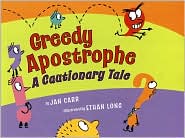
I love the book Greedy Apostrophe by Jan Carr. In this book, the punctuation marks all take jobs from the Director. But Greedy Apostrophe wreaks havoc in toy stores and magic shops, inserting apostrophes where they don't belong.

This book makes talking about apostrophes so easy and fun! Like many elementary students, many of my fourth graders start to put apostrophes everywhere in their writing. Greedy Apostrophe gives us such an easy and concrete way to address this problem--after we read the book, I can just say, "Hm...I see a greedy apostrophe in this paragraph," and kids know what to look for.

I created the sheet below to help students apply the ideas in the book as I read it aloud.


But the best part of this book is that there is more to it than the grammar rules. Kids like to look at how all of the different punctuation marks have been characterized, and many pick up on the punctuation puns that are scattered throughout the book. Some kids even notice the color scheme--"Why does red always mean angry?" one girl wondered, pointing out the fact that Greedy Apostrophe stands out from the rest of the punctuation marks. Another student drew a picture of Greedy Apostrophe in the Punctuation Pen, with a word bubble: "I've learned my lesson! Only use apostrophes to show ownership!"

Sunday, June 12, 2011

Adding Richness to Grammar Instruction

I've always had a love/hate relationship with grammar lessons. In my own life, I really love grammar. I love the way that one word can change an entire sentence, the way that punctuation has evolved over time (and is still evolving!) and the way that words have entered our language.

But it's never been easy to communicate this love of grammar in the classroom. Few fourth graders really want to hear about how the word sports really is related to import. And not many are up for a discussion about how the rules for commas in a series differ across countries. There are also the practical issues of where to fit in grammar and how to connect it to everything else.

Of course, it's easy for people who are outside of the classroom to say that grammar fits in everywhere. And it does--in a way. It's easy for me to talk about grammar all the time. But for my talking to translate into actual learning, I need to take the time for more formal planning. Just try to get fourth graders to write sentences with adverbial phrases! 

While I haven't completely solved the grammar problem, I have developed a general formula that gets me through.

Link to academic vocabulary: This satisfies my desire to talk about new and interesting words. Instead of teaching students with how the word comma entered the language, however, I try to pull out an academic word that links to the grammar content. When I taught about commas in a series, however, it worked perfectly to teach the word series. We looked at how they already know this word (World Series, television series) and connected it to new meanings.

Silly writing: With fourth graders, I have to keep things light and playful. For teaching about commas in a series, I drew some silly pictures and asked kids to write sentences about them. For example, next to a picture of a monster, the question was, "What are this monster's favorite foods?" These kinds of questions provide lots of practice, but are still interesting and engaging. (And kids love teacher-illustrated pages, even when the illustrations are not the best.)

Fun interactives: Grammar is something that lends itself well to computer games. For commas, I found this great interactive site.  These sites are a big improvement on the dreadful workbook pages I did as a child! I do make sure that I go through every site, of course, to make sure that the rules in the site are the same as what I am teaching.

Flexibility in rules: I've decided that it's not confusing to students if I show them examples of how usage might be different in different situations. Kids need to see this--in fact, it's more confusing to not address this issue. When we were looking at commas, I found examples of how some writers do not use the comma before the and. When I teach capitalization next year, I'm going to actively seek examples of the changing usage of capitalization.

Real writing application: This is the hardest part, but also the most important. When we were working on commas, students wrote pages for a book about our field trip. Each page included a series of items that we saw or did on the trip. When the book was put together, we had the story of our field trip.

Tuesday, October 12, 2010

Nouns and "What's My Rule?"

Fun with nouns! Well--maybe. I guess it depends on your definition of fun.

While students were sharing their journal entries, I played a little game of "What's My Rule?" We do this in math class to help students recognize patterns. But it is a great grammar activity, too.

I wrote down words from the text as a student read aloud, and then the students had to try to guess the rule for the list. I started out with just nouns, but branched out into common nouns, proper nouns, and plural nouns. After I made each list, students gave the list a name based on the words that I chose. It was a fun way to reinforce nouns AND look at their role in the students' writing.

Each list turned out to be a little different! They led to some interesting discussions about how the content of the story is shaped by the nouns that students use. It was a quick way to show students how the abstract ideas of grammar translate into their everyday writing.