Wednesday, July 28, 2021
Reading Survey for Students
Thursday, June 17, 2021
Looking Back: Classroom Libraries and COVID
This year has been tough! My school was face-to-face with the entire class for almost the entire year. Last year, I wrote about plans for a classroom library in the face of a pandemic. Now, I'm at the happy point of looking back on the year and thinking about lessons learned.
Taking Books from Room to Room
Because I moved about this year, I couldn't have a typical classroom library. Instead, I had to take a bin of books with me from room to room. (By the end of the year, I was carting a tall table and an overhead cart with handouts and books!)
I expected this to be harder than it was. My start of year book survey helped me to do first day book assignments. Then, I could pick out follow-up books to put into my book bin to cart from place to place. I did make many trips back and forth to my classroom to get books that I'd forgotten; luckily I had a co-teacher for two classes and a lunch break in the middle of the other.
I had some tried and true books that went with me and were in almost constant circulation! Because of this year's overall atmosphere, I found that kids gravitated toward quick and fun graphic novels. These were the all-time favorites from the year.
Teacher Sign-Out Book
In the past, students have been responsible for signing out books. This year, I needed to keep the sign-out book myself. Returned books went into a quarantine bin, while I checked books in and out with a sign in book.
And this worked out wonderfully! In fact, I think that I will clear the first 10 minutes of every class this year to do this again. I kept better track of books than ever before. Previously I had thought that I absolutely could not handle writing down student book checkouts, but I learned otherwise. It worked out well and helped me to have short conversations with readers every day.
No Browsing
At the start of the year, I worried about the lack of browsing in my classroom library. However, this turned out to be less of an issue than I thought. Between the book survey and my traveling book bin, I managed to get kids set up with the next book they'd like pretty easily. Each morning, I would sort the quarantined books that were ready to be returned, check my notes for what to take the next day, and get my book bin set up.
In fact, I noticed that no browsing meant that more time was spent reading. Students became more skilled at asking me for the kinds of books they'd like ("Mrs. Kissner, I want something that's sad and long") and I got better at making recommendations. I did sometimes give students three books that I'd selected for them to look through. They could choose one and return the rest to the quarantine bin.
I don't think that I will disallow browsing for the future, but I think that I will limit it. I always have a core group of students who like to avoid reading, and too much freedom to browse gives them time to do this. Finding a balance between browsing and teacher recommendation is my task for next year!
Outdoor Reading Time
This isn't something new for the pandemic...but wow, does some outdoor reading time brighten everyone's mood! In the first few weeks of school, I had students bring along a beach towel to sit on outdoors. Our bright and sunny courtyard was the perfect place for fresh air, reading time, and much-needed social distancing.In my end-of-year survey for students, independent reading time rated highly as one of the favorite activities for students. In fact, several students suggested that I give more time next year! This just goes to show that independent reading is important no matter what.
Lessons for Next Year
What will next year bring? I can't even begin to guess. But I have learned some new tricks for my classroom library and figured out how to make daily reading time work in a wide range of situations.
Saturday, March 16, 2019
Take your class to read outdoors
Did anyone else have such a beautiful Friday as we did in Pennsylvania? By March standards, it was the perfect day: windswept blue skies, bright sun, and warm temperatures.
After lunch, a student said, "Maybe we can go read outside after we finish our spelling test." I glanced at the clock and made a doubtful face. I hadn't planned reading outside, mostly because it had been five months since our last session and I didn't think we'd have time to run down the expectations again.
Still, we finished our assessment quickly and the students looked at me with such hope in their eyes that I gave in. "We'll try some outdoor reading," I said. It was Friday, and I didn't really expect much reading to happen. However, with colder weather on the way, I thought giving kids more time outside was the nice thing to do.
Getting ready to read outdoors
I admit that I have an exceptional location for outdoor reading. I mean, this view is amazing, right? (Don't be too jealous; we don't have air conditioning and I'm a good half hour from the nearest Target, so there are trade-offs.)I'm sad to admit that for the first ten years of teaching here, I didn't really think of reading as an outdoor activity. I took students outside for science walks, and perhaps we read once or twice a season as a special activity, but it wasn't part of my consistent instruction.
Then I moved to the end of the hall. I had an entrance twenty feet from my door. Could we read outside more often? I started to dismiss the idea. Students wouldn't want to sit on the hard ground, they wouldn't stay focused, there would be too many complications. But the pull of the outdoors was strong enough to overcome these issues. So I did some prep work to get everything ready. Here's what to do!
Collect blankets and sheets: I pulled together a collection of old blankets and sheets from my house. You know, the character twin sheets that the kids don't want to use anymore, the blankets that just feel weird, the beach towels that are frayed on the edges. I was able to pretty quickly get about 12 together, enough for my entire class. Alternatively, you could ask students to bring in beach towels or see if any parents have some to donate.
Get some old patio cushions: I didn't plan for these, but someone was upgrading their patio furniture and offered me the old and faded cushions. They are perfect for outdoor reading!
Check schedules and locations: The last thing you want is to have a PE class walking through your reading session. Think about the school sessions and find a location where you won't be disturbed. You'll also want to think about how big of an area you want to control. Spreading out the students can be great, but can also make it harder to see what students are doing.
Consider the sun: Depending on the time of day, bright sunlight can make reading uncomfortable. It helps to find a location that is part sun/part shade so that students can choose what is best for them.
Grass will be wet in the morning: If you want to read first thing in the morning, the grass will be wet and will soak through your blankets and sheets. Trust me. We know. You will want some flannel-backed vinyl tablecloths instead of blankets if you are reading first thing, OR you will want to be sure to read on blacktop. As you can tell from the pictures, my reading locations vary slightly depending on the time of day and outdoor conditions.
Setting up expectations
I like to create a looks like/sounds like chart with students before our first outdoor reading session. We talk about how reading outdoors can be a fun and relaxing activity for us. But what would a class of engaged readers look like? What would it sound like? We talked about how there would be things outdoors that we may want to look at--an overhead vulture, for example--and how we could switch our attention back and forth between what interests us and our books.For the first few sessions, I had my co-teacher watch the class for a few minutes while I slipped outside to arrange the blankets. I set them a good distance apart so that students can spread out. After I do this a few times, students pick up on the expectations and can arrange everything on their own. (Funny story: When we went outside on Friday for the first time in months, students fished their favorite blankets and sheets out of my bag as if they were long lost friends!) The cushions are given out by picking Popsicle sticks.
I also made sure to take some high-interest picture books outside for the first few sessions. In August and September, students are still settling into the reading routine, and one or two will inevitably finish their books during an outdoor reading session. Having some books on hand makes it easy to get those kids right back into a book.
Managing behavior
I never have any behavior issues outdoors! It always goes perfectly!Hahahahahahahahahahaha. Working with sixth graders is never dull, that's for sure. Some issues are bound to occur! For this reason, I don't generally get a chance to read myself when we are outside. Instead, I circulate to check in on what students are doing.
Bug freak-outs: Some students are more concerned about this than others. We talk about how to handle bugs and have a few volunteers who will handle spider removal if necessary. If there's a student who really really doesn't want to sit on the ground, talk with them to brainstorm a solution. One year I had a student who would carry a stool out with him. It worked!
Daydreaming: I'm not sure of how big of an issue this is. Sometimes students will be outside and will just look into the mountains or sky instead of reading. I keep an eye on this and alternate indoor with outdoor reading to make sure that some reading gets done. But then...with a view like ours, who can begrudge some moments to enjoy?
Delighting in the teachable moment
Spending time outside always brings unexpected delights, like the bald eagle flying overhead or the robber fly stopping by. In October, when the insects are sluggish and easy to catch, we usually bring a collection container with us when we read outside to catch our six-legged friends.I usually take two minutes before we go inside to share what's new and interesting that day. If students don't know what's there, they won't miss it when it's gone. On Friday, the killdeers had returned, so we spent a few moments listening for them.
Outdoor reading time is a way to combine two wonderful activities for students. It's surprisingly easy to manage, and students find it enjoyable. Give it a try!
Tuesday, June 19, 2018
Engaging Readers with Independent Reading
I presented on the topic of independent reading. Structured time for students to read during class has been an important piece of my instruction ever since I started teaching (waaay back in 1997!) I've never presented about it before, however. Why not? I never feel totally comfortable with how I implement independent reading. Each year I make small changes as I consider whether my classroom was too structured or not structured enough or whether I didn't hold students accountable or whether I sucked the joy out of reading.
This level of existential discomfort, however, is vital to teaching reading. I think that the day I decide that everything is "just right" will be the day that I am done as a classroom teacher! I need to learn how to embrace that uncomfortable feeling and keep making small changes as I adjust to each new group of students.
Speaking of an uncomfortable feeling...I didn't have my Mac adapter to plug into the Promethean board, so I used the handy PC computer that was already connected and just signed into my Chrome account. No problem, right? Except that the computer RESTARTED twenty minutes into my presentation and took the entire session time to look for updates and finish. Ugh! Luckily I could talk forever about books and reading, but I don't think the participants were impressed.
Here is a link to the presentation, with some photos removed:
Here is a list of my favorite classroom books for independent reading!
Anyone else have a presentation fail to share?
Tuesday, September 12, 2017
Reading Round Up: Starting the Year
Getting Started with Assessments
So this August I was back to square one with a new crop of readers and writers. True to my reading specialist training I've been using the Qualitative Reading Inventory to listen to my students and gain an insight into their word-solving and comprehension techniques. There are so many things to like about this as a quick reading assessment--the word lists help me to see where kids are with words in isolation, while the passages allow me to listen to students and gain insight into their answers to both explicit and implicit questions. I've been working with one students each day, during independent reading time, and this has worked well.

Popular Books
It's been interesting to see how readers have taken to my classroom library. I always love seeing
which books they love! What's great about having so many excellent books around the classroom is that I can quickly pull them to explain concepts that I'm teaching.
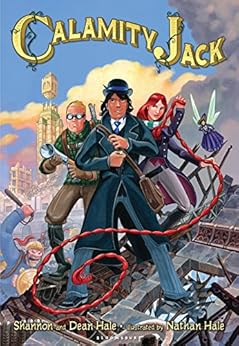
Calamity Jack by Shannon and Dean Hale retains so much appeal for students. This is one book that hasn't seen the shelf (actually, the bin dedicated to Shannon Hale's books) all year. What's neat about this book is that it leads to so many others--not just the Shannon Hale books, but also books by Nathan Hale.
Another popular graphic novel has been The Nameless City by Faith Erin Hicks. The characters are interesting, the setting is new and exciting, and the action appeals to a wide cross section of readers. Today a student even brought me the sequel, The Stone Heart, to show me the way it reveals a flashback in the text.
With a movie on the way, Wonder has been making its rounds through the room. It's so great to have this book at hand to illustrate important concepts about point of view. There are so many reasons to love this book, but Auggie's wry sarcasm is my favorite part.
New on TpT
I made these Expository Text Structure signs for my classroom. They're pretty simple, but a nice ongoing reference for my students.
I'm starting the year teaching about Earth's Spheres, so I'm using this set of resources that I made last year. They go very nicely with the Crash Course Kids videos on the topic.
These Summary and Analysis sets are easy to use for ongoing summarizing and text-based essays! I use them on a two-week basis (we're doing the Stormwater text right now) and see so much growth from my students over the course of the year.
Sunday, April 26, 2015
What Happened When I Said, "No More Graphic Novels!"
However, as I fielded requests for the missing copy of Amulet 3 and watched students flit restlessly as they waited, I started to think about what kids haven't read this year. The list was alarming. No one has picked up the Dragon Shoes series by Jessica Day George. A few students read Frindle, at my suggestion, but never moved on to the other Andrew Clements books. The series Among the Hidden, which has been a perennial favorite of fourth grade, was virtually untouched.
So I did it. I said, "Between now and May 18 you must all read one chapter book, approved by me. Not a graphic novel."
I expected resistance. I expected sulking. I expected anything except what I got.
Because what I got was--total acceptance. "Can you help me find a chapter book?" one student asked.
In two weeks the reading of the classroom changed. I have students on the fourth book of the Among the Hidden series. The One and Only Ivan has changed hands twice. Students have brought in their own books, from home or from the library, books that they have had and have been planning to read but never did. Kids who thought that books with no pictures were too hard for them or no fun are liking what they find.
And they are still reading graphic novels, only now they are using them at extra times throughout the day--before school, in between classes, whenever they have an extra minute. In fact, my decree seems to have only increased demand for graphic novels.
I love the surprises in teaching. In this case, a restriction led to more reading. Instead of feeling deprived, my students seemed to thrive. Would this have happened at the beginning of the year? I don't think so. I think that the experiences students had with graphic novels have gotten them ready for reading all of these other books. They just needed my nudge to get them there!
Have you ever done something like this--something that surprised you? What were the results?