Sunday, March 13, 2016

Building Recursive Processes for Essay Writing

 
Writing passage-based essays and other synthesis tasks are important for students. However, these tasks can be very frustrating for teachers! The frustration comes from the issue of how classroom work is accomplished versus how creative work is accomplished.

Linear Process
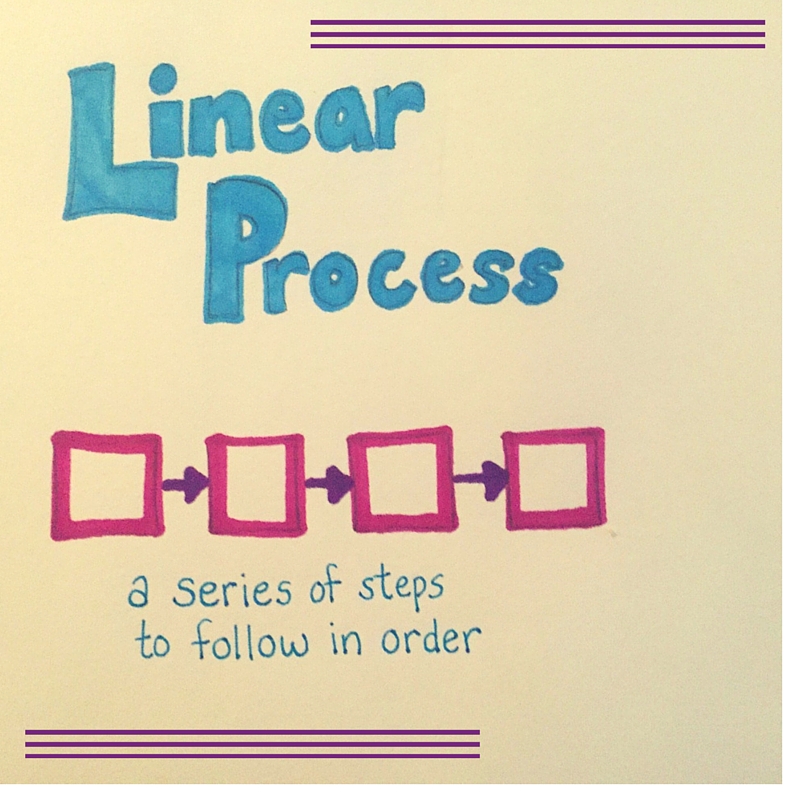
    In the classroom, a linear workflow rules. I write these kinds of directions on my board every day: First complete step one, then go on to step two, and so forth.
    Linear processes work well for managing many students and many assignments. A linear workflow shapes a task into approachable chunks.
 
    Unfortunately, a linear process just doesn't work for high-quality writing. In fact, a study of synthesizing found that a linear writing process is associated with lower quality synthesis (Sole et al, 2013). Readers who follow a linear process, with each step following the other, miss connections between ideas. They fail to follow up on key concepts and don't show as deep of an understanding of the text.


Recursive Process
    The best process for a synthesis task like a passage-based essay, as it happens, is a recursive process. A recursive process sees a student shifting flexibly back and forth between tasks. Step two doesn't always follow step one, and sometimes step three leads back to the beginning.

    It's easy to see how this kind of process can be tough to manage in the classroom. Many traditional classrooms are built on an assembly line model: Get a task, finish it, get the next.

   But it's worth the time and effort needed to move to more recursive processes in the classroom. It's worth it to think about:

-How can I help students to revisit key steps in the writing process?

-How can I model a recursive process as a reader and writer?

-How can I structure my classroom to allow more time for synthesis tasks?

    The answers to these questions aren't easy! I'm still struggling with them myself. I like to think that this productive struggle on my part as a teacher will lead to productive struggle--and creative benefits--for my students.


Sole, Isabel, Miras, Mariana, Castells, Nuria, Espino, Sandra, Minguela, Marta. 2013. Written Communication, v30 n1, p 63-90.

Saturday, February 13, 2016

Adding Text Quotations to Passage-Based Essays


This week my students have been working on writing a passage-based essay. They are using two different texts from the Wonders series, and are synthesizing information from the two texts for the essay.

This is a hard task. When I studied the research on students and synthesis tasks, I wasn't surprised to find that even college students struggle with it. Left to their own devices, students may copy information from texts, rely on a single text instead of referring to both, or engage in shallow thinking at the expense of true synthesis. (You can find the references here)

As I talked with students about their essays, I found that many were struggling with adding text quotations. One student tried to start the essay with two quotations from different texts, without any introductory phrases. Another added text quotations in the middle of paragraphs with no context. Another said, "I'm tired of using 'according to the text'. What else can I say?"

I realized that this was probably a skill that the whole class felt shaky with. Even though they've been writing passage-based essays for two years now, they are still not sure of how to integrate the text quotes into their own writing.

And there are so many things for writers to consider as they do this integration! My writers were struggling with

-How to choose the text quotations
-How to introduce the text quotations
-How to punctuate the text quotations

I started to remedy this with some read aloud. First, I chose Gary Blackwood's Enigmatic Events for its engaging content and great use of quotations from primary sources. Students need to hear much much more of the kind of academic writing that they are expected to do read aloud for them.

Then, I created a handout to guide a lesson about adding text quotations. (I love making handouts as lesson guides because they make catching up with co-teachers or kids who have been absent so easy.)

The handout shows different ways to introduce text quotes. In the first part, students underline the introductory words and phrases. In the second part, they  figure out how to use the punctuation correctly by looking at examples.

We're still working on the best ways to add text quotations, but I feel that we're making progress! Next time--writing introductions.

You can find the handout for free at this link: Adding Text Quotations to Passage-Based Essays.

Wednesday, February 10, 2016

Hexagons Build Connections


I really admire tessellations. When we set up our game of Catan, I always marvel at how the hexagons fit so beautifully together. The same goes for Takenoko, a new game that my son got for Christmas that I just love.

So when I saw some blog posts about using hexagons to review key ideas, I was intrigued. It seemed like a great combination--using tessellations to make content review more meaningful and engaging.

The idea is simple. Take some hexagons, write concepts or words on them, and have students connect the tiles. The key is that students should be able to explain their tessellations, describing how the different ideas are connected.

1. Make or copy your hexagons

I made mine in Google Drawings. Apparently everyone else in my house knows that holding "shift" while creating the shape makes a regular shape--it was a new trick to me! I left some spaces between them to allow for easier cutting.

2. Write content words in the hexagons

Because this was the first time for me to use this activity, I decided to add the content words. I chose words that go along with my current forces and motion unit.

I made four different sets of hexagons, and then copied each set onto a different color of cardstock. This would be handy later. (My first class ended up cutting out the hexagons, which I stored in report card envelopes.)

3. Explain the importance of connections to students

I told my students: "Our goal here is to see and explain how these ideas from our unit are related. The more connections we can make, the more easily we will be able to work with these ideas and use the vocabulary."

4. At first, have students work with one set of hexagons

I circulated to watch carefully what was happening. Some students set up interesting shapes right away, while others struggled a bit. I encouraged them to go back to their resources to check for ideas and information!

5. Gallery walk by hexagon color

For the first set of gallery walks, students got up and walked around the room to hear from their peers. In some cases, the seated students challenged their friends to guess, while in other cases they pointed to the hexagons and shared their sentences. Having the four different colors made grouping for this really easy!

6. Pair up colors

This was really fun! Students got together with partners who
had differently colored hexagons to try to make new connections. Some groups challenged themselves to make one giant tessellation, while others made sets of small ones.

Reflections

As a review activity, this worked very well to get kids using challenging vocabulary. I heard great dialogue between students as I walked around the room: "I'm not sure how I could add acceleration here" or "What is lift again?"

I hate review games in which only one or two kids practice answering questions, and this worked well to get everyone involved. Some kids even asked to take the hexagons home for more practice!

Next time, though, the hexagons will be much, much more artistic. I can't wait to see what students do when I hand over the blank hexagons to them at the end of the next unit.


Saturday, February 6, 2016

Expanding Learning with Task Cards


I've always been sort of ambivalent about task cards. While I like the idea of students getting up and walking around the room as they practice key concepts, I don't like the fact that task card tasks tend to nurture...a focus on "tasks". One of my key goals is to get readers and writers to think more deeply and linger over text. When students see a long list of blanks to fill in, their brains tend to switch to "get it done and over with" mode.

This week, I tried a set of science task cards to help students review forces and motion. But how could I get kids to think more deeply?

Day 1: Task Cards

Have kids complete task cards as usual, emphasizing quality of collaboration over quantity of answers completed. We even modeled and practiced collaborative conversations and how to check back through our resources.

Day 2: Expert Work

This is when the hard thinking begins! First, I sorted the task cards into sets of odds and evens. Then, I gave each pair of students a set of task cards. No need to put them in any sort of order--just make sure that one pair gets two even cards, the next pair gets two odds, and so forth.

Each pair of students then became an expert on their task cards. I projected the answer key to the whole set of task cards with these directions: "You and your partner are about to be the experts for your two cards! Check your answers with the answer key to make sure that you have the correct answer. Then, find evidence in your science folder that supports the answer. Be ready to explain the steps in getting the answer or to give other examples."

This process took about six minutes, and it sent students back to their folders to sort through their resources. (My tests are open-note, and I want to encourage students to use their resources, so I love to see them paging through their work!)

Then, the students with even task cards stayed at their seats to be the experts, while students with odd numbered task cards moved in pairs to check their answers with the experts. It was great to see how explanations developed--from across the room I could see students displaying pages of their notes, gesturing with their hands, and explaining calculations.

After the first session, students nominated expert explainers and we talked about what had led to their high-quality explanations. Then, students reversed roles and repeated the process.

Not every task card got checked or completed--but that's okay! Remember, quality trumps quantity each and every day. Our work as teachers is not to make sure that every line gets filled in.

Reflections

While it added time to the whole process, the quality of discussion and engagement really showed the value of the expert time. Instead of the teacher grading seventy task card answer sheets, students got to be the experts and explain answers in real time.

What other tricks have you used to expand the thinking with task cards?

Saturday, January 30, 2016

Argumentative Essay Readers Theatre


I love using readers theatre scripts to introduce key concepts. Kids find scripts engaging and interesting; the script format leads to high engagement; and kids have a real reason to pronounce and use key vocabulary.

Writing these scripts makes me feel like I'm a writer on a 50s-era variety show. What madcap situation should I use? How can I put characters in an interesting situation? I work under some serious constraints, too. I have to make sure that the roles are fairly even, or squabbling will ensue. I have to make sure that key vocabulary is repeated by more than one character. And whatever situation I develop must come to a conclusion in two or possibly three pages.

This week I wrote a new script about argumentative essays. Like most of the scripts that I write, this one was born from necessity--I wanted an engaging way to introduce the parts of an essay. My goal was for students to be able to annotate an argumentative essay and mark the parts. This got me thinking about what the parts of an essay would be like, personality-wise, which led to the script.

It's silly, it's ridiculous, but it got the job done. After reading the script students were able to go into an argumentative essay (I used these) and mark the parts. The script also led to some great questions, like these:

-Can the counterclaim come in the introductory paragraph? (Yes, definitely!)
-Do argumentative texts have more than one claim? (Indeed! Why did the script have only one Claim?)
-Why is Conclusion so sleepy? (Why, indeed?)

Bringing the parts of an essay to life can be fun. Try it out! The script is free and can be downloaded here.

Other Readers Theatre Scripts


Sunday, January 24, 2016

Summarizing Narratives


     For many students, summarizing a narrative is far easier than summarizing nonfiction. Narratives are organized in time order, the way that we experience life. The underlying structure of the narrative summary is already built in to our daily experiences. 
    But this doesn't mean that summarizing narratives is easy. Easier, yes, but not at all easy. In fact, students often struggle with many parts of summarizing a narrative. Here is what I look at when I assess student summaries. These are arranged in priority order--to me, it's important to work on comprehension before dealing with writing a summary in present tense.

Comprehension: Did students understand the story? It seems obvious, but many teachers miss the fact that a failure to summarize is based in a failure to comprehend. A great way to explore this with your class is to have them summarize an easy story. With the comprehension weight lifted from their shoulders, students can focus more on the process of summarizing. If you listen to students as they collaborate, you may hear some great metacognitive statements. 

When students are summarizing a narrative that is at or beyond their reading level, they will need more support and structure. Consider giving them the introductory sentence for the summary, a list of words to include, or a scaffolded summary. (Scaffolded summaries can be found in Daily Warm-Up Activities for Narrative Texts.)

Important events: Very capable students often write the longest summaries. "But everything is important!" a student argued. And she's not wrong. When students can really comprehend how all of the events in a story fit together, they want to include all of those fascinating events.

Of course, a summary needs to be shorter than the original text! I  use the question "Which event does not contribute to the outcome of the story?" to help students choose which events to leave out. 

For example, as my students were reading the drama "Perfectly Happy", (available here) many wanted to include all of the trades that the main character made. Looking at examples of how different students left out events or collapsed the list of events helped students to figure out what needs to be included in the summary.

When I realized that students were having trouble with choosing important events to include in their summaries, I taught a series of lessons about how to plan the narrative summary. Students used sketchnoting to take notes--and went back to their notes for the next assignment!


Paraphrasing dialogue: Once students have understood the story and can explain which events are most important, they sometimes fall into the habit of including key dialogue in a summary. I especially see this with stories in which important events unfold through dialogue. (Right now I even have a sign hanging in my classroom: Do not include dialogue in a summary!) 

In my Summarizing Stories bundle, I have some activities that focus on helping students to paraphrase dialogue. You can also show some dialogue from the story, or, to make it even more engaging, from a video. How can students paraphrase this dialogue? 

Using present tense: Many of my students are now working on this aspect of summarizing. After four weeks of summarizing narratives, they have a good handle on the basics and are working on the finer points. Encouraging students to use present tense in their summaries will lead them to more success in high school--and helps them to consider the role of verb tense in their writing. It's a great example of how writing and grammar work together.

Saturday, January 16, 2016

Close Reading Tip: Connect Images to Text Evidence

    I just love this quick routine for building student skill with finding text evidence. Yesterday, as we were reading the classic "The Land of Counterpane" by Robert Louis Stevenson, I showed students classic illustrations of the poem. Here is one of my favorites, a 1907 illustration by Jessie Wilcox Smith.

   Not only does the illustration help to give students crucial context for the poem, but it gives us a quick, engaging task for finding text evidence. "Can anyone find a line in the poem that connects to this image?"

   Suddenly students had a real reason to go back into the text, and they loved scanning the illustration for tiny details. They eagerly plunged back into the text to find the lines that connect directly to the image.

    A quick image search yielded other illustrations, as this poem has been heavily anthologized. We looked at the similarities and differences, always going back to the text--how does this connect to specific lines in the poem? Because we were also working with a companion expository text (found in my Comparing Texts 2 bundle), our next step was to broaden our comparison to see if sentences from the expository text could be connected to the poem. And they could!

   Matching images to texts is highly motivating for readers, and it's fun to do. Even better, though, it builds connections for learners. What are your favorites for this kind of activity?