Thursday, January 24, 2019

Understanding Narratives: Story Events

    Supporting all learners in a mixed ability classroom can be a daunting challenge. Over the years,
I've found that having the right materials makes a huge difference! When I'm teaching narratives, my go-to tool is a simple set of events from the story.
    These event cards are so useful! Differentiation is quick, easy, and meaningful, as event cards have so much potential for helping students to zoom in on a story and read closely.

Preparing Event Cards

    Event cards are simple to prepare. Just make a single-column table in Word and type the events from the story in order. Use the same number of lines for each cell to keep your final cards the same size. (I find that a 16-point Georgia with three lines per cell work well.) Remember that it's almost impossible to cut a single line cell!
    Depending on your students, you may want to make your events simple, or more detailed. Be sure to include a sentence to establish the setting and the characters.
    When I'm ready to use my cards, I photocopy them on some cardstock and trim the edges at the paper cutter. The kids can do the rest of the cutting! I store cards in envelopes or clear plastic bags in the hopes that I will find them again the next year. (Narrator's voice: She won't.) I never make enough for everyone in the class, because I want students to have to share! Groups of 2-3 are best to make sure that everyone gets to handle the events.

Sequencing

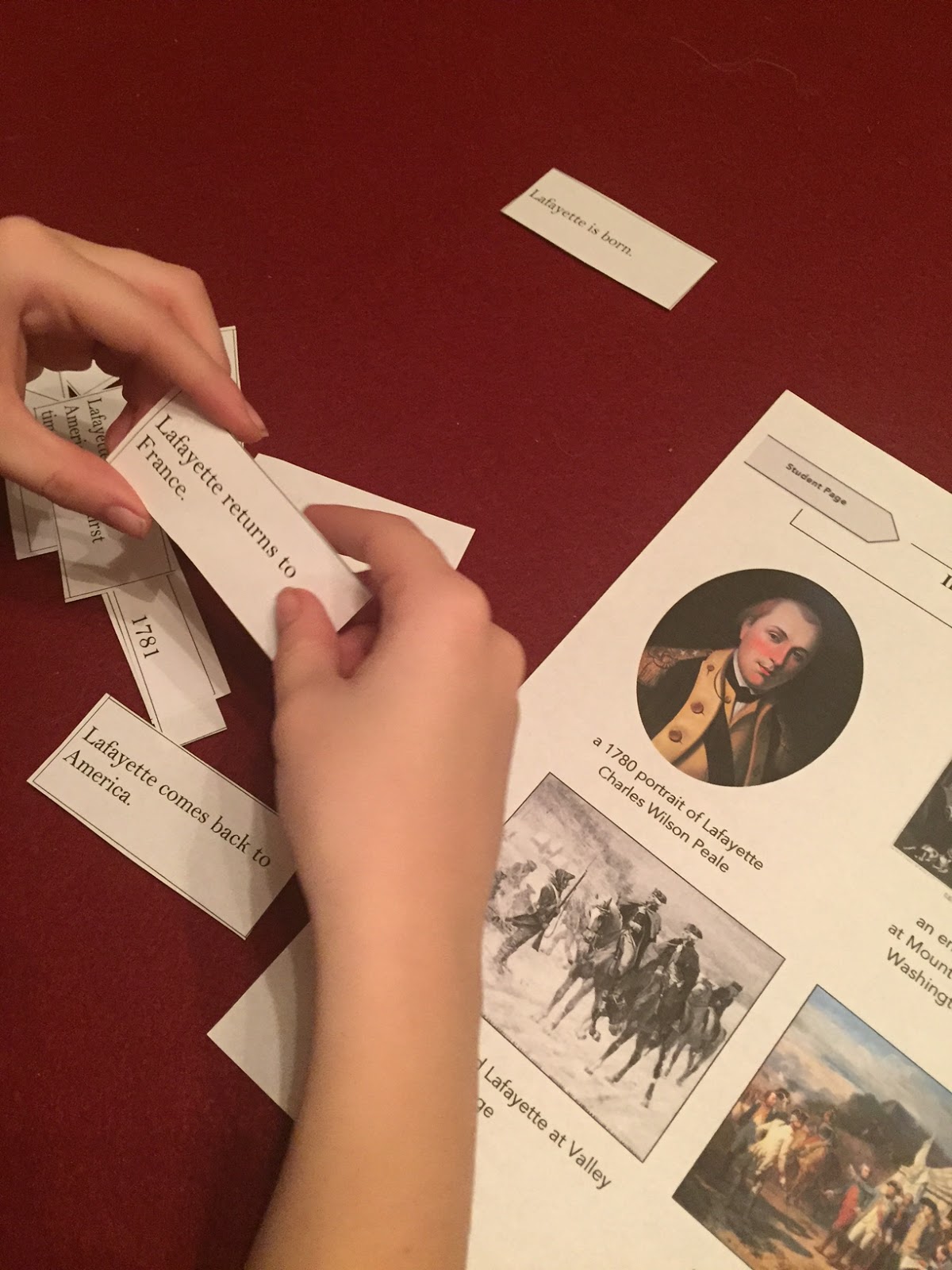
    At the most basic level, the event cards are great for helping students to sequence the events in a story. This week, students read a drama from our literature anthology. Putting events from the drama in order helped students to piece together the action.
    Here's where these cards are great for differentiation! It's fascinating to listen in on the conversations that students have. As they argue about which event comes before that one, they often can't resist going back to the text to prove their points.
    Groups finish this task at different times, of course, and so I always put an extension question on the board. In this case, it was: "Read through the event cards with your partner. How is this reading experience different from reading the story in the drama format?"
   

Understanding Parts of a Plot

     Event cards are also perfect for talking about how a plot unfolds. This is an important standard for sixth grade, and one that requires lots of productive conversation.
     Using event cards is so much friendlier for students than filling out a plot diagram! A mistake in ordering doesn't mean tedious erasing and rewriting--instead, it's just a simple swap of the cards. Watching my students piece together the events of a story helped me to see how their understanding of plot is developing and how they see the different pieces come together.

Character Changes

     If students are having trouble talking about how characters change over the course of a plot, event cards can be helpful tools! Events provide anchors to help students recall the sequence and understand what happens when. Sometimes students who struggle to respond verbally can hold onto an event card and explain how the character changed in response to what occurs. For students with retrieval and executive functioning issues, having manipulatives for reading can be just the scaffold they need for higher order thinking.

Have you tried story event cards? What have you noticed with your learners?


Sunday, January 20, 2019

Teaching Summarizing: If It's January, They Must Be Writing "About" Summaries

    Outside, the snow is falling, and our classroom feeder is attracting many beautiful birds. Students are learning to observe and ask questions about these birds, noticing the small differences in species and individuals.
    Inside, my co-teaching partner and I decided to do a formative assessment on expository summarizing. We used the bedbugs text from my Paraphrasing and Summarizing pack, which I like because it uses a main idea scoring tool instead of a rubric. Main idea scoring tools are a great way to quickly score many summaries without too much pain.
     We've been working on expository summarizing a little at a time over many weeks. Students have had scaffolded summaries (from this resource), modeled summaries, and main idea work. We felt confident that students would do well with this assessment.

What is an "about" summary?

     So imagine our surprise when we ended up with a pile full of "about" summaries! I really hadn't seen many of these so far this year, which made their sudden proliferation more surprising. If you're not sure of what an "about" summary looks like, take a look at the example on the right.
    "About" summaries hopscotch through a text, using chronological order transitions to show the reader's journey from topic to topic. You can see why it's called an "about" summary--the word appears over and over again. This kind of summary includes only topics and not main ideas.

What do these summaries mean?

     Over the last ten years, I've come to recognize "about" summaries as a key step on the way to summarizing skill. Notice that this kind of summary shows an awareness of the topics in a text, and the order in which they are presented. It's no surprise that these summaries often come from high-performing students. These readers are experimenting with ways to express ideas from a text in fewer words.

Next steps

     Students can't be allowed to stop at "about" summaries. This kind of thinking keeps them at the topic level, not looking for a text structure or deeper connections within a text. Here are some ideas to help students improve:
Choose the best summary tasks: After reading an expository text, have students choose from 3-4 sample summaries. Write one as an "about" summary. Then, discuss their choices. This is a great way to gently nudge students away from this style.
Text structure awareness: If students have to put information from a text into a graphic organizer that reflects the text structure of the text, then they are much more likely to write a strong summary. Help students to see that a successful summary should reflect the structure of the target text.
Continued work with summarizing: Yup, we need to keep working on it! Summarizing doesn't have to be a single week of instruction. Instead, spread it out over the course of the year so that students put summarizing and paraphrasing skills to work again and again.

News and notes

I've put up some new materials on TpT!

 Algebraic Expressions: This is a free (for now) PowerPoint that introduces algebraic expressions. I wanted some lovely pictures to enhance my math class.

I haven't made many math materials because I'm still relatively new to teaching sixth grade math (this is year 3!), but I'm looking forward to doing more.


A Look at Lightning: My husband, who teaches third grade, has been using the "Lightning Readers Theatre" script for years. This year, he asked if I could write a short text to go along with it. I added two levels of the text, plus some writing activities to make this an activity for both writing and science.


Comparing with Adjectives: This was another special request! Using the comparative and superlative forms of adjectives is so important for young writers. (I couldn't resist adding bird pictures.)
   

Wednesday, December 12, 2018

Christmas Tree Text Structures

If it's December, I must be pulling out my hair over text structure! It seems that every year around this time I get to wondering where I went wrong.

Earlier this week I remembered that I'd written a few little texts about Christmas trees several years back. A little formatting work and I made something that would be a nice text structure review. You can pick it up free over at TeachersPayTeachers: Christmas Tree Text Structures.


Sunday, November 25, 2018

Building Content Area Reading Experiences

I'm delighted to be presenting about content area reading experiences at Shippensburg tomorrow! Well, I admit that I'm not delighted about driving "over the mountain" on the first day of hunting season...but I know that it will be enjoyable to talk about content area reading.

Content Area Reading Presentation
You can find the link to the presentation here. Because I do periodically clean out my folders on Google Drive, you may want to save a copy to your own Drive if you think you'll refer back to this later.

Other content area reading posts
Anticipation Guides: Read more about one of my favorite content area reading strategies.

Nominalizations: No one ever talks about these word constructions, and in my mind, that's a shame. Nominalizations really wreak havoc with the reading comprehension of learners, and understanding their role in text helps students as readers and writers.

Animal Adaptations Synthesis: A reflection about an activity that I led with fourth graders.

Previewing Content with Phenology: How to find out what vocabulary words your learners already know.

Concept Maps: How to develop knowledge with students by making concept maps


Friday, November 23, 2018

Sixth Grade Classroom Management: Grouping Tips

   Sometimes the trouble with teaching for 20+ years is the curse of knowledge. I have tried so many different techniques and noticed so many different results that I get to feeling paralyzed by choices!  I've also learned that some strategies are great for winning the battle, but losing the war--they work really well in the short term, but leave me with greater challenges in the long term.

    But last month, I learned that sometimes techniques that I discarded a decade ago are worth a closer look.

Table Competitions

    Enter Star Table. In the research compilation library of my mind, assigning points to different tables as a competition has as many entries in the "Con" column as it does in the "Pro" column. In the short-term, it is highly effective, as groups will quickly learn how to manage their behaviors to earn points. In the long-term, well, are the students really shaping up to improve as learners, or are they just performing to win points? Because of these issues, I really had abandoned table incentive schemes ten years ago.

Star Table for Cleaning

    In October, I added a "Star Table" incentive, but it was only for cleaning up under the tables and putting up chairs at the end of the day. For these small chores, I feel that a tangible incentive is both helpful and necessary. Each day I'd assign points to table based on what their desks looked like at the end of the day, and at the end of the week the Star Table got to "spin for dollars" with my wheel of fortune and the classroom economy. It was pretty simple, actually, and got the classroom cleaned up with a minimum of fuss.

Group Norms

    But Star Tables were on my mind when I rearranged tables for the month of November. To build a better climate, I started the new groups by having students create group norms for their table. (I picked up this idea from a NASA STEM workshop, and as a teaching tip, is the one of the BEST little tricks I've ever learned.) The idea is that students have a dialogue with each other to dream up what they want for themselves. When issues arise, it's easy for a leader to refer students back to the group norms to address problems.

    Group norms are also great for finding out what you value as a teacher, because to a degree the norms that students create tend to echo what they hear a lot of in the classroom. (I know this from working with group norms in after school clubs, in which we have a mix of students from different classes.) If the group norms come out anemic or weak, that can be hard to face, because it means that somehow my messaging as a teacher is not coming through.

 November's norms were an interesting assortment! Notice in this one the students in the group took turns writing the norms, which I hadn't expressly suggested. They also used a nice numbered list format--again, not something that I had directed them to do!

What do these norms say about our classroom? I was really happy to see #1, but I can see the impact of Star Table right there in #3: "Stay clean." I especially love #4: "Have a sense of humor but not to much."

    In this next set, I really liked that they started with kindness and respect. Once again, though, I could see the influence of Star Table.

    As I'm writing this, I wonder if maybe I should have backed off from Star Table. However, in the first week of November, I made a different choice. I looked at these norms and realized that my casually implemented Star Table was a powerful force in the classroom. What if I could harness that force to achieve more good? What if I kept points throughout the day, for things beyond cleaning?

Star Table Throughout the Day

    For the rest of November, I created a chart on the dry erase board each day, and put up points for tables throughout various classes. As I recreated the chart every day I could never help but reflect on how this method of management has gone wrong for me in the past. As I wrote the table names each day I berated myself for employing such a meaningless technique.

    Once I defeated my anxiety each day, I added or subtracted points as issues arose. Because I prefer to be the Generous Benefactor instead of the Evil Deductress, I was often quite generous in the giving of points. Each table could earn 3 points for every session, and I would add an X or a star in the box as needed. I have to admit, sometimes adding that X felt satisfying, like when it was five minutes into independent reading time and AN ENTIRE TABLE had digressed to a conversation about Fortnite.

    Of course I never gave or took away points for academic work, like getting answers right or wrong. Instead, I looked for things like having out assigned tasks, being ready for the next part of class, showing kindness to one another, and walking through the hallway quietly. (Ugh, like 50% of my classroom management stress comes from trying to keep my class quiet in the hallways!)

    When there were issues that involved only one student, I addressed them with that one student instead of marking down the whole table. I know from experience that taking points off a table for the behavior of one student is the pathway to ruin!

    What was different with this year's implementation of Star Tables? First of all, this was the first time that I explicitly linked them to the group norms that students created. Another innovation was to give minutes to our entire class's Preferred Activity Time if all four tables earned all of the points for a class. This helped to provide an incentive to benefit everyone instead of focusing on the competitive aspect.
   
    I just finished Week 3, and it was still working harmoniously in the background. Working to the point at which I can just pick up my dry erase marker and frown at the board for a moment to encourage a class to get started! Instead of taking too much time to implement, this method has really allowed me to spend more time working with students and less time giving directions.

Lessons Learned

    The curse of knowledge can be a huge obstacle for those of us in our third and fourth decades of teaching. However, by pairing new tricks with old techniques, we can dust off some strategies and make them work again.

Warnings, Side Effects, and Contraindications

Thinking about Star Tables for your classroom? Consider these warnings:

  • De-emphasize the competitive aspect to build cooperation in your room.
  • Start with a robust set of group norms to guide how tables will behave.
  • If one table is significantly behind the others, make adjustments to the seating chart.
  • Do not punish the entire group for the misdeeds of one. Instead, let that one student earn points or minutes for the whole class.
  • You will be much happier if you are generous with points.
  • This works best for short periods of time, especially the period of November-January. Eventually every management scheme gets stale!
  • Encourage group members to help each other: "In one minute I'll be checking to see how tables are doing. Does everyone have their ____ and ____ ready to go?"
  • Try random point awards: "I'll be pulling popsicle sticks at random times through that work session. If I pull your name and you're on task, your table will get a point."
  • Pair up Star Tables with Preferred Activity Time: http://www.fredjones.com/pat


Sunday, October 21, 2018

Preparing for Text-Dependent Analysis

In Pennsylvania, text-dependent analysis is a big deal.  Teachers in schools all over the state have probably worked with their text-dependent analysis (TDA) data this fall.

First, let's think about all of the skills that students have to combine to write a successful text-dependent analysis essay:

Reading skills
-identifying text elements
-selecting strong text details
-analyzing components of the text
-switching between "micro-level" or local processing of text and "macro-level" or big picture processing

Writing skills
-creating a thesis statement
-using an introduction and conclusion
-linking ideas with transitions
-weaving in text evidence
-using appropriate conventions

The issue with TDA essays, however, is that your efforts in one area from the above list do not lead to instant improvement. As with summarizing, it's like playing a game of Whack-A-Mole--as soon as you deal with one issue, another one pops up.

But we must not despair...nor must we fall into the trap of sacrificing high-quality instruction for the sake of one assessment. Again, as with summarizing, there are good teaching moves that can improve a TDA as well as being worthwhile in the greater sense, beyond the requirements of school and state.

Return to reading stances

I think it's time to shift the reading discussion back toward the idea of "envisionments" as described by Judith Langer. As she writes, "Envisionment building is an act of becoming – where questions, insights, and understandings develop as the reading progresses, while understandings that were once held are subject to modification, reinterpretation, and even dismissal."

I just love this thinking about envisionments. The texts we share in the classroom aren't just what's printed on the next page in the reading series; in the minds of our students, they become so much more.

Anyone who taught in Maryland in the early 2000s remembers building questions around the stances of Global Understanding, Developing Interpretation, Personal Connection, and Critical Stance. And guess what? These ways of looking at a text lead students very well into the kinds of thinking needed for a TDA.

With the tumult surrounding the arrival of the Common Core, the stances and envisionments were dropped at the school level.  I have lots of cynical ideas about why and how this happened, but do you know what? The stances make sense and bring up the level of classroom discourse!

Have students practice connecting text elements

In Pennsylvania, the TDA always has students connecting two different elements of the text. For example, students might have to show how the character traits relate to the theme. In expository text, students may need to show how the organization of the text conveys the key ideas.

This is a very global way of thinking about a text that requires flexibility in student thinking. This year, I'm going to focus more on having students discuss these elements in low-stakes classroom conversations. We might even have these discussions before our district-mandated weekly assessment tests (Shh, don't tell!)

My reasoning is this: If students don't get to thoughtful analysis and comprehension at the discussion level, they'll never get there in writing. Grading 20 well-structured but empty analysis essays is a thankless task. Students won't put effort into the writing portion of the task unless they care about what they're writing about! Engaging in group discussions and meaningful conversations is a proven way to get kids to care.