Showing posts with label analysis. Show all posts

Saturday, November 4, 2017

Exploring Author's Point of View in Expository Text

   
Identifying Point of View
    I think that many teachers have struggled over the past few years to expand their teaching of "point of view" beyond the traditional first and third person narratives and into identifying an author's perspective. There is a gradient of expository texts, from objective texts in which the author's point of view is faint and difficult to hear, to biased texts dripping with the author's opinions. As I explained to my students, most texts exist in a middle territory in which the generalizations and main ideas of the text do most of the work of conveying the author's point of view.

   As we started to identify point of view, I found that my students needed the academic language necessary for this task. I designed this resource to give students help as they work on defending their claims about the author's point of view.

Link to Google Doc


Supporting Point of View
    At this point in the year, many of my sixth graders are writing lengthy text quotes as evidence for their claims. I adapted a chart from the EngageNY materials to help them find the best evidence for their assertions. In the photo you can see the chart we filled out together based on the "Columbian Exposition" text from my Paraphrasing and Summarizing materials over on TpT.


     This chart worked wonderfully with students, especially the "Word Choice" column. Even students who struggle with identifying the point of view can find the author's words that carry the point of view. A nice way to mix it up is also to show students text evidence and have them infer the author's point of view conveyed by that text evidence.

    Link to Author's Point of View chart


    Helping students to listen for author's point of view in expository text is important! What successes have you had?


Sunday, January 1, 2017

Summary and Analysis: An Approach to Middle Level Homework

 I like to look at "homework" as an ongoing set of reading activities that students can do either in or out of school. Some students like to do reading activities at home on their own or with adults. This is great! For students who don't have that home support, I like to build in flexibility within the school day for students to do the activities in the classroom. It's not hard to manage this approach and makes everything about my teaching life so much easier.

 When I taught fourth grade, I spent years devising meaningful homework assignments with vocabulary, fluency practice, and writing. (You can find the January set here.) I loved these packets because they were fun and interesting for kids and adults.
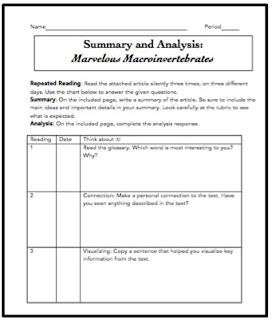
The move to sixth grade forced me to think of a new homework routine. What kinds of activities did sixth graders need for ongoing practice and response? I devised the Summary and Analysis packets to answer this question. Each packet contains an article, a summarizing prompt with a rubric, an analysis response question, also with a rubric, and a comprehension quiz.

I started with the texts. The teacher side of me said, "I need high-quality, well-researched texts related to our science topics, please!" The writer side of me harrumphed, procrastinated, and finally came through.

I assign texts on an alternating week schedule, with assignments due every other Thursday. This gives students plenty of time to work on the assignment both in and out of class. To add to the enjoyment and understanding of the texts, I often show a video or two about the topic--here is my playlist: Article Response Playlist.

Through the months I've tweaked the routine a bit. At first I thought that students would read the texts and generate responses and questions on their own. They found this very challenging, however, which led me to adding some questions to the assignment cover sheets. I've found it interesting how much students resist repeated readings, even with the support that I provide in the classroom. The repeated readings are so important for fluency and for comprehension! I still have trouble convincing students of this, however.

A key component of each packet is the summarizing task. I feel on pretty solid ground as I teach students how to summarize--after all, I've written a book about it--but every year students find new and interesting ways to baffle me. This year, my own son took to writing "about" summaries, which led to some funny home conversations while I was scoring student work! (For more on these, check out this blog post from last year.)

One scaffolding tool that I didn't get to write about in my book is the simple topic/details frame. I've added some of these to the Summary and Analysis packets to help students see how the texts are developed. Very simply, these graphic organizers show the headings in the text and provide space for students to write key ideas. They work well for students and can be provided with varying levels of support.

After students summarize, they respond to a prompt. Most of these are analysis prompts. Some lead to an essay, while others can be answered completely in just a paragraph or two. These analysis prompts are very challenging for sixth graders, many of whom still confuse content with structure. Most of the analysis questions ask students to think about how a piece is written, and sometimes students try to answer by writing about content or rewording their summaries. This shows me that analysis is a skill that needs continued practice and feedback!

A summary and analysis routine is easy to implement with any texts! If you are interested in checking out what I have written, you can find a bundle here.


Thursday, March 31, 2016

Comparing Texts: New Passages!


This year I've been working on new Article Response sets to use as ongoing practice and homework with sixth graders. They have worked wonderfully all year and I'm thrilled to share them.

All of the response sets are set up in a similar pattern: cover sheet, summarizing prompt, response prompt, and text. Each also has a comprehension quiz.

At the start of the year, I planned to send these home as homework. As the year has progressed I've changed my thinking! We start class with ten minutes of independent reading followed by ten minutes of working on the texts and responses. Some days I do a mini-lesson about summarizing or writing a response, while on other days students partner read. A two-week span for each packet gives us enough time to have thoughtful conversations without feeling pressured to produce.

"Damon and Pythias" and "The Two Travelers"

The latest two sets have been focused on comparing narratives. I think that comparing texts is such a meaningful, authentic purpose for close reading. When kids read two texts and spontaneously offer comparisons, I know that good things are happening!


This text set pairs a retelling of "Damon and Pythias" with a version of the fable by Aesop "The Two Travelers". Both of these stories examine the meaning of loyalty and friendship, but in very different ways! For students dealing with sixth grade drama, the concept of loyalty is fascinating to discuss.

We acted out both stories in class. Acting out stories helps readers to grasp the action and better understand the events. When it came time to summarize "Damon and Pythias", students really were able to consider which events were important to the outcome of the story and which were not! The fable "The Two Travelers" teaches a lesson about friendship through a non-example, and raises an interesting question for students--did the bear in the story really talk?

"Damon and Pythias" is also the basis for the 2003 film Sinbad: Legend of the Seven Seas. If you are working on comparing texts, this is a great opportunity to compare a story to a film.

"The Elves and the Shoemaker" and "The Magical Cyber Elf"


This text set has been perfect for reviewing key content for standardized testing! I started with thinking about the classic fairy tale "The Elves and the Shoemaker". How could this story be translated for modern times? Because I am currently up to my ears in yearbook work the modern story "The Magical Cyber Elf" came to mind.

There have been so many great concepts to review with this text set. We used "The Elves and the Shoemaker" to review the parts of a plot diagram and talk about theme. Then, we used "The Magical Cyber Elf" to discuss point of view and how a shifting point of view can influence the unfolding of events in a story. We had some great conversations about how the themes of the two stories are very similar, even though the settings and conflicts differ.

If you try these text sets, let me know what your students think!