Showing posts with label characters. Show all posts

Saturday, September 12, 2015

Flipping Lessons with Frolyc

In the early weeks of the school year, I admit to loving the computer lab. Not only is it equipped with great Macbooks for student use, but it is also air-conditioned! The cool air is a welcome respite from the heat and humidity of August and September.

Last week, I experimented with flipping a lesson. Instead of me standing up and teaching all students at once, I wanted to give them the flexibility to move through a lesson at their own pace. While they worked in the cool comfort of the computer lab, I could work one-on-one with students to complete our beginning of the year assessments.

Frolyc is the perfect tool for creating a flipped lesson. I can put all of the text, videos, and activities that I want students to use in one easy place. Even though my students don't all have computers at home, they still need to learn how to work through online content and learn from these kinds of lessons.

I started out by creating my classrooms. No need for student e-mail addresses or lengthy forms--I just had to type in student first names. Each student receives an individual code that they use to access their activities.

Next, I created my lesson through the authoring tool on Frolyc. We are working on story elements with a focus on protagonist, antagonist, and parts of a plot. I used a "Multimedia Text" activity to combine an image, a video from YouTube, and text. This is what it looked like on student computers:


I couldn't find a great video for parts of the plot diagram, so I adapted a few slides from a PowerPoint that I have already made (Story Elements) and did a screencast using QuickTime. Then I posted it to YouTube so that I could embed it in the next page of the Frolyc activity. (link to video)

The kids found it very amusing to listen to me! Even better, though, they had full control of stopping and starting the video. "Can we watch it again? I don't really remember all of the words," one student said. "Of course!" I replied. This is one advantage of a video!


After the video, students read a story, and then answered sequencing and multiple choice questions. These questions required students to apply the vocabulary that they had learned in previous pages. Some kids realized that they had to go back and reread, which was a great lesson for them.


 The lesson ended with a drawing activity. Kids enjoyed interacting with the drawing tool, and I loved watching the collaboration bloom--"How do you add a text box?"--and "How do I draw instead of erasing?"


I'm planning to continue creating flipped lessons for students in the weeks to come. These lessons are great for introducing vocabulary and helping students to experience content.

You can find the full activity here if you would like to try it out with your students.

If you would like to try to create your own flipped lesson, here is a story that you can use--for free! This retelling of "Stone Soup", told from multiple points of view, can be used for teaching about theme and point of view.

Saturday, April 11, 2015

Examining Character Motives

   Why do characters do what they do?
    This is a big question for intermediate readers. Sometimes, they don't even know the motives behind their own actions! (Dealing with an indoor recess squabble--"Why did you do that?" Student: "I don't know!) 
    Because our reading homework text this week focused on "Theseus and the Minotaur", I decided this was the perfect time to examine this question. After all, there are big questions of motive in "Theseus and the Minotaur"! 

Implied or Stated?

    A character's motive can be implied or stated--and it's important for readers to know the difference. I modeled reading to find the difference between implied motives and stated motives with our read-aloud, Fair Weather. I just love this book! It seems that no matter what I want to teach, I can find it in the books of Richard Peck.

This year I've been keeping a daily log of our reading with the Promethean board, which makes a handy flipchart and a great way for us to keep track of our thinking as we read. After we read the day's chapter, we talked about the actions of the characters. What were their motives--their reasons for doing what they did?

A quick chart showing action and motive can illustrate this. Intermediate readers sometimes try to write the same statement for both action and motive. This reveals a bit of where they are developmentally---they confuse action with reason behind the action. In the chart to the right, it took a bit of discussion before students stopped restating Granddad's action and started guessing at his motives.

We put question marks behind these motives to show that we were guessing at them. These motives are implied in the text, and as readers we had to make inferences to figure them out.  This contrasts with Mama's motives for sending Lottie and Rosie to Chicago--this motive is stated right there in the text, as she wants to "nip it in the bud" Lottie's romance with a neighboring farmhand.

In a novel, readers have to play a long inference game, and we might have to wait a few chapters before we see how our inferences pan out. That's why keeping track of our thinking all along is so important!

Independent Practice

Students then worked with the familiar story "Theseus and the Minotaur" to make some guesses about character motives. (The story and the page are available in February Reading Homework.) I like having a partially filled out chart to scaffold students for success. This activity led to rich discussions between partners. Why did Ariadne betray her father? Why did Theseus go to Athens as a volunteer? 

Most importantly, students had to go back to the text to find evidence to support their thinking about motives. A few groups had put their stories away and tried to complete the task without looking back to the text. I didn't intervene at first, hoping that they would get to a point at which they would realize independently that they had to use the text. Fortunately, they did! And it's so much better for students to come to this conclusion on their own than for it to just be something that I tell them.

I knew the lesson was successful when students started thinking beyond the text. "Why did King Minos build the labyrinth for the Minotaur, anyway?" one student asked. Their version of the myth did not go into detail about this. "And why did he leave Ariadne behind?" another asked. Hopefully once Percy Jackson's Greek Heroes comes out they will be able to find their own answers to these questions. 

The lesson had another layer of success--suddenly students wanted mythology books to read. Any lesson that leads to independent reading books flying off the shelves is brilliant in my book!

More on the reader-based inferences used to figure out character motives can be found in Chapter 6 of The Forest and the Trees.


Sunday, July 27, 2014

Story Elements: Looking at Characters


This summer, as I've listened to the last of the Harry Potter series and started The Lost Hero with my family, I've enjoyed our conversations about the characters, the conflicts, and the setting. Each year, I try to replicate these kinds of conversations in my classroom.

Teaching story elements is a great way to begin. When kids can identify story elements, they can pick out the parts of the story that fit together and start to talk about them coherently. Who are the characters? What is the setting? What is the main problem in the story?

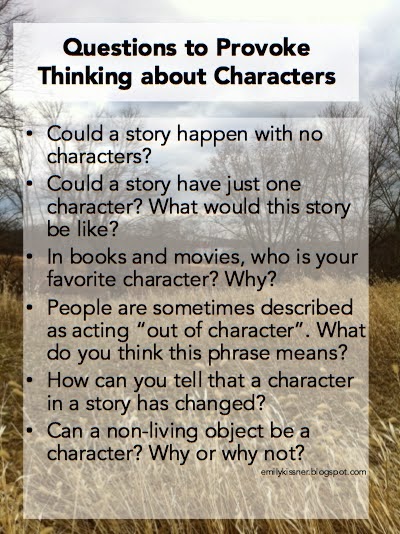
Of course, teaching story elements needs to go much deeper than simple identification. Filling out a story map quickly becomes a dull classroom routine without an inspiring conversation to go along with it. In fourth grade, I like to ask students provoking questions about characters. These questions stimulate our discussion and help students to see story elements as being more than just disassembling a story.


When we have these conversations, I can judge from student responses where to go next. Sometimes I do hear the sound of crickets. This tells me that I've tried to move too far too fast, and that kids need some time before we can have this particular conversation. Sometimes their responses remind me of a fabulous book that I just have to share--a character who is similar to one of their favorites, or a character who acts the opposite of what is expected.

Most importantly, these kinds of questions bring a spark of "what if?" to our classroom...a spark that lights up the room with the love of reading.

Notes
-My Story Elements PowerPoint is a classic that I do come back to, year after year.
-I wrote some fun Story Elements Readers Theatre scripts for my students to share. 
-You can try out the activity Camping Together for free over on Frolyc. Try it out if you have student iPads! (The story is also available in my Visualizing packet.)
-Analyzing Story Elements is finally ready. Four new stories with before reading pages, questions, and activities to help students understand and analyze story elements.