Showing posts with label spelling. Show all posts

Monday, July 27, 2015

Differentiated Spelling Program: Looking Back

Several years ago, I became disenchanted with the spelling program that I was using. I've been teaching for a long time, and I've used many different spelling programs. And I've hated them all.

A normal person would have said, "Well, this program isn't perfect, but it's what I have. I guess I'll deal with it."

I'm not a normal person. So I embarked on a three-year journey to reinvent spelling in my classroom. Along the way, I learned that the most commonly taught roots are not the ones that appear most frequently; that language is a devious, tricky pathway; and that I will always end up hating a spelling program. And that's okay.

Step One: Identify Words to Teach

One of my biggest issues with the spelling program that I had used in the past is the words. They seemed randomly chosen to fit a pattern. What if I could work in the opposite way--select high-utility words, filter them according to their attributes, and then plug them into spelling lists?

I started typing in words! My first source, of course, was the Academic Word List by Averil Coxhead. I added words 200-500 from the Fry List, the Nifty Thrifty Fifty, words from the Common Core, and words from a Reading Teacher article about character traits.

But just typing the words was too easy. I wanted data! I added columns to the spreadsheet with information about the words--number of syllables, phonograms, root or base, prefix or suffix, mythology link, and use in idioms. It was the work of many winter evenings.

When I was finished, I had an Excel spreadsheet that I thought was amazing. Not many others have thought so. But I didn't care much about how others reacted--my list was a stepping stone, a means to an end. Here it is if you are interested. (To use the filtering capability, you will need to download it.)

The Master Word List

Step Two: Plan Out Units

The next step was to plan out units. Because this was going to be a fourth grade program, I had to involve the others that I work with in this process. We combined our new PA Core Standards with concepts from the Literacy Continuum to do this.

Our units leaned more toward vocabulary and patterns of meaning instead of patterns of spelling. In looking at the core standards, there are so many things related to roots, prefixes, and suffixes that students need. Would I like to do more of the spelling-based patterns? Absolutely! But time is precious, and finite, and I needed to choose. In the long run, I do think that time spent working with prefixes is going to have a stronger impact than time spent working with ei/ie patterns.

Because we work in the real world, we limited our units to 12-15. We were planning to teach spelling on alternating days for 30 minutes at a time. A program that can be completed in one year is better than one that claims to do all things for all students, but can never be finished.

After Year 2 we rearranged some lists, realizing that putting prefixes and suffixes before word roots is better for students who don't have much experience with semantic analysis.
Step Three: Assign Words to Lists

This was my Frankenstein moment--"It's alive!" This was the time to use the filtering capabilities of the Master List to select spelling words. And...it worked! Even better, every list includes high-quality words that students WILL encounter again and again. With each list kids came to me with words that they found in their independent reading books, in their science books, and other academic tasks.

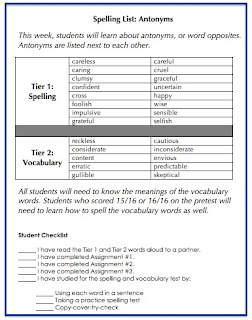
Our lists are tiered lists. On Day 1, students take a pretest with Tier 1 words. Students who reach a certain score work from the Tier 2 list for spelling throughout the week.

Step Four: Create Meaningful Activities

I undertook this step on my own, creating list-specific homework tasks for each list. These tasks are also heavily vocabulary based, with some handwriting included. Of course, I never grade homework, and if you use my materials, please make sure that you don't grade homework either!

 There is also a list-specific spelling test for each list, including both spelling and vocabulary questions.

Everything is included in this folder on Google Drive. You may feel free to use these materials, but obviously do not sell them or distribute them in any other way. Make sure that you are viewing the folder in ABC order so that the files show in the correct order.

Spelling Folder

Step Five: Implement and Reflect

Like every spelling program, this has parts that I love, and parts that I hate. I really enjoy exploring the meanings of words with students each week. Students especially enjoy the drawing tasks, and their creativity shines as they create new and interesting ways to depict the words.

The pretest always invites interesting conversations, as some students try to cheat and correctly spell the words. Why do this on a test that isn't graded? What are they trying to prove? Being open and honest with these discussions gives everyone insight into our classroom routines.

I also like that this program is fairly easy for parents to understand and assist with. Definitions for all words are included in my Quizlet links (you can find them all by clicking on my username here).

Step Six: When all is perfect, change grade levels
Because what's more fun than starting from scratch?

**You may feel free to use and share the Master Word List and the spelling materials here. Please know that these are shared folders and others have added materials! If you find any mistakes, let me know so that I can fix them.

If you especially like them, please consider a visit to my store for other classroom materials.

Sunday, September 7, 2014

Tried and True: Literacy Activities I Love

What a week! After a relatively cool summer, Pennsylvania enjoyed (?) some hot and humid temperatures this week. I used old-fashioned heat management strategies like closing my blinds at 10 and starting fans early in the morning to pull in cool air. These strategies kept the temperature in my room to a manageable 86 degrees. The kids were amazing about it and never complained.

One of the nicest parts of my week was going back to some tried and true activities that should be part of every literacy teacher's repertoire of techniques. Even in the heat, these activities were engaging and fun for everyone involved.

Making Big Words

I first saw the Making Big Words activity back when I was doing my first round of graduate classes, and I started using it in middle school immediately. It is one of those rare activities that fits every ability level.

Kids get a strip of letter tiles arranged with vowels first in alphabetical order. This week's letters were:

e e i o o c h m n n p r s

The teacher gives clues about words that can be made with those letters, and kids arrange the letters to make the words. At the end, the students try to build the big word that can be formed with all of the letters. Can you figure out this week's big word?*

What I love is that it gives me instant information about how kids approach words and word-making. Every student in fourth grade used the same set of letter tiles this week, but as they were divided into our intervention groups we could see how each group dealt with the challenges. For example, students in the ESL group struggled with changing shop to shoe because of the odd spelling pattern in shoe. In my grade level group, I saw many different spellings of poison--poisen, posion--which shows me that unaccented final syllables are a topic to explore.

It is a fabulous activity to get to know a new group of students and get real-time information on how they are processing and working with words.

You can read my ancient review of Making More Big Words at Amazon--a relic from before I started blogging!

Retelling with Figures

When students have trouble comprehending a text, retelling with figures is my go-to plan. The idea grew from my days as a preschool teacher, when I used felt figures to tell stories. (Remember feltboards? Does anyone use them anymore?) With older students, having figures to retell the events in a story helps them to attach meaning to the events. Students have a visual cue for retelling and have fun manipulating the figures.
This picture from last year shows students using retelling figures
to retell key ideas from an expository text. 

This week, students in one of my reading classes read "Clever Coyote" and then retold the story using four pictures: a coyote, a mouse, a rock, and a rattlesnake. Watching them retell in pairs helped me to see how they were comprehending the events of the story. This story worked especially well because the plot hinges on the locations of the characters.

You can read more about retelling with figures at this blog post. I have some sets of retelling figures and stories available in Analyzing Story Elements (Gwen and the Witch) and Summarizing Stories (The Magic Key).

Settling into our literacy routines has become so meaningful and enriching. Even though I have done these activities many time before, I always love seeing how new students engage with them. What are your tried and true activities that you return to, year after year?

*comprehension

Sunday, December 2, 2012

Update on Spelling

Over the summer, I wrote about making a master word list and creating our own grade-level spelling list. We're now a few months into the project and I thought I'd take a moment to reflect on our progress.

The Master List
I started the master list last year. My goal was to create a list that could be filtered and arranged to find the absolute best words for vocabulary study. I took words from the Academic Word List, the Fry Words 200-500, the Common Core, and several other sources. Then, I gathered data on the words--how many syllables? What is the root? Is it a compound word? What syllable type is the first syllable? What phonograms does the word contain?

The result is an Excel spreadsheet of over 1,800 words. It's been useful for making spelling and vocabulary lists. For example, when I wanted to teach the root fin, I could quickly find important words that had the root. To teach words with long vowels, I looked under the open syllables category. (I am still sending out copies of the list if you'd like one.)

Our Fourth Grade Topics
We created a list of fourth grade spelling topics based on the Common Core and the Fountas and Pinnell Literacy Continuum. Here is an overview of the lists that we selected:

-Long/short vowel sound review
-Greek and Latin roots
-Silent letter combinations
-Contractions
-Homographs and homophones
-Multiple meaning words
-Synonyms and Antonyms
-Prefixes
-Noun forming suffixes
-Adjective forming suffixes
-Other suffixes
-Compound words

You'll notice that it's heavier on word meanings than spelling patterns. This is a tough issue. But with limited time for instruction, we decided to lean more heavily toward the vocabulary and look at spelling patterns as they fit into the words we selected.

To adjust for varying ability levels, we have two "tiers" within each list. Our words were selected from the Master Word List. The first tier includes words with more basic spellings. The second tier includes words that are more complex. Students are assigned a list based on their pretest score. Right now, we're at the silent letter combinations.

How it's going
We're moving along! It is a challenge for students. I'm glad to come back to self-corrected pretests, as I think that this is a really meaningful activity for students. I think that I have some of the old-fashioned country schoolma'am within me. I like the structure of a list, a set of homework activities, some carefully planned lessons, and a test. I think that there is some value to memorizing spelling words--as long as the words are carefully selected to be relevant and meaningful.

Friday, June 8, 2012

Creating a Spelling Program


We're making a new spelling program! With the Common Core coming into effect, our team realized that we have to do more with spelling and vocabulary.  Even our strong readers and spellers need to extend their academic vocabulary knowledge. (I could go into detail about why we feel that we need to abandon our current program, but the less said, the better!)

So where to begin? We looked at some of the commercial programs, but none of them had what we wanted. I developed the half-crazy idea to make our own. It's not so crazy, I guess--I've made a spelling program before. This time, though, I wanted to make something that had a firm foundation.

Scope and sequence
Our first step was to figure out what we wanted to teach over the course of the year. We used multiple sources to build this. Our first stop was the Fountas and Pinnell Continuum of Literacy Learning. We looked at what was listed for our grade level and matched it to what we were currently teaching. Then,  we put these skills up against the Common Core. We thought about how many lists each topic requires, and how many lists we can comfortably teach in one school year. We put it all together on Excel and created a rough outline. The Excel filter feature allowed us to rearrange topics until we had an order that we all could agree to.

Master list of words
This has been my winter/spring/early summer project. My husband estimates that it has taken 100 hours. (I just know it has been at least 5 seasons of Dr. Who.)

I wanted to create a searchable, useful list of words. First, I entered words into an Excel spreadsheet from several different sources:

-The Academic Word List by Averil Coxhead

-Words 200-500 from the Fry List (K-2 uses the first 200 words)

-The Nifty Thrifty Fifty by Patricia Cunningham

-Words from the Common Core, especially words like analyze and explain that would be likely to turn up in question stems

-Character Traits words (from a list included in this article by Patrick Manyak)

Once they were all entered, I created multiple columns to use to filter them. This was the time consuming part! As you can see from the screenshot, there are several ways to generate lists. You can sort the words by syllable or by root. If you are looking for compound words, you can filter a list of compound words only. You can also filter by phonogram, multiple meaning words, or digraphs.

I have spent many, many hours looking up word roots and considering phonograms! To save space on the spreadsheet, I combined some categories, such as myth link/diphthong.

Did the list work? I felt like Dr. Frankenstein on Thursday when we sat down to try to generate some lists. I was thrilled when we were able to make it work! We now have the words for about 15 of our spelling lists chosen. Of course, fourth grade will not do all 1800 words on the master list. But other grade levels will be able to use the same master list to help them select the words that fit the concepts they have chosen to teach.

We are using a tiered list system, just like the Differentiated Spelling Program that I already made. The tiered lists are a great way to meet the needs of different kids while still having coherent instruction. For example, when we do Greek and Latin roots, everyone will study Greek and Latin roots. The struggling spellers will focus on words with simple spelling patterns, like graph and erupt, while the stronger spellers will have more challenging words. Each week, students will take a pretest to determine which tier they will be studying.

But the best part about it is that the words will all be important, useful words that are likely to come up in their reading. When we teach silent letter combinations, for examples, we'll include insight from the Academic Word List, as well as thought and though from the Fry List.

I'm still working some bugs out of the Master Word List and double-checking for internal consistency (quite a task with 1,806 words). If you'd like a copy, write me an email at elkissn@yahoo.com. Let me know what you plan to do with it (non-commercial and non-profit uses only, please!). And maybe you could leave a comment or follow the blog?

Wednesday, November 30, 2011

Meaningful Spelling Homework

 Now that I have two children in school, I realize the importance of homework. For many parents, it's a welcome glimpse into the life of the classroom. When I work on homework with my sons, I can see what they're doing in school.

So I am now careful with the homework that I send home. What do I value in spelling instruction? What do I want to be communicated across home and school? My first step, of course, is to make everything predictable and easy to understand. (As a parent, I love predictability!)  I put the spelling list on the front page, along with a list of the assignments. Usually I also include a little note about the list, explaining why it is interesting or important.  The rest of the homework assignments are stapled in opposite order, so that pages are easy to tear off and turn in.

But what do I put on those pages? If you're a classroom teacher, you can probably appreciate the challenge the of coming up with homework for each week. I know that generic assignments are easy. However, since so many of my spelling words are vocabulary words as well, I want to make assignments that are content-rich. Helping kids to learn about words and how they work is something that I value highly. Here are some assignments that I use and recombine for each list.

Semantic maps
These take some teaching, but they really work well. I have kids do about 2 semantic maps for each list. They are best used judiciously--I would never want to make kids do a semantic map for each word on a list. I look for words that will lead to interesting conversations, and words that have lots of possibilities for adding prefixes and suffixes. For example, "murky" is not the most common academic word, but it is an interesting adjective, and has many different forms, like murkier, murkiest, murkiness, and so forth. A month later, a few students spontaneously used this word in their descriptive paragraphs.

To make a semantic map, simply make a nine cell table in word. Use "merge cells" to combine the middle three cells, and gray out the middle cells on the left and the right.

After kids have created their own semantic maps, we make class maps together. It's always interesting to hear how different dictionaries and thesauruses list different words. And it's good for the kids to have a use for the dictionaries they were given in third grade.

(More information on semantic maps is included in my Differentiated Spelling file.)

Sentences
It's pretty disheartening to see hastily written spelling sentences. At the same time, I don't really want to spend my entire life grading spelling sentences. I've found that the quality of sentences increases when I give kids two words to use. Sometimes, I offer words that fit together well, like "phantom" and "night"; sometimes, I offer words that will nudge kids toward writing more complex sentences, like "fought" and "but". (These were from a list of gh and ph words) When we share our work, it's always fun to see how everyone used the same two words to create very different sentences.

Comics
These offer the artistic students a chance to shine! I make four panels on the page, and students have to write a comic using a given number of words. 

Multiple Meaning Words
No matter what the list, I can always manage to find a few multiple meaning words. These are so important for reading success that I want to give kids a chance to work with them. One easy task is to put two definitions in a box, and then have kids decide which definition is shown in each sentence. Another task is to illustrate sentences that show each meaning of the word. Notice the common theme--I like to give kids the definitions, and then have them work with the words in a meaning-based way.


Affix study
Many of our lists focus on what happens to words when we add prefixes and suffixes. In homework assignments, I try to highlight these aspects. Charts are a great way to do this. You can give kids the base words and suffixes; they can write the derived words and try to use a few in sentences. You can give kids the derived words; they can write the base words. In the chart to the right, students have to decide how to change the spelling of the base word as they add the given suffixes.

Handwriting
Practicing cursive has its place. After all, kids need to be able to read cursive. I practice my cursive skills each week when I make a handwriting practice sheet. But handwriting practice doesn't have to be boring! On the page that I gave students today, they had to circle the illegible writing and find the invisible hamster. (Can you tell that we were examining words with the -ible suffix?) On another assignment, they had to copy and illustrate the sentence "Please refrain from raisin mistakes." Lots of funny discussions there--but they helped kids to build their understanding of the use of the word refrain.

 By mixing these different assignments, I can add some variety to each week's spelling list--without feeling like I'm starting from scratch each week. I haven't published any of the lists in this style, but I can send some your way if you'd like. (I'm doing materials for Syllables and Affixes and Derivational Relations this year.) How has your thinking about spelling homework changed?

Tuesday, July 5, 2011

Differentiated Spelling: Revised!

Back in 2008, I posted a differentiated spelling program that I had created for my sixth grade class. I've revised some parts and added the missing "Assignment #2" for each list. Here's the link to the revised program:

Differentiated Spelling Program

It turned out to be over 75 pages long--enough to get anyone started with spelling for the 2011-2012 school year. Enjoy!

Friday, July 30, 2010

Differentiated Spelling in the Classroom

What is the best way to manage spelling in the classroom? When I was a student, everyone had the same list every week. But this is not the best approach. A single list will be too hard for some students, but too easy for others.

Over the years, I've experimented with several different ways to differentiate spelling. Each one has its own benefits and drawbacks.

One classroom, multiple groups
I tried this when I taught in middle school. After administering the Words Their Way spelling inventory, I grouped students into three groups based on their level. I had a Within Word Pattern group, a Syllables and Affixes group, and a Derivational Relations group.

The benefits of this arrangement are clear--students had words that matched their developmental levels. However, it turned out to be very difficult to implement. Each week I had three lists to juggle, and I had to create time in the classroom schedule to meet with three different groups for pretests, teaching, and post-tests. I felt like I was going crazy!

I didn't have the Words Their Way word list books when I was doing this. These books would help tremendously. In fact, my husband uses them to support multiple spelling groups in his third grade classroom. He has been doing this for several years and finds it worth the time it takes to manage. His secret is to use one routine homework assignment for all groups, with targeted word sorts for students according to their levels.

One classroom, differentiated list
When my language arts block took a time cut, I knew that I couldn't do multiple groups any more. But I still wanted to differentiate. I solved the problem by creating tiered lists. Each week, we studied a spelling pattern. Students were placed in a basic list or a more challenging list based on how they did on a spelling pretest.

For example, a list including different spellings of /au/ (aw, au, and ong) might include a word like launch on the basic list, and distraught on the more difficult list. All students would study the root for the week, aud-, as it fits the pattern and is a source for learning vocabulary words.

This turned out to be very workable. I could spend time doing whole group lessons that focused on the spelling pattern or principle. Students would spend their time studying the simpler words that had the pattern, or the more difficult ones. All students would work to learn the meanings of the words. The spelling test consisted of whichever word list students were responsible for learning that week, plus some multiple choice vocabulary questions.

The tricky part with this arrangement is creating the lists. I posted the full set of lists that I created for free over at TeachersPayTeachers. Once the whole thing is put together, it becomes a fairly simple routine.

Multiple teachers, multiple groups
If you have several teachers who are willing to work together, you can try regrouping students according to their spelling level. The benefits of this are clear. Not only will students be working with words at their developmental level, but teachers will only have to plan for one group. Hooray!

Of course, there are some drawbacks to this. It can be difficult to schedule, as you need a time period in which all teachers can switch. We found that, for three classes of fourth graders, we really needed to have 4 or 5 teachers. This is because students at the lower levels needed smaller groups. Luckily, we were able to pull in the special education teacher for our team, which worked quite well for all of us. Students working at the Syllables and Affixes level or Derivational Relations level had larger groups, while those who were struggling had smaller groups.

Another problem is keeping track of work between the groups. This year, we're hoping to make working on spelling a non-negotiable task for all students at the start of the day. We want to make sure that there is time in the school day for students to practice their words. When we leave it for homework alone, there will always be some students who don't complete the assignments and don't progress.

Which is best?
Each one of these methods can work, and can help students to become more successful with spelling. The key is creating a system that works for you, and for your students. When you keep the focus on learning patterns, listening for sounds in words, and linking spelling to vocabulary, you can make spelling work for all of your students.

Friday, July 9, 2010

Support in Spelling

What do you do when a kid asks you how to spell a word?

The standard procedure, as practiced by many, is to refer the student to the dictionary. But this is a lengthy process--and, for many students, a frustrating one. Looking in the dictionary can take a student up to six minutes. (I know, because I've timed it!) When I'm teaching writing in a 40 minute time block, I can understand why a student would be reluctant to use up precious writing time just to find the spelling of one word.

As adults, most people use a very practical spelling strategy: Find someone who is a good speller, and ask them. Depending on the expertise of others is not a bad strategy.

So, when students ask me how to spell a word, I used to just jot it down on a sticky note. But this spring I wanted to try something new. What could I do that would give some of the work back to the student? What could I try that would be more supportive than just referring the student to the dictionary?

I decided to use a version of Wheel of Fortune. When a student asked me for a word, I put lines for the number of letters in the word. This gave me instant information on which word parts and syllables the student was able to spell, and which were problematic.

When a student asked to spell disturbing, I put the lines on a sticky note:

_ _ _ _ _ _ _ _ _ _

She tried it out on the lines, checked with me, and quickly went back to writing. The lines offer an added bit of support, especially for words with doubled letters and odd vowel patterns. If a student thinks that she has spelled the word correctly, but has a letter left over, then she knows (without my intervention!) that he has to go back and rethink.

Sometimes, I needed to give a little more support. Depending on what I knew the student has trouble with, I provided some chunks. For example, one struggling speller asked how to spell tractor.

I gave him this:
_ _ _ _ _ o r

I wanted to see if he could come up with the complex consonants in the first syllable. The -or ending, however, is a little odd, so I wanted to give that part to him.

Another student asked how to spell architecture. This is a pretty complex word! I wrote:
_ _ c h i _ _ _ _ _ _ _

I was pretty sure that this student knew the ending -ture, but the Greek ch is often new to fourth graders. I couldn't resist telling him a bit about the Greek ch and why words from Greek often show this hard ch sound. (Think about it: school, scholar, architecture, archaeology...!)

What is so neat about this strategy is that it allowed me to get instant information about what students could and could not do. I could see exactly what part of the word caused the problem, and do a little quick teaching about the pattern or the exception. For students, the lines for letters made it a little more like a puzzle, and they were more willing to retry a word several times.

I knew this strategy had taken root when I saw students using it with one another. "How do you spell later?" one student whispered to another. When I looked over, I saw that her neighbor had drawn out lines for her. It's always neat to see kids teaching one another.

Sunday, July 4, 2010

A Spelling Experiment

Toward the end of school, I started to worry about my students' spelling. I had a vague notion that our program wasn't working as well as I wanted. But how could I know?

I tried a little experiment that was time-consuming, but illuminating. After a field trip, I gave students a prompt to write a paragraph. They had 5 minutes to plan, after which I promised that I would tell them how to spell words that they wanted. I wrote all of the words on the dry erase board. Then, they had the rest of the class (about 30 minutes) to write their paragraphs.

I looked at their paragraphs to give them a general writing score, based on the domains of focus, content, and organization. But I also counted up the misspelled words to find a percentage of correctly spelled words. I found that, for the most part, the percentages were in the high 90s, which I thought was pretty good. (For the first time in my life, I actually had a real use for a stem and leaf plot!)

But it was the next step that told me the most. I tabulated the misspelled words, filling two sheets of paper with information about which words students were misspelling and how many students were misspelling them. These were the words that students didn't know they were misspelling. Remember, I had filled the dry erase board with the "harder" words they wanted to have spelled for them, mostly the proper nouns and specific vocabulary that related to our trip.

And I saw some interesting patterns. Students were very weak with contractions. "Different" was frequently misspelled, along with words with complex vowel patterns. There were also the predictable problems with are/our and there/their/they're. Contrary to what I expected, students were pretty secure with high frequency words, with the exception of were/where.

Although it did take a great deal of time, I found this useful. Instead of just a vague funny feeling that my students weren't very strong with spelling, I had real data. I knew which kinds of words were problematic for students. I knew which students were lagging behind, and which were most proficient.

As I plan for next year, I know that I want to do this again in the first few weeks of school. I don't think that a spelling percentage, on its own, is a particularly useful piece of data. However, when combined with a list of the words that students are misspelling, this percentage can become a powerful planning tool.