This summer, "leaving my kids to their own devices" has taken on an entirely new meaning for my own children. They are very happy to be left to their devices--that is, their tablets! Summer reading is now just as much about finding new and interesting apps and e-books as it is about lugging home a huge bag of books from the library. I love to watch my own kids try things out and experiment with new technology and new books so that I can plan for the upcoming school year.
Over the spring I have had the chance to try out an app called Activity Spot. This app allows me to author my own texts, questions, and activities, and then publish them to the iPad. It's ready for wider testing right now. If you download the app from the iTunes store, you'll have access to just a few texts that I have written. In a few months, teachers will be able to author their own texts. (You can read more about Activity Spot at the Frolyc website, or download it here.)
My youngest son has been fascinated by the entire process. He has read each piece and given me lots of constructive criticism. ("Leopard seals was your best yet!" he told me...wow, that is high praise from an 8-year-old.)
Watching him interact with the device has helped me to do some thinking about what I want for my classroom next year. It's fascinating to watch him take the learning to different places--spread out on the couch, in the yard, in the car--and do activities at all times of day.
Accountable independent reading
Right now I only have one iPad. But my students still loved using it during independent reading. For my struggling readers, the questions at the end of the texts in Activity Spot helped them to see how they had understood the texts. Instead of being frustrating or boring, the questions were somehow motivating. The kids proudly brought me their scores or showed me how they had improved from before.
I can't wait to have more iPads to use during independent reading times. They'll be the perfect tool for the "reading vacation" that kids like to take between books. (A reading vacation is something that I let readers do when they have just finished a book or a series and they are not quite ready to commit to something new...a day or two of reading picture books or using the iPad can be very refreshing!)
Building background knowledge
Filling in the background knowledge gaps can be a daunting task for teachers. But the right content can help students to learn new concepts quickly. The iPad is the perfect tool to help students learn about scientific or historical concepts. A quick YouTube playlist can help students to learn about topics of interest. (For example, many of my students had never heard of tide pools. While it's not a topic that we cover, several kids were interested, so I made up a playlist to use next year.) Down times like bus time and indoor recess can become great learning opportunities.
How are you planning to use iPads or tablets in your classroom next year?
Other news
-Spelling is now on Google Drive! Email me at elkissn@yahoo.com with your Gmail address and I'll add you to the list to view the folder. You can read more about the spelling program we made here. If you have used the Master Word List, please comment or write to let me know!
-Several people have written have written to ask about the Reading Intervention that I made last summer. It is available in four parts: Part 1, Part 2, Part 3, Part 4. It includes texts, PowerPoints, and activities to build academic vocabulary and text structure awareness.
-If you're looking for an easy introduction to text structure, you might like Introduction to Text Structure. It includes texts on the chinstrap penguin and the peregrine falcon, showing how text structures can be used to communicate different information about the same topics.
-I'd love to hear what you think about Activity Spot!
Wednesday, June 26, 2013
Tuesday, June 18, 2013
Focus on Grammar: Grammar Games
We had a great morning talking about grammar and the Common Core! Looking for the language standards by strand and then lining them up in grade level order helped everyone to really read the standards carefully and think about how they progress through the grade levels.
Here is a playlist with some of the videos that we watched, as well as some others that work well for instruction:
Computer games can be another way to help students review and practice key grammar topics. However, there are so many games out there that sometime it is hard to find the ones that are really useful for elementary students. Here are some games that I have found (and tested) that work well for various concepts.
Punctuation Games
Learn about basic punctuation with Comma Chameleon.
In Alien Punctuation from BBC, students help aliens by correcting sentences to add correct capitalization and punctuation.
The game Complex Sentence Camp helps students to learn how to punctuate complex sentences.
Along the Sentence Trail, students decide on the kind of sentence and add correct end punctuation.
Parts of Speech
This simple Noun Explorer game helps students to learn about nouns.
The Adjective Adventure game helps students to identify adjectives.
With the game Verbs in Space, students look for verbs. Multiple tenses are used.
Other Resources
When we worked with sentence combining, I mentioned that Bruce Saddler had a book that includes more detail about sentence combining. The title is Teacher's Guide to Effective Sentence Writing. If you get it, drop a line and let me know what you think!
Additional resources about sentence composing can be found at the Sentence Composing page hosted by Don and Jenny Killgallon.
Here is a playlist with some of the videos that we watched, as well as some others that work well for instruction:
Computer games can be another way to help students review and practice key grammar topics. However, there are so many games out there that sometime it is hard to find the ones that are really useful for elementary students. Here are some games that I have found (and tested) that work well for various concepts.
Punctuation Games
Learn about basic punctuation with Comma Chameleon.
In Alien Punctuation from BBC, students help aliens by correcting sentences to add correct capitalization and punctuation.
The game Complex Sentence Camp helps students to learn how to punctuate complex sentences.
Along the Sentence Trail, students decide on the kind of sentence and add correct end punctuation.
Parts of Speech
This simple Noun Explorer game helps students to learn about nouns.
The Adjective Adventure game helps students to identify adjectives.
With the game Verbs in Space, students look for verbs. Multiple tenses are used.
Other Resources
When we worked with sentence combining, I mentioned that Bruce Saddler had a book that includes more detail about sentence combining. The title is Teacher's Guide to Effective Sentence Writing. If you get it, drop a line and let me know what you think!
Additional resources about sentence composing can be found at the Sentence Composing page hosted by Don and Jenny Killgallon.
Saturday, June 15, 2013
Focus on Grammar: Progressive Tenses
I'm working on a new teacher workshop for next week--Grammar and the Common Core. Hooray! Sitting and sifting through research articles and putting together a slideshow is a great way to celebrate the beginning of summer. (Well, at least I could kind of justify my Pinterest browsing as looking for funny grammar-related memes!)
It's interesting to see how verb tenses are expressed through the Common Core. Beginning in second grade, students are expected to use verbs to show a sense of time. In third grade, they need to form and use the simple verb tenses. Fourth grade adds the progressive verb tenses, while fifth graders are expected to use verb tenses to show a variety of sequences and conditions.
Here is a PowerPoint that I made to help students understand and use the progressive tenses:
It's interesting to see how verb tenses are expressed through the Common Core. Beginning in second grade, students are expected to use verbs to show a sense of time. In third grade, they need to form and use the simple verb tenses. Fourth grade adds the progressive verb tenses, while fifth graders are expected to use verb tenses to show a variety of sequences and conditions.
Here is a PowerPoint that I made to help students understand and use the progressive tenses:
Progressive tenses from Emily Kissner
**There are pictures of my youngest son in this presentation, used with his permission of course. Although now he is negotiating Terms of Use every time I get out the camera...
Tuesday, June 11, 2013
Acquisitional Readers
Like I said yesterday, the end of the school year has allowed me to return to the life of a fairly normal person. But traces of the chaos of May remain--the piles of laundry, the unanswered emails, the children left to their own devices.
Ah, the children left to their own devices. This school year I haven't intervened much in my younger son's reading life. His reading assignment every night was blissfully easy--read anything you like for 20 minutes--but after Christmas he went to reading on the Kindle. It wasn't until Saturday at the library that I noticed that he had somehow transformed into what I call an "acquisitional reader".
What is an acquisitional reader? Here are some characteristics:
7-12 years old
I've noticed these kinds of readers in every grade that I have taught--fourth, sixth, and seventh.
Love a series or a kind of book
Acquisitional readers all share a love for a particular series or genre. For some kids it is a series of books (The Warrior series for my young one), while for others it is a kind of book, like books about wolves or airplanes.
Seek out information about a series beyond the actual books
Acquisitional readers are often very impressive in their knowledge about the series or books. Aidan knows everything about the Warriors books, the result of Internet searches and browsing online. Acquisitional readers can talk very knowledgeably about their favorite books.
Value acquiring the books over reading the books
And this is the heart of the problem.
This one characteristic is what unites every acquisitional reader that I have ever known. Acquisitional readers are quite different from reluctant readers because acquisitional readers love books. They love the idea of reading. They stand in the library and chat about their books. In fact, they love books so much that many people never even realize what's happening. (Like, uh, a mother who has been sucked into the thrall of too many May activities.)
Development
How do acquisitional readers develop? I've noticed that they are often kids from families that value reading, or kids who just love school. The brain work of really deep reading is invisible to most kids. What do these kids see an older sibling or a parent doing? They see the role model:
-getting books
-talking about books
-seeking new information about books.
Put all of this together--minus the invisible brain work of engaging with books--and you have the acquisitional reader.
Moving forward
In the library on Saturday, I realized that my youngest son is an acquisitional reader. He loves the Warriors series and knows a great deal about it. He has started many of the books. He knows all about the authors and why they chose the name Erin Hunter. But he hasn't really finished any of the books at all.
The good thing about acquisitional readers is that they already love books. They already love reading. They just need to be nudged into that deep invisible brain work. From my experience, it sometimes takes a clean break away from the series or kind of book that they like so much. They already have such a rich knowledge of that series that they don't even realize that they are missing anything.
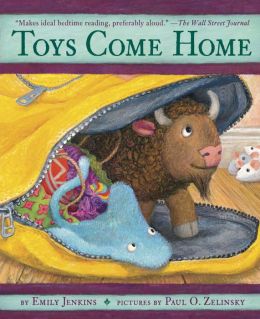
For Aidan, choosing another book proved a challenge. He and I have been reading the Tollins books together over the last few months, so I knew that he loves word play and wry humor. I brought a few books to our library table for him to try. Toys Come Home proved to be the winner. (Yay! I love these books.) Although I had read aloud Toys Go Out to him three years ago, he didn't remember it, which meant that he was experiencing StingRay and the Girl for the first time.
We're reading chapters together and then talking about them in detail, which I hope will help him to get to that feeling of being "way down deep" in a book. Most importantly, I want him to realize the dual pleasures of reading and enjoying what's on the page he's on right now and putting that together with the bigger story of the book as a whole.
Why worry?
In some ways, acquisitional readers are not doing that badly. They do find pleasure in reading, even if they don't finish books, and they are able to have lively and animated conversations about books. Many adults wouldn't even notice that they aren't finishing.
But they are missing out on the best part of reading. This is why for Aidan, and for my students, acquisitional reading must always be a stopping point, never the end destination.
Questions
-At the end of the school year, what did you notice had been neglected for the last few weeks?
-Have you noticed any acquisitional readers? What advice do you have for helping them?
Ah, the children left to their own devices. This school year I haven't intervened much in my younger son's reading life. His reading assignment every night was blissfully easy--read anything you like for 20 minutes--but after Christmas he went to reading on the Kindle. It wasn't until Saturday at the library that I noticed that he had somehow transformed into what I call an "acquisitional reader".
What is an acquisitional reader? Here are some characteristics:
7-12 years old
I've noticed these kinds of readers in every grade that I have taught--fourth, sixth, and seventh.
Love a series or a kind of book
Acquisitional readers all share a love for a particular series or genre. For some kids it is a series of books (The Warrior series for my young one), while for others it is a kind of book, like books about wolves or airplanes.
Seek out information about a series beyond the actual books
Acquisitional readers are often very impressive in their knowledge about the series or books. Aidan knows everything about the Warriors books, the result of Internet searches and browsing online. Acquisitional readers can talk very knowledgeably about their favorite books.
Value acquiring the books over reading the books
And this is the heart of the problem.
This one characteristic is what unites every acquisitional reader that I have ever known. Acquisitional readers are quite different from reluctant readers because acquisitional readers love books. They love the idea of reading. They stand in the library and chat about their books. In fact, they love books so much that many people never even realize what's happening. (Like, uh, a mother who has been sucked into the thrall of too many May activities.)
Development
How do acquisitional readers develop? I've noticed that they are often kids from families that value reading, or kids who just love school. The brain work of really deep reading is invisible to most kids. What do these kids see an older sibling or a parent doing? They see the role model:
-getting books
-talking about books
-seeking new information about books.
Put all of this together--minus the invisible brain work of engaging with books--and you have the acquisitional reader.
Moving forward
In the library on Saturday, I realized that my youngest son is an acquisitional reader. He loves the Warriors series and knows a great deal about it. He has started many of the books. He knows all about the authors and why they chose the name Erin Hunter. But he hasn't really finished any of the books at all.
The good thing about acquisitional readers is that they already love books. They already love reading. They just need to be nudged into that deep invisible brain work. From my experience, it sometimes takes a clean break away from the series or kind of book that they like so much. They already have such a rich knowledge of that series that they don't even realize that they are missing anything.
For Aidan, choosing another book proved a challenge. He and I have been reading the Tollins books together over the last few months, so I knew that he loves word play and wry humor. I brought a few books to our library table for him to try. Toys Come Home proved to be the winner. (Yay! I love these books.) Although I had read aloud Toys Go Out to him three years ago, he didn't remember it, which meant that he was experiencing StingRay and the Girl for the first time.
We're reading chapters together and then talking about them in detail, which I hope will help him to get to that feeling of being "way down deep" in a book. Most importantly, I want him to realize the dual pleasures of reading and enjoying what's on the page he's on right now and putting that together with the bigger story of the book as a whole.
Why worry?
In some ways, acquisitional readers are not doing that badly. They do find pleasure in reading, even if they don't finish books, and they are able to have lively and animated conversations about books. Many adults wouldn't even notice that they aren't finishing.
But they are missing out on the best part of reading. This is why for Aidan, and for my students, acquisitional reading must always be a stopping point, never the end destination.
Questions
-At the end of the school year, what did you notice had been neglected for the last few weeks?
-Have you noticed any acquisitional readers? What advice do you have for helping them?
Monday, June 10, 2013
Persuasive Writing: Introductions
For me, the 2012-2013 school year has come to a close. Now it's time to settle back into the routines and do what I've pushed aside during that frantic month of May--read some books, conquer Mt. Laundrymore, and do some writing.
In that month of May, my students and I focused on persuasive writing. What fun! We diagrammed examples of persuasive pieces, looked at how to craft strong persuasion, and wrote persuasive essays.
Because May is such a piecemeal month, full of interruptions, I needed materials that would help us to bridge the crazy times (band practice! field day! field trips!) and give students enough guidance to catch up when we had time. Here is what I created to help students work through writing introductions:
How did it go? We finished our essays three days before the end of the year. Whew! It was cutting things a little closer than I like, but we took a leisurely pace in the last two weeks and everything came out okay.
The rest of the persuasive writing materials can be found here. Enjoy these weeks of June!
In that month of May, my students and I focused on persuasive writing. What fun! We diagrammed examples of persuasive pieces, looked at how to craft strong persuasion, and wrote persuasive essays.
Because May is such a piecemeal month, full of interruptions, I needed materials that would help us to bridge the crazy times (band practice! field day! field trips!) and give students enough guidance to catch up when we had time. Here is what I created to help students work through writing introductions:
How did it go? We finished our essays three days before the end of the year. Whew! It was cutting things a little closer than I like, but we took a leisurely pace in the last two weeks and everything came out okay.
The rest of the persuasive writing materials can be found here. Enjoy these weeks of June!
Friday, May 24, 2013
Tadpole News
Wow, May is busy! Field trips, special activities, wrapping up the school year...it's a pretty hectic time. But it's been a good May for me, mostly measured by the number of frogs I've caught on trips with students (3), the number of trees I've planted with students (30+), and the fact that the yearbooks arrived at school on time and with no problems (whew!)
We've been raising tadpoles again this year, with much better success than last year. Here are some simple steps to raising tadpoles in the classroom. More information can be found at the NatureNorth page.
1. Check out your state's rules for tadpoles.
2. I never really gather tadpoles myself...they always just show up. This year, the tadpoles were brought in by a student, and she will take them home later. Wherever you get the tadpoles, it's important to collect a good amount of water for them. I always have the best luck using water from the tadpoles' ancestral home.
3. The best container ever for tadpoles? Plastic pretzel containers! Rinse them very, very well to be sure that there is no salt in them. Then put your tadpoles in, along with the water that you collected from their original home. (Never use water straight from the tap.) The tadpoles don't need very deep water. A few inches at the bottom of the plastic container is fine.
4. Feed your tadpoles bits of cooked lettuce. I just cover some lettuce with water and boil in the microwave for a minute or so. I let the lettuce cool for a few hours and then put it in with the tadpoles.
Long term care...
-Keep a few gallons of pond water on hand to change the water frequently. Try to change 1/3 of the water each day. (I never manage to do this, though. I have kids work to collect bits of mud and--uh, tadpole waste--from the bottom of the container with droppers, which really helps to keep the water clear.)
-Every day or two, take out the old lettuce as it starts to decay.
-When the tadpoles start to grow legs, put some rocks in the water for them to crawl out on.
Get ready for surprises!
This tadpole came along in an algae-filled bottle of pond water that another teacher brought to me. (Thanks, Kelly!) I thought it might be a bullfrog tadpole that had overwintered as it was much bigger than any of the other tadpoles.
When it fully transformed, however, it was obviously a wood frog--right down to the tiny black mask that is so characteristic of wood frogs. What a neat surprise. The kids had read about wood frogs in the Chronological Order texts activity, so they knew how to recognize it. Just like with spring peeper tadpoles, the full-grown frog is actually a little smaller than the tadpole.
This is a good scientific lesson, because it shows how we need to make observations and be ready to change what we think we know. A similar surprise happened with what we thought was a salamander larvae, because it had external gills. As it turns out, spring peeper tadpoles have external gills for a few days.
Keeping froglets
This is the hardest part of the process. In years past, we have not been able to figure out what kinds of tiny insects to give our froglets and toadlets. I always tried to release them quickly after they transformed.
A student and her father discovered a solution last summer. We live in orchard country, and the student's father found that fruit is the key. The froglets don't eat fruit, of course. But the fruit attracts tiny fruit flies...just the food for a tiny froglet! He also found success with aphids from tree limbs.
Today we made a new home for our wood froglet, complete with mulch, a water dish, and moss. Hopefully the froglet will thrive until the end of the year.
Why tadpoles?
The table of tadpoles is just a quiet hub of activity for the last two months of school. Kids check in on them every day and talk about what has changed. There is always something new to see or discuss, and always tadpole care to manage. As our own little classroom star becomes the supernova of brilliant May, the tadpoles give us one last long project to share together.
We've been raising tadpoles again this year, with much better success than last year. Here are some simple steps to raising tadpoles in the classroom. More information can be found at the NatureNorth page.
1. Check out your state's rules for tadpoles.
2. I never really gather tadpoles myself...they always just show up. This year, the tadpoles were brought in by a student, and she will take them home later. Wherever you get the tadpoles, it's important to collect a good amount of water for them. I always have the best luck using water from the tadpoles' ancestral home.
3. The best container ever for tadpoles? Plastic pretzel containers! Rinse them very, very well to be sure that there is no salt in them. Then put your tadpoles in, along with the water that you collected from their original home. (Never use water straight from the tap.) The tadpoles don't need very deep water. A few inches at the bottom of the plastic container is fine.
4. Feed your tadpoles bits of cooked lettuce. I just cover some lettuce with water and boil in the microwave for a minute or so. I let the lettuce cool for a few hours and then put it in with the tadpoles.
Long term care...
-Keep a few gallons of pond water on hand to change the water frequently. Try to change 1/3 of the water each day. (I never manage to do this, though. I have kids work to collect bits of mud and--uh, tadpole waste--from the bottom of the container with droppers, which really helps to keep the water clear.)
-Every day or two, take out the old lettuce as it starts to decay.
-When the tadpoles start to grow legs, put some rocks in the water for them to crawl out on.
Get ready for surprises!
This tadpole came along in an algae-filled bottle of pond water that another teacher brought to me. (Thanks, Kelly!) I thought it might be a bullfrog tadpole that had overwintered as it was much bigger than any of the other tadpoles.
![]() |
| A wood frog tadpole |
When it fully transformed, however, it was obviously a wood frog--right down to the tiny black mask that is so characteristic of wood frogs. What a neat surprise. The kids had read about wood frogs in the Chronological Order texts activity, so they knew how to recognize it. Just like with spring peeper tadpoles, the full-grown frog is actually a little smaller than the tadpole.
![]() |
| An adult wood frog |
Keeping froglets
This is the hardest part of the process. In years past, we have not been able to figure out what kinds of tiny insects to give our froglets and toadlets. I always tried to release them quickly after they transformed.
A student and her father discovered a solution last summer. We live in orchard country, and the student's father found that fruit is the key. The froglets don't eat fruit, of course. But the fruit attracts tiny fruit flies...just the food for a tiny froglet! He also found success with aphids from tree limbs.
Today we made a new home for our wood froglet, complete with mulch, a water dish, and moss. Hopefully the froglet will thrive until the end of the year.
Why tadpoles?
The table of tadpoles is just a quiet hub of activity for the last two months of school. Kids check in on them every day and talk about what has changed. There is always something new to see or discuss, and always tadpole care to manage. As our own little classroom star becomes the supernova of brilliant May, the tadpoles give us one last long project to share together.
Wednesday, April 24, 2013
Building Independence with Text Structure
It's never fun to see the chasm between what I think I've taught and what students have actually learned. But when this chasm becomes apparent, I have to dig a little more deeply to find out exactly where things have gone wrong...and find a way to fix it.
Take this past week. As we were getting back into working on text structure (after a break for state testing), one of my students wrote, "I have injoyed learning about text structures like peregrin falcons and red tail hawks."
Oh dear.
If this student was confusing the text structures with the topics that we have been reading about, other students were probably doing so too. On reflection, I could see where she got this idea. This year I have really worked to put together a coherent text set of related texts. For a struggling reader, it makes sense that the concrete, real topic (peregrine falcons) would replace the abstract idea (text structure). Add to this the fact that my text structure bulletin board has been concealed for the last three weeks for testing purposes, and I could see why she would write this. And I was glad that she did--after all, I need to know when things aren't working well!
Look back to texts
Our first order of business at the next class was to find examples of different text structures in our reading folders. We worked on this one text structure at a time, for about 10 minutes in each class. In my co-teaching class, students have worked with various adults and read various texts. We found all of the chronological order texts and stapled them together. The next day we found all of the cause and effect texts, and then the problem and solution texts.
This was actually very helpful, as students shared their different texts with each other and talked about why each one fit a particular text structure. Of course the process was a little painful ("Is this one? What about this? Is this one?") but it was a good way for students to move into the abstract thinking for text structure.
Emphasize using the text structure
The next thing I needed to make clear to students was that text structure can be useful. I made this poster quickly and then worked through it with the first guided reading group. We talked about the word browse and what it means. Then I handed out copies of Salamander Crossing--a text with a familiar topic for students--that had the text structure cue words problem and solution highlighted.
Well, the kids thought this was very amusing, and they quickly figured out that the text structure was problem and solution. (Whew!) Then we talked about how the text structure could help students to understand the topic. What might the problem be? What about the solution?

Independent graphic organizers
I love neat and tidy graphic organizers...but kids definitely need to learn how to make their own. I showed students examples of different graphic organizers to see if they could pick out which one to use. "That one! That one!" they said excitedly, when I showed the simple boxes for problem and solution. Double whew!
I had kids scatter throughout the room to work alone on reading the text and making a graphic organizer. Then they added some pictures to their graphic organizers to show the problem and solution with pictures. I wrapped it up by having students share their pictures on the document camera as we talked about which ones related to the problems (one showed a sad, flat salamander and a driver saying, "Oh no!") and which ones related to the solution (a very cute little person holding a flashlight).
Looking back
Looking back, it was good that I found out that students were having trouble with text structure. It never hurts to make the abstract concepts we are teaching as explicit as possible.
If you're curious about mole salamanders, here is a lovely video. Some night I may go out and try to see them for myself...unfortunately, March and April evenings are always too chilly for me to brave it!
Take this past week. As we were getting back into working on text structure (after a break for state testing), one of my students wrote, "I have injoyed learning about text structures like peregrin falcons and red tail hawks."
Oh dear.
If this student was confusing the text structures with the topics that we have been reading about, other students were probably doing so too. On reflection, I could see where she got this idea. This year I have really worked to put together a coherent text set of related texts. For a struggling reader, it makes sense that the concrete, real topic (peregrine falcons) would replace the abstract idea (text structure). Add to this the fact that my text structure bulletin board has been concealed for the last three weeks for testing purposes, and I could see why she would write this. And I was glad that she did--after all, I need to know when things aren't working well!
Look back to texts
Our first order of business at the next class was to find examples of different text structures in our reading folders. We worked on this one text structure at a time, for about 10 minutes in each class. In my co-teaching class, students have worked with various adults and read various texts. We found all of the chronological order texts and stapled them together. The next day we found all of the cause and effect texts, and then the problem and solution texts.
This was actually very helpful, as students shared their different texts with each other and talked about why each one fit a particular text structure. Of course the process was a little painful ("Is this one? What about this? Is this one?") but it was a good way for students to move into the abstract thinking for text structure.
Emphasize using the text structure
The next thing I needed to make clear to students was that text structure can be useful. I made this poster quickly and then worked through it with the first guided reading group. We talked about the word browse and what it means. Then I handed out copies of Salamander Crossing--a text with a familiar topic for students--that had the text structure cue words problem and solution highlighted.
Well, the kids thought this was very amusing, and they quickly figured out that the text structure was problem and solution. (Whew!) Then we talked about how the text structure could help students to understand the topic. What might the problem be? What about the solution?

Independent graphic organizers
I love neat and tidy graphic organizers...but kids definitely need to learn how to make their own. I showed students examples of different graphic organizers to see if they could pick out which one to use. "That one! That one!" they said excitedly, when I showed the simple boxes for problem and solution. Double whew!
I had kids scatter throughout the room to work alone on reading the text and making a graphic organizer. Then they added some pictures to their graphic organizers to show the problem and solution with pictures. I wrapped it up by having students share their pictures on the document camera as we talked about which ones related to the problems (one showed a sad, flat salamander and a driver saying, "Oh no!") and which ones related to the solution (a very cute little person holding a flashlight).
Looking back
Looking back, it was good that I found out that students were having trouble with text structure. It never hurts to make the abstract concepts we are teaching as explicit as possible.
If you're curious about mole salamanders, here is a lovely video. Some night I may go out and try to see them for myself...unfortunately, March and April evenings are always too chilly for me to brave it!
Subscribe to:
Posts (Atom)