Monday, January 12, 2015

Behind the Scenes: A Classroom Economy

I write a lot about individual lessons and activities, but sometimes I forget to talk about the deep routines in the classroom. One thing that I love is a classroom economy! It runs totally in the background of the classroom (well, usually) and solves many daily problems. Basically, kids earn tickets in various ways and then can use those tickets for different purposes.

How do kids get tickets?

The basic way to get tickets is to do a classroom job. For other ways, the answer differs as the year goes on. Early in the year I would give kids tickets if I accidentally called them by a sibling's name--much to the delight of my younger son! Sometimes I also give tickets for random tasks, like stapling book orders or cleaning up from a science experiment.

As the year has gone on,  students also get tickets when they remove 5 vocabulary cards (you can read about the vocabulary system here).  But most students earn tickets through contracts. How do they get the contract? Students see a problem in the classroom and write a contract to fix it. Right now students are passing out reading binders, doing the lunch count, taking care of the bird observations and bird feeder, erasing the whiteboard, and, yes, keeping track of all of the contracts!

Kids write the contracts themselves, which makes for interesting conversations and an authentic reason for writing. What do you intend to do? How often will you do it? Once their contract work is complete, they fill out an "invoice" that I sign.

How do kids use tickets?

So here are the things on our class poster:
-Switch seats for the day: 2
-Special chair: 3 (I have an old teacher's chair that they can borrow for the day)
-Stool: 2
-Stuffed animal for the day: 2
-Extra copy of a paper: 1
-Returning to class to get a forgotten item: 1
-First choice of recess equipment: 1
-Laptop use (kids have assigned days, so this is for extra): 3
-Popcorn Party for the class: 50 (kids can donate into an envelope)

I also auction things off once or twice a cycle. These things include donated little toys, books and bookmarks, school supplies, and other randomness. Such a great way to get those odds and ends into good hands!

What else happens?
A student wrote a contract for making the
morning message.


Well--it's different every year. It's always interesting to see how kids make the system theirs. I don't allow students to bring things from home to sell for tickets, although kids do try to do this every year. Sometimes kids start businesses. Right now, some students are making friendship bracelets and "selling" them during indoor recess. Another student is selling drawings. One student purchased the rights to a fancy set of fine line markers, and rents them during recess.

When students kept forgetting to move their lunch cards in the mornings, the student in charge of the closets proposed a win-win solution: If you don't move your lunch card by announcements, you have to donate to ticket to the Popcorn Party envelope.

During indoor recess, we found that we were going through construction paper at an alarming rate. A student came up with a tiered payment system. Now, using recycled classroom paper is free, while construction paper has a ticket cost.

The area by the door to my classroom is covered with student-created posters, advertising their various goods and services. Students are even considering marketing and how to connect with customers. After the Hour of Code, one student even offered computer programming lessons!

Potential problems

...are not actually a big deal. I say to students early on--this is supposed to be fun. And students really treat it as such. We talk about safe places to keep tickets and the need to be responsible. There are minor problems with dropping tickets here and there, but nothing major so far. And I've done versions of this for four years.

Some fun

All in all, our classroom economy is a great routine to have going on in the background. Lots of fun and room for discussion and growth!

News and notes
-I finally finished Exploring Point of View! This includes two original stories--one written in a shifting point of view, and the other written in first person point of view.


Friday, January 2, 2015

Multimedia Texts and Activities


Over the past two years, I've been working with Frolyc to create activities for student iPads. It has been a wonderful experience to see the Activity Spot app grow and change.

Now, teachers can add text, pictures, web links, and video. Students can respond with drawings, open-ended responses, fill in the blank responses, and drag and drop organizers. Teachers can see student responses in real time.

Over the break, I spent time cataloguing the activities that I have created. Wow--I have created and posted 130 different activities! At first, much of my work focused on learning the affordances of the app--what could I do with it? What could kids do with it? What regular classroom tasks could the app encompass?

In the past few months, I've become much more strategic, trying to put together sets of activities to complement units of study or classroom topics. And all of this has been happening at a time when I have been learning all that I can about digital literacy and multimedia in the classroom.

Activity Spot is the perfect tool to help students transition into critical thinking about multimedia. Texts, videos, pictures, and web links are right there for students to explore.

Here are some of my favorite activities! Some are premium activities, while others are free.

Activities for grades 2-3
The A-10 Thunderbolt:  This informational text describes the A-10 Thunderbolt, and is a favorite with reluctant readers. Students read the text and complete a scaffolded summary. (Also included in paper form in Paraphrasing and Summarizing Lessons for Nonfiction Reading.)

The Flooded City: Venice: This informational text shows the text structure of problem and solution. (Also included in paper form in Problem and Solution Texts for Teaching Text Structure.)

Black Bears and People: This is another problem and solution text. I love looking at the pictures that readers create to go along with the text!

Activities for grades 4-5
The Painted Turtle: This is one of my newest activities and I am so pleased with it. My home beta tester (my fourth grade son!) enjoyed it. With this activity, I really used the capabilities of Activity Spot to create something that cannot be duplicated in a traditional text--students read the cause and effect text, and then compare it to a video on the same topic. (You can find the Painted Turtle text in Cause and Effect Activity and Texts for Teaching Text Structure.)

What is Mass?: This activity is an example of how Activity Spot can be used for science instruction. Students read about the difference between mass and weight, and then think about which tools are used for measuring these properties.

Energy Flow in Ecosystems: Picture the scene--a holiday party with grown-ups, kids dressed in their best clothes, surrounded by breakable Christmas collectibles. How can I amuse 8 and 10 year old cousins? With learning, of course! This picture shows what my son and nephew created after they read about energy flow in ecosystems. They used the camera roll on the iPad, found the awesome praying mantis picture, and labeled it. My proudest moment.

Activities for grades 6-8
Steel: From Swords to Skyscrapers: This chronological order informational text is so appealing to kids who like Minecraft! Multiple choice questions and a sequencing activity challenge students to use the text structure of chronological order. (Also available in paper form in Chronological Texts for Teaching Text Structure)

Emily Dickinson: I really like how this activity uses the capabilities of Activity Spot. Students learn about Emily Dickinson's life, and then view a video that highlights her use of imagery. Finally, they look at a commercial for "Emily Dickinson's Garden" to consider elements of author's purpose.

Endangered Species: The web features some fantastic writing, and with Activity Spot, you don't have to print and copy digital texts. This activity includes a link to an article from the US Fish and Wildlife Service highlighting lesser-known endangered species. After reading the article, students compare the text to a video, making this a great activity to help readers compare different kinds of text.

Looking forward
This is only a small sampling of the texts and activities that are available. Other teachers are creating and sharing as well. In the next few weeks, I hope to add even more informational texts. If there are activities you would like to see, fee free to request them here or on the Frolyc site.

Do you have lesson ideas that you'd like to add? You can create your own free and premium activities on Activity Spot! Visit Frolyc.com to learn how.


Tuesday, December 30, 2014

Passage-Based Essays Aren't Scary

...well, okay. They are a little scary.

This year in Pennsylvania, we get to have an entirely new test in the spring! Instead of the standard open-ended responses of the past, students will have to write passage-based essays. In other documents, this writing has been called a Text-Dependent Analysis.

I have been pretty nervous about this. The first samples that came from the state were awful--the kind of formulaic writing that no thoughtful teacher would want students to produce. "Is this what I'm supposed to do?" I thought. My next thought--"I'm going to have to do much better at TeachersPayTeachers, so that I can still have an income once the inevitable happens."

Well, I couldn't stay pessimistic for long. After all, if I left the classroom, who would identify all of the bugs and the birds around the place? So the easiest path was to figure out how to help kids write good passage-based essays.

Step 1: Teach students how to quote from the text

Teachers who haven't worked with 9 and 10 year olds might be surprised at how challenging students find the process of quoting from text. They don't know how to choose the sentences to support their thinking; they don't know where to put the quotation marks; they get confused about whether to switch from first-person to third-person pronouns. Teaching students how to quote from the text in short, low-stress activities early in the year makes the passage-based essay process much easier.

Step 2: Create a high-quality prompt to go along with a really great text.

My students were working in three different texts in late November, so I made a prompt for each. The prompts were all similar--each one had two areas for analysis.

     In the story Molly’s Pilgrim, Molly’s feelings about school change. In the beginning of the story, Molly feels as if she doesn’t belong at school. By the end, her feelings have changed.

graphic organizerWrite an essay analyzing Molly’s feelings about school and how they change over the course of the book. Be sure to include specific details, including quotations, from the book.

To help me keep everything straight I made prompts, checklists, graphic organizers, and rough draft pages on different colors of paper for each text.

Step 3: Model, model, model!

I decided to work through the process along with the students. I wrote a fourth prompt, this one for Santa Calls by William Joyce, and I modeled each step of the writing process, from dissecting the prompt to finding text evidence to putting it all together. It worked quite well to model-do--kids didn't have to sit and watch me for very long as I was just showing them the next chunk of what they would do.

I feel very strongly that my modeling needs to show a sophisticated version of the product--the piece of writing that I can produce as an adult. Kids need to see the real thing. And I did show my real, true, crazy revising process, beginning each session by rereading what I had so far and smoothing out the wording.

Step 4: Make it collaborative

In my first reading class, students had read the books as literature circle groups. It was only natural, then, for them to continue to work in their groups as they moved into essay writing. Some groups worked cohesively together, while others chose to do parallel writing and only consult with each other as needed. (In my other class, which I co-teach, students did not work in groups--which I came to regret when I saw how nicely the collaboration unfolded in the first class.) There is so much in this picture that I love--the students sitting together on the yoga mat by the library, books open as they refer to the words and pictures to grapple with the ideas.

Step 5: Don't worry about the time

I had estimated that it would take us a week to write the essays. Well, with discussion of reading homework and vocabulary, independent reading, and holiday schedule changes, it has stretched out longer. I feel a little bit panicked as I think about all that is before me, but I don't regret spending the time on these essays. Students have to do so much thinking as they consider the prompt, select text evidence, explain how the text evidence supports their statements, and write an introduction and conclusion!

I felt a little Grinch-y as we worked on passage based essays two days before holiday vacation. After I modeled writing a conclusion, students settled around the room to work on their essays. One student said, in that contented way that fourth graders have, "This is fun."

Trust me, nothing could have surprised me more. Fun? But this student wasn't trying to butter me up or make a joke. The work of creating, the work of weaving an author's words with her own thoughts to make something completely new--that can be fun. And it took a fourth grader to help me realize that passage-based essays aren't scary.

Resources

Books I used: Molly's Pilgrim by Barbara Cohen, Weslandia by Paul Fleischman, and The Memory Coat by Elvira Woodruff

Copies of the passage-based essay prompt, graphic organizer, and rough draft page can be found in this unit.

Tuesday, December 9, 2014

You can do better than a generic summary frame

   This week, Pinterest has repeatedly coughed up a pin with a generic summary frame. "Use with any informational text!" the caption reads. This generic summary frame has lots of color and a bright, cheerful font. Basically it looks like this: "I read the text ____________. First ______________. Then I learned that ________________. Finally I found out ____________________."
   I wince every time I see it. If there is one thing that I know about teaching summarizing, it is that one frame cannot be used with every informational text.

Summarizing

   I first learned this more than 10 years ago, as I researched my first book, Summarizing, Paraphrasing, and Retelling. Intrigued by what I was observing in my classroom, I read scores of articles about summarizing, reading about how readers develop summarizing skills and how teachers can support this process.
    And there is so much to learn about summarizing! A teacher can learn so much about a student's reading processes by looking at a student summary. Some summaries are too long. Others do not reflect the main ideas of the text. Other students use the "copy and delete" strategy, copying some ideas from the text and leaving out others.

Topic Summaries

   One kind of summary that is particularly thorny for intermediate readers is what I call the "topic summary". This summary just gives a run-down of the main topics in a text: "I read about mummies. First the author explained how mummies are made. Then the author described why mummies are important. Finally the author told about mummies today."
    This is not a good summary! Notice how it just discusses the topics, but not the main ideas. When I have students who write these summaries (and usually they are strong readers), I know that we need to discuss the difference between topics and main ideas. These topic summaries can often be written by just running down through the headings of the text. But do they show a deep and rich understanding of the content? Not at all.
    Another problem with the topic summary is that it uses chronological order transitions instead of reflecting the structure of the text. In fact, a topic summary reads more like an account of the reader's experience of the text instead of showing the author's ideas.

Generic Summary Frames

    ...but what does a generic summary frame lead kids into writing? Yup. A topic summary.
    Teaching readers how to summarize is hard. But we need to acknowledge and embrace this difficulty instead of looking for a simple fix. Generic summary frames attempt to circumvent the real cognitive work of crafting a summary and boil it down into something simple. Getting really good at this kind of writing will not naturally lead into being able to write sophisticated summaries.

What to do instead?

    Lots of things! The first step is to figure out what students can do independently. Give them an appropriately leveled text and have them write a summary.

Blank stares
   If they don't have any clue of how to begin, this tells you to start with some model summaries. Use short, familiar texts to show students what a good summary looks like.

Scattered summaries
    When students have a shaky understanding of a text, they produce oddly scattered summaries. This represents students' attempts to play the game of summarizing--they pick out ideas from here and there, without understanding how the whole text hangs together.
     Techniques that focus on basic comprehension really help students who are writing these summaries. Try retelling nonfiction texts. When kids put ideas into their own words, they have to wrestle with the language and pin down the meaning. Next, show students how authors signal main ideas in a text with headings and topic sentences.

Long summaries
    If students write really long summaries with the main ideas of the text, they are probably comprehending well. Start by telling students, "Okay, cross out one sentence from your summary." Expect some resistance--"It's all important," or "I can't decide!" After some time, though, students will probably find at least one sentence to take out. Repeat, repeat, repeat! Eventually students will bring you their work and say, "Don't tell me to take out a sentence, because I already thought about everything that was most important and I only wrote that."

Making a scaffolded summary
    All students can benefit from a scaffolded summary. Simply write a good summary of a text, and then decide which parts to give to students, and which parts to leave out.
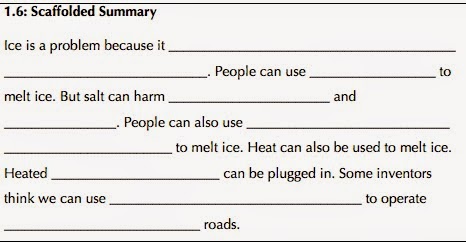
    In a scaffolded summary, you can decide how much support to give to students. The scaffolded summary at the right is a very supportive frame, which gives students a great deal of language. It can become easy for kids to think of this kind of task as simply "fill in the blanks", so be sure to connect this to meaningful summarizing. (This particular summary is from Daily Warm-Up Activities, Grade 3).
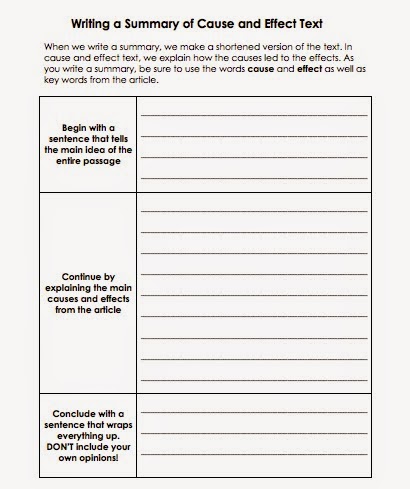
    A scaffolded summary with less support can be seen here. Notice that this frame does not give any language specific to the text, but gives suggestions based on the text structure. It's different from a generic summary frame because it does not claim to be suitable for all passages--in fact, it only works for cause and effect text.
    Lately I've found that teaching summarizing as I teach each text structure yields great benefits. This page is from Cause and Effect Activity and Texts.


    Teaching students how to summarize is hard. Anyone who says differently is selling something...probably a generic summarizing frame.

Sunday, November 30, 2014

Centers, Play, and Fourth Grade

    This year I've been following some amazing kindergarten teachers on Twitter. I started out teaching in a preschool, so I have a deep appreciation for all things early childhood. But I have also felt that some element of play is missing in the middle grades.
    As I looked at what the kindergarten teachers were posting and saying, I wondered, "How can I adapt this for my older students?" They are so full of fun, enthusiasm, and questions. They deserve open-ended learning experiences and beautiful experiences just as much as younger students. As some forces are pushing me to make my classroom even more rigorous and demanding, I want to balance things by providing creativity and room for intellectual growth.

Getting Started: Limited Choice
    I decided to dedicate about 20 minutes each day to open-ended work. In the first few weeks of school, I spent great care in developing the culture of our centers and what would happen there. It was not without bumps. Many students associated open-ended free time with recess. I had to constantly remind them--"This is a learning time," and ask, "Are you taking advantage of the learning opportunities in this room?"
    As you can see from the centers list, I chose a wide range of activities that could happen in many different places in the room. Issues of access and squabbling caused us to make some tweaks to our routines, such as making daily schedules for Marbleworks and the computers.
    Early on, kids started asking to do things that weren't on our list. My natural inclination was to say, "Sure!" However, sometimes I have to go across my natural inclinations. (I am always tending toward chaos.) I said, "For now, please choose something that is on our list." Then, as months passed, I would update the list with their new suggestions.

Spreading Wings
    The centers became a great place to put materials after a unit. For example, after we studied volume, I put a wide range of tools by the sink. Sink play is virtually unheard of at my grade level. (If you are a grade 3-5 teacher and you let kids play in the sink, please send me pictures!) Kids took responsibility for any mess. And kids discovered so much about the different measuring tools--the
The Erector set was hugely popular in the
early weeks of school.
relationships between teaspoons and milliliters, the accuracy of their water bottles, the volume of a marble apple. Weeks after the measurement center waned in popularity I heard one student telling another, "Don't use the liter cube to measure--it's not accurate."
    By mid-October I felt comfortable enough with routines to loosen up in what students could do. The open-ended time became a time for freeform investigations and jobs. One student, seeing that our closet was a wreck each morning, wrote a contract to take care of the closet in return for a coupon (from our class economy) each day. He enlisted the help of another student and gave occasional reports to the class about how it
A student drawing from a Frolyc iPad
activity. 
was going and what they could do to make the closets better.
    Another student, seeing the neglected animal cards, created an identification game. From the corner I could hear kids calling--"Dragonfly! Otter!" as they raced each other to identify the animals. Students also work on open-ended, optional activities, such as their Bat Week posters, Frolyc, bird observations, reading, and computer games. Checking in on animal observation cams has also been a favorite activity of late.
    The time has also become an opportunity for students to work on their own science investigations. With the onset of cold weather, we've had several ice experiments. It's been fun to hear kids talk to each other about using the measurement tools from early in the year to create more sophisticated experiments.
The animals that students bring in
are great opportunities for open-
ended exploration.
    Our morning work has also tended to run into other parts of the day. When there are odd moments in the schedule or kids have finished one activity in a lesson it has become natural to just move into the open-ended activities of center time. One day, we moved from our centers time into indoor recess. There was no perceptible change in the quiet, busy hum of the room. I said, "It's recess," but nobody really changed what they were doing.
     In the weeks to come, I plan to add more opportunities for science experiments. Students have written and conducted their first simple experiments, and now are eager to try more with vinegar, baking soda, food coloring, and the like. Just like every new activity, I expect this to be hugely popular.

Kids weighed everything on the balance. Erasers,
pencils, paper clips, water bottles, and a mix
of all of the items together.
Questions and Wonderings
    I could easily write this blog post to make it sound as if this
routine in my classroom always works beautifully and is perfectly wonderful in every way. But I can't ignore the bumpy spots and the thorny questions.
    One day last week I counted 17 different activities going on over the course of the morning. They were all rich, meaningful activities, and I was fascinated at the range of curriculum areas and topics that they reflected.
    But are students switching too often? I have noticed several students engaging in at least four different activities in 20 minutes. I've intervened a few times, but I've also stood and watched, and wondered. Should I tell students to choose one activity and stick to it? Or should I just allow them to enjoy this time of complete choice?
    There are also some kids who sit back and opt out of the social aspect of this time. These students love to read and sit, completely absorbed in a book. My short-term attempts to pull them into the social whirl of activity are politely tolerated for a day, and then they go back to reading.
    A few students seem to just watch what the other kids do--I'll find them looking over the shoulder of someone playing a game or looking at our class blog. Again, these students politely take my suggestions, but do not engage themselves on their own.
     Should I be more insistent about pulling these students in? Or should I wait, hoping that the new activities I'm introducing on Tuesday will do the trick?
    For all of my out of class reflections, often my best decisions about open-ended time come about when I am in the moment--when five kids are calling me over to see something, a colleague has stopped by to ask a question, or someone brings in something unexpected and exciting to look at. These are the moments when I know that time for centers and play is worth pursuing for my fourth grade students.


Wednesday, November 26, 2014

Keeping Up with a Vocabulary Routine

    I've wrestled with this question for many years. Many of my students come to fourth grade with huge word deficits and large gaps in speaking and writing vocabulary. Others come with an eagerness to learn new words and build upon what they have picked up from their reading. I need a vocabulary routine that helps students to be excited about new words...a routine that is manageable and practical...a routine that has lots of room for new additions and learning.
     Faced with the need to do something to build vocabulary, I decided to focus upon five words each week. Before I could choose these words, however, I needed to learn a great deal about which words would be most useful to teach. I made a spreadsheet of Averil Coxhead's Academic Word List, and then added words from the Common Core, the Nifty Thrifty Fifty, and a few other sources. I gathered information about the words, including roots and idioms, and eventually came up with this master list:


  As I created reading homework passages, I chose a mixture of words that were important to each text and words from the Master Word List. Each week, we learn five new words. The vocabulary instruction is not lifeless and dictionary-based; instead, I give kids the definitions and we use the words in sentences. Sometimes the prompts are silly ("Could a cat devise a system of writing?") and sometimes serious ("How can we honor veterans?") 

Word Rings
    Last year I wrote about putting words on word rings for students to study. Each word is put on the ring, with the definition on the back. Students read their words with instructional assistants, parent volunteers, and me. When a student can correctly read the word and explain its meaning, I use a fancy hole punch to punch the card. After three punches, students can remove the word. 
    Lots of good things are going on here! Kids are practicing decoding with multi-syllabic words. Kids are talking about words and their meanings, and get to have time with caring adults. For me, the routine is super-simple to explain to anyone who comes into my classroom to help--the aide who has 10 minutes free due to a schedule change, the parent who can come in one morning, the substitute teacher who has a free period.
    This year we've made some innovations. The wonderful ESL teacher who is co-teaching with me put our word lists on Quizlet and showed me how to print flashcards directly from there--how simple! The instructional assistant who manages all of the cards has even figured out how to engineer the paper so that the cards can be made with the fewest cuts possible. When kids get five cards removed, they earn a coupon for our classroom economy. 

Drawings
     Because many of my students are strongly visual thinkers, I've started adding drawings to our routine. We have lots of tracing paper in the storage closet (why? Not sure), and kids have found it calmly peaceful and engaging to trace the pictures as we talk about the words. In the weeks to come, students will take over the drawing part of the routine.

Finding Words in New Texts
    During our independent reading time, kids are always showing me how they have found vocabulary words in their books. This gives us a great opportunity to talk about the word in context as we look at the sentence containing the word and talk about what it means. Kids copy the sentences onto notecards for us to display in the classroom. (The Amulet books by Kazu Kibuishi are especially rich in academic vocabulary.)

   Is this the best vocabulary routine ever? I don't think such a thing exists. Each new teaching book tries to tell readers that this new thing is the ultimate in teaching. However, I think that good teaching resides in the place where practicality, big dreams, and pedagogy meet. Hopefully you can carve out your own functional and delightful routine for teaching vocabulary!


Saturday, November 22, 2014

Close Reading for Understanding Dialogue

    Young readers have a great deal of trouble with dialogue. It seems as if the task of every autumn for me is to help readers learn how to recognize dialogue, figure out who is speaking in dialogue, and visualize conversations as they read.  And what an important task this is! Dialogue carries plot details and characterization. When students don't know who is speaking, or don't realize the importance of dialogue, they miss essential details of a story.
    For fourth graders, tracking a conversation in text without pictures requires careful attention to detail. After some initial instruction, I was curious to see what my students could do. I designed this assessment to peek in at their processes:


Dialogue Assessment from Emily Kissner

   As I looked at student responses, I noticed several patterns.

1. Every question correct. About a quarter of my students answered every question correctly. This doesn't mean that their instruction is done--in fact, it means that students are ready to really explore dialogue and learn how to wring more meaning from it.
2. Trouble with Line 4. Notice how the dialogue in Line 4 does not have a speaker tag. Readers have two ways to identify the speaker. They could look at the textual conventions of quotation marks and a new paragraph to know that someone new is talking. Alternatively, they could look at the context of the conversation to know that the miller wouldn't thank himself. Students who did not answer this question correctly often said "the miller" or even "sir".
3. Trouble with "You look tired". Teachers who know kids--really know kids--will not be surprised to hear that a decent number of students said "the miller" in response to this question. Skilled adult readers are shocked by this, as they clearly see that the miller has dropped out of the story by this point. However, readers who are having trouble managing characters in their heads will assign dialogue to anyone that seems convenient!

Next Steps
   I hate "going over" tests. This is probably a major character flaw. Instead of "going over" the answers, I made clean copies for all students who scored less than 4/5. Then I gathered the students in small groups to reteach. Together, we read the text and aloud and answered the questions again.
    I used sticky notes to symbolize each character, so that we could talk about who was in the story when. This helped students to see that Hans leaves the mill on Line 10, which makes the miller drop out of the story.
    The small group setting helped students to talk out their issues and their misconceptions. "Well, of course the miller wouldn't say thank you," one student said. "It would be kind of silly for him to thank himself for gold."
   "Oh, the rider is a different person!" another student exclaimed. "Well, that makes a lot more sense."
   I waited until after we had discussed the passage to hand out the scored assessments that students had already taken. Then we were able to talk about new understandings. What did students know now that they didn't know then? How were they thinking through the story events differently? How might this help them with their independent reading books?

Resources
    I eventually wrote three dialogue assessments, which I have added to Analyzing Story Elements. It took us a few tries to get it right! Even now there are still some students that are working on identifying narrators in first person stories. More lessons on identifying speaker in dialogue can be found in my book, The Forest AND the Trees.

New Texts

    Last year I wanted to combine social studies and fluency. I realized that my struggling readers needed much, much more exposure to the names of states! I wrote sets of leveled geography texts about different regions of the United States. I think that I can safely say it is one of the more difficult writing tasks that I have undertaken. You can find them here:
-US Geography Leveled Readings Northeast
-US Geography Leveled Reading South
-US Geography Leveled Readings Midwest
-US Geography Leveled Readings West
    Hawai'i and Alaska are both so big and interesting that they deserve their own texts, which aren't quite finished yet.

What's New on Frolyc
    I have lots of texts and activities for student iPads over at Frolyc. If you want to see new activities, subscribe to the What's New on Activity Spot Pinterest board. This month I have worked on Genres: Science Fiction and Fantasy, Autumn Poem, Anthony Wayne (a chronological order text) and more.