Showing posts with label text structure. Show all posts

Wednesday, July 20, 2022

Reading Intervention for Fluency, Academic Vocabulary, and Nonfiction Text Structure

      This product has been a labor of love. Back in 2010, I wanted to put together a research-based set of activities for classroom teachers working with intermediate level readers. I wanted materials that would focus on academic vocabulary and nonfiction text structure, with lessons that were easy enough to add to an already full schedule and materials that were ready to be copied. Most importantly, I wanted to create something that would be inexpensive for classroom teachers. After months of work, I created this:

Reading Intervention for Fluency, Academic Vocabulary, and Nonfiction Text Structure.

     I worked this summer to freshen up the materials to make them even easier for classroom teachers, adding answer keys, PDFs, and better formatting. More than ten years after I wrote it, I'm still proud of the features!

The texts

    In this set, the texts are science-based, with topics ranging from poison ivy to bluebirds to caverns. I worked with topics that are adjacent to key science topics, often inspired by my visits to area museums, science centers, and parks. 

Academic Vocabulary

     Academic vocabulary is essential for unlocking the meanings and nuances of nonfiction texts. In certain reading series, I've noticed that the vocabulary words are jammed into texts, resulting in some odd usages and questionable sentences. Instead of doing this, I wrote the texts, and then searched them for academic words from Averil Coxhead's Academic Word List and other academic word list sources. 

     Engaging students in learning academic vocabulary is important. In my experience, building playful experiences in which students use the words to answer questions works well! I created a PowerPoint presentation for each text in which the words are introduced. These presentations include photos and questions to help students interact with the words, see them repeatedly in print, and use them in sentences. 

Fluency

     Is fluency broken? I kind of think so. I'm not sure that it has the prediction power that it once held. (Read more here.) Nevertheless, I still value time spent in helping students to read aloud with accuracy and expression. Each text in this intervention set includes a phrase-cued text for students to read and a fluency progress monitoring page.

     I love phrase-cued texts because they help students to see how sentences can be chunked for easier reading. Phrase-cued texts also support students in understanding sentence chunks for my favorite grammar activity, sentence unscrambling

     Fluency readings are a great way to talk one-on-one with a student and get a better idea of how they are word-solving. When I do fluency readings with students, I emphasize that the timing is just one part of the reading, and that I also want to hear what they can do with expression and word-solving. At the end of the reading, I give the student a compliment ("I notice that you took the time to figure out the word vanished.") and choose a quick teaching point to discuss with the student. Sometimes we look at the pronunciation of a word, and sometimes we focus on expression within a sentence. The next time that I work with the student, we review what we talked about previously.

    I created fluency passages for each of the texts in this intervention. Fluency passages are also a great way to involve parent volunteers or instructional assistants in your reading intervention. Most adults enjoy the opportunity to work individually with students.

Nonfiction text structure

     Many readers in grades 4-6 are still reading at the "local level"--that is, they're focusing on individual words and sentences within a passage without building a model of the passage as a whole. Understanding text structure and using graphic organizers to represent details can help students to move beyond the local level and develop a global model of the text.

     Each text in this series includes a graphic organizer to represent the big ideas and important details in the text. Students can then use these graphic organizers to help them write a summary of the passage as a whole.

Multiple choice questions

      While these were not part of the original program, I decided to add them as I was using the program with my own students. Each passage has 4-5 questions, along with an open-ended response prompt. 


Working on this intervention has been a bit of a passion project for me, and it's been gratifying to see so many positive reviews. Here's to another 10 years of academic vocabulary, fluency, and text structure!


Sunday, May 10, 2015

Sea Turtles and Expository Text: A Peek Inside

I love writing short expository texts, and I love sharing the texts that I create with other teachers. 

But I can't deny that there is always an uneasy tension between my inner writer and my inner teacher as I start a new project. The inner teacher says, "Wouldn't it be cool to have a set of texts with x, y, and z?" The inner writer groans--"You want what? Do you realize how hard that will be to write?"

So there is a sense of compromise between teacher and writer. I have seen enough hideously contrived texts to know that I shouldn't keep going if something isn't working. Teacher and writer must negotiate to come up with a workable compromise. (And all of this is going on in my head!)


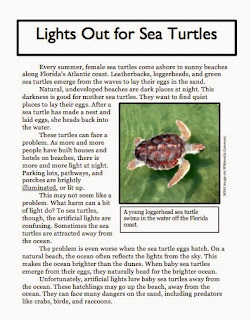
Lights Out: Problem/Solution


This spring, I started to write a series of texts about sea turtles. The project began with a problem and solution text about the importance of turning out lights during nesting season. I find problem and solution to be one of my favorite text structures, probably because it is inherently optimistic. I also love the symmetry of problem and solution. It's fun to write.

I generally prefer to do all of the writing first before I mess around with formatting. Adding the formatting gives me another chance to reread every bit of text. I often read everything aloud to my family as well--my ten year old is a great listener and offers useful criticism. 

After the text has been written, read, and reread, the teacher side takes over and works on questions and activities. Waiting several weeks between text and questions helps me to look at the piece as a teacher instead of as the writer. This year, I've been experimenting with adding synthesis tasks to reading sets. These are very similar to the performance assessments that we used in the late-90s, but with a Common Core twist. Yes, they tap some of the skills that will be needed for high stakes testing, but they are also activities that are real and relevant for students.


Compare and Contrast

After I finished the problem and solution texts, I moved on to the bigger challenge--two compare and contrast texts, each one about two different sea turtles. 

These texts were hard to write. The writer in me balked at writing them, but the teacher stood firm--these are necessary. Compare and contrast is one of the hardest text structures to use. There are two topics, and the writer must work hard to balance them and make clear transitions back and forth. All too often, compare and contrast ends up sounding choppy and awkward. And conclusions? Natural, fresh conclusions to compare and contrast texts are especially difficult.

Of course, this is the lesson that the teacher-me wanted! I saw the need for two texts, both compare and contrast, but using different styles of organization. Compare and contrast texts can be alternating or clustered. Before students look for these structures in the real world, it's helpful for them to see study texts that present each. Texts on similar topics will help them to focus on the structure of the text instead of the content.

The first text, "Loggerheads and Green Sea Turtles" is written in the alternating style. This took a great deal of research and many hours of time. I found conflicting information from various credible sources, and delved deep into Google Books and other sources to find the best information possible. From a writer's point of view, I did create a comparison chart to gather my details. (I hate Venn diagrams for writing.) 

The second, "Leatherbacks and Kemp's Ridley Sea Turtles", was a little easier. I used the clustered style, which deals with each topic in turn. Writing these two texts really helped me to see the strong similarities between description text structure and compare and contrast. After all, clustered compare and contrast could be looked upon as double description. 

The close reading activity that accompanies these texts is the one that my teacher self envisioned at the start of the project--using colored pencils to underline sentences referring to either kind of turtle. As I made the answer key, it clearly showed the difference between alternating compare and contrast and clustered compare and contrast. Victory!

The final activity of the unit challenges students to create their own compare and contrast text, using whichever style they would like. A chart of information is provided to make the task more of a writing task instead of a research task. 

Thank you!

Combining teaching and writing is a challenge. I'm so grateful to everyone who has purchased my texts on TeachersPayTeachers and offered such positive feedback. Thank you! 

You can find the texts and activities here:
Sea Turtles Expository Text


Friday, March 13, 2015

Teaching Compare and Contrast Text

This week I decided to turn text structure on its head and and start with compare and contrast! I made this decision to provide some additional continuity with our texts, and compare and contrast was the perfect bridge between our Antarctica theme set and text structure.


In the past, I've always started text structure with chronological order. This is the easiest text structure for many students to understand, as it is the structure of narratives and everyday living. But of course there is no rule for where to start, and I have to admit that I thought it would be fun to try things differently.

The teaching is much different, too, when compare and contrast is the first structure for careful examination. Here are some things that I've (re)discovered this week.

1. Not all transition words show similarities and differences.
Compare and contrast text is the perfect place to explore this! Teaching guides for text structure include lists of transition words...but these words often serve multiple purposes. Is the word while showing a similarity or a difference? Or is the author using it to connect two ideas? What about the word like? Even struggling readers can find looking for clue words and analyzing their use to be very meaningful and engaging.

2. Move to student-made charts as quickly as possible.

Beautiful graphic organizers just look so nice, don't they? But I've learned to get kids into making their own charts as quickly as possible. For looking at compare and contrast text, I prefer charts to Venn diagrams. This helps students to think more carefully about how information is organized in the text. Generating criteria for comparison gets readers looking more deeply at what aspects of the topics are being compared.

Student-made charts are gloriously messy. Kids think and rethink and change their columns. And that is all part of the process. When students decide, "I don't like the way I represented these ideas--I'm going to change it," major thinking has occurred! 

3. Connect, connect, connect!
Complex texts reflect complex thinking. Showing connections to the wider world helps students to see how ideas are reflected in the text.

After we read "Peregrine Falcons and Red-Tailed Hawks", we watched the peregrine falcon cam live from Harrisburg. This is always a student favorite. (I love it too!) Then we looked for sentences in the text to support what we were seeing. This got students diving once more back into the text, looking for connections between the live video view and the words on the page.

Our next text, "Vernal Pool or Puddle?", is the foundation text for a short text set about vernal pools. Students will read about vernal pools across several different text structures, hopefully helping them to see how content and organization connect.

Looking back
Teaching the text structure of compare and contrast turned out to be a great introduction to text structure. 

Have you tried changing up the order of any topics in your classroom? What have you noticed?

Texts mentioned
"Peregrine Falcons and Red-Tailed Hawks" is included in Introduction to Text Structure
"Vernal Pool or Puddle?" is included in Compare and Contrast Texts for Teaching Text Structure

Friday, January 2, 2015

Multimedia Texts and Activities


Over the past two years, I've been working with Frolyc to create activities for student iPads. It has been a wonderful experience to see the Activity Spot app grow and change.

Now, teachers can add text, pictures, web links, and video. Students can respond with drawings, open-ended responses, fill in the blank responses, and drag and drop organizers. Teachers can see student responses in real time.

Over the break, I spent time cataloguing the activities that I have created. Wow--I have created and posted 130 different activities! At first, much of my work focused on learning the affordances of the app--what could I do with it? What could kids do with it? What regular classroom tasks could the app encompass?

In the past few months, I've become much more strategic, trying to put together sets of activities to complement units of study or classroom topics. And all of this has been happening at a time when I have been learning all that I can about digital literacy and multimedia in the classroom.

Activity Spot is the perfect tool to help students transition into critical thinking about multimedia. Texts, videos, pictures, and web links are right there for students to explore.

Here are some of my favorite activities! Some are premium activities, while others are free.

Activities for grades 2-3
The A-10 Thunderbolt:  This informational text describes the A-10 Thunderbolt, and is a favorite with reluctant readers. Students read the text and complete a scaffolded summary. (Also included in paper form in Paraphrasing and Summarizing Lessons for Nonfiction Reading.)

The Flooded City: Venice: This informational text shows the text structure of problem and solution. (Also included in paper form in Problem and Solution Texts for Teaching Text Structure.)

Black Bears and People: This is another problem and solution text. I love looking at the pictures that readers create to go along with the text!

Activities for grades 4-5
The Painted Turtle: This is one of my newest activities and I am so pleased with it. My home beta tester (my fourth grade son!) enjoyed it. With this activity, I really used the capabilities of Activity Spot to create something that cannot be duplicated in a traditional text--students read the cause and effect text, and then compare it to a video on the same topic. (You can find the Painted Turtle text in Cause and Effect Activity and Texts for Teaching Text Structure.)

What is Mass?: This activity is an example of how Activity Spot can be used for science instruction. Students read about the difference between mass and weight, and then think about which tools are used for measuring these properties.

Energy Flow in Ecosystems: Picture the scene--a holiday party with grown-ups, kids dressed in their best clothes, surrounded by breakable Christmas collectibles. How can I amuse 8 and 10 year old cousins? With learning, of course! This picture shows what my son and nephew created after they read about energy flow in ecosystems. They used the camera roll on the iPad, found the awesome praying mantis picture, and labeled it. My proudest moment.

Activities for grades 6-8
Steel: From Swords to Skyscrapers: This chronological order informational text is so appealing to kids who like Minecraft! Multiple choice questions and a sequencing activity challenge students to use the text structure of chronological order. (Also available in paper form in Chronological Texts for Teaching Text Structure)

Emily Dickinson: I really like how this activity uses the capabilities of Activity Spot. Students learn about Emily Dickinson's life, and then view a video that highlights her use of imagery. Finally, they look at a commercial for "Emily Dickinson's Garden" to consider elements of author's purpose.

Endangered Species: The web features some fantastic writing, and with Activity Spot, you don't have to print and copy digital texts. This activity includes a link to an article from the US Fish and Wildlife Service highlighting lesser-known endangered species. After reading the article, students compare the text to a video, making this a great activity to help readers compare different kinds of text.

Looking forward
This is only a small sampling of the texts and activities that are available. Other teachers are creating and sharing as well. In the next few weeks, I hope to add even more informational texts. If there are activities you would like to see, fee free to request them here or on the Frolyc site.

Do you have lesson ideas that you'd like to add? You can create your own free and premium activities on Activity Spot! Visit Frolyc.com to learn how.


Sunday, April 13, 2014

Questions to ask of chronological order text

 
  I usually teach chronological order text fairly early in our study of text structures. Students can draw on their understandings of narratives and their own experiences with time order to quickly build an understanding of this text structure.
    But this doesn't mean that chronological order text is simple. In fact, these texts often have deep complexities lurking beneath the surface.

How does the author play with time?
    Comparing a timeline to a chronological order text is fascinating. While timelines have a regular, ordered interval between events, chronological order texts often zoom in on certain time periods while flitting over others. An event that is important to the sequence may have several sentences devoted to it, while a less important event may be glossed over in just one or two sentences.
    With a group of fourth graders, we looked at the use of time in "Lafayette and the Battle for Freedom." Lafayette's early years are discussed very quickly in the first paragraph. The rate slows down in the second section, however. Why? How does this match with the main idea of the article as a whole?
    Noticing these differences in fourth and fifth grades can help students to have more sophisticated discussions in upper grades. How does this use of time reveal an author's bias? Why might an author want to devote more space to a particular event?
 

How is this different from a narrative?
    As you can see in the last post, my students really love reading about animals. Because we're doing a choice-based activity right now (Expedition Text Structure), they are happy to select animal text structure books for themselves. I've started to devote more read-aloud time to technology and history texts.
   We were reading Steam, Smoke, and Steel: Back in Time with Trains when a student said, "Wait. How is this different from a story?"
    This is a great question! It's best to send it right back to the students: "What do you think? What does a story have that this text does not?" Some texts have blurrier edges than others. These can provoke wonderful discussions. (Bad News for Outlaws comes to mind as a great example of this.)

How do the paragraphs line up with events?
   This question can lead to great discussions as students are reading. Many students will think that authors will use one paragraph for each event in a narrative. But this isn't always the case! Check out this text from my Introduction to Text Structure unit. Which paragraphs have only one event? Which have more than one? Why might this be so?


Peregrine Falcon Chronological Order from Emily Kissner

    As you can see, chronological order text can be fascinating to explore and discuss!

Other posts about text structure
-Peregrine Falcons, Chronological Order, and More! (from 2013)
-Assessing Text Structure (from 2012)
-Chronological Order Texts (from 2011)
-Comparing Texts: Chronological Order (from 2011)
-The Many Sides of Chronological Order Text (from 2011)
-Text Structure: Chronological Order (from 2010)
-Teaching Text Structure (from 2009)


Wednesday, April 9, 2014

Summarizing Chronological Order Text

Looking for classroom-ready chronological order texts with graphic organizers, multiple choice questions, and teaching plans? Check out this resource:  Chronological Order Texts for Teaching Text Structure   

I love teaching text structure because I love exploring all of the different ways that authors can play around with expressing ideas. (See my Pinterest board for some texts.)
    Today I shared a wood frogs text with a group of readers. I had selected texts for the class based on a quick interest survey designed by one of my fabulous colleagues. A student agreed to tabulate the results (for 10 coupons, our classroom currency) with these unsurprising results.
  I love the other ideas listed at the bottom. I will have to start working on some texts about gems, koalas, and technology! (Or maybe koalas who create technology with gems...hmm...)

From text to graphic organizer
    In the small group, we started by looking at the text, especially the headings. "The headings don't really help you know the topics," one student mused.
   I modeled a strategy for note-taking with chronological order text by underlining and numbering events in the text. We went section by section through the text, discussing which paragraphs introduced new events and which gave additional information about events. (Notice that a student convinced me to add an event. Awesome!)
  A quick note about this: Looking for these events is a fuzzy process. There may be multiple ways of considering what are separate events and what can be lumped together. After all, I wrote the wood frog text and a student convinced me to change my mind about an event.
    Don't turn away from this fuzziness. If you're not sure about something, tell the students. "Would this be one event, or two? What do you think?"
    After we had our events underlined, making the graphic organizer was easy. I modeled the process of writing first and then putting boxes around the text. We also talked about how to change the wording and condense ideas.
    Notice that this is not beautiful, but quickly sketched and displayed with the help of the document camera.

From graphic organizer to summary
    I love scaffolded summaries. If I were ever to be able to write another edition of the summarizing book, I would add a whole chapter about scaffolded summaries! These frames help students to see what the summary should look like while still giving them some work to do.
    Fourth grade readers are always asking, "How long should this be?" when asked to write a summary! So I introduced the scaffolded summary by asking students to count the sentences. How does this relate to the original text?
    Then, we went between the scaffolded summary and the graphic organizer. We explored which events were put together in the summary, and why. Then we filled in the blanks and read the entire thing. Some blanks could have multiple answers, while others required just one.
    A scaffolded summary is a good first step for summarizing chronological order text. Often, kids love the details of the text so much that they just can't discard any, and their summaries go on and on and on. Explicit teaching about how to combine events (also known as "collapsing lists") helps them to confront this tendency and try to avoid it.
    Our next step is for students to write the graphic organizer and summary independently. To give them some choice, I've set up a box with a wide variety of chronological order texts. They can browse the box and select the texts that interest them.

Notes
-The wood frog text used above is available in Chronological Order Texts. Wood frog eggs are in vernal pools now and are great for the classroom!


Friday, February 7, 2014

Literacy Centers as Pre-Assessment

"Mrs. Kissner, I know the pattern! We have a two-hour delay, and then we have off. We have a two-hour delay, and then off."

And this student was right--that has been the pattern this week! I haven't been able to accomplish much teaching because of the weather. Yesterday, during what should have been my fluency intervention, I was digging a drainage canal in front of my house:

It was like building the biggest sand castle moat ever, and it was hugely satisfying to see the water start to run down to the storm drain instead of pooling in front of my driveway. I have always loved standing in slush and yesterday's slush was about the best ever.

All of these odd days left today's reading class as a finish-up and catch-up day. Some students were still working on their poetry assessment and others were completing their Comparing Poems projects. I needed something for the students who were finished with everything. I didn't want to have them work on their other ongoing projects, as the noise level would quickly escalate.

So I decided to pull down my nonfiction literacy center activities and use them as pre-assessment instead of independent practice. I created these over several years, and slowly added sets to my box. There are two versions of a paragraph match in which students match paragraphs to text structures. A retelling center directs students to read a short text about an animal life cycle and then retell the text with pictures; a main idea center has students arrange sentences from paragraphs in an order that makes sense.

Here's what I found: Using the center activities to find out what my students already know was incredibly effective. The informal nature of the activities made students much more willing to talk to me about their thinking than they would have been if they had been taking a traditional pretest. "What does this word mean?" one student asked, pointing to chronological. "Are these paragraphs or poems?" asked an ELL student. "I don't think I've learned about text structure before," said another. I love to overhear these questions--they mean that the kids are actively thinking about what they are reading and are searching for meaning.

Using the centers before instruction increased the overall level of engagement. Although I expected the activities to only take about 20 minutes, students kept coming back for more. "I want to try the water park one!" or, passing an envelope from one to another, "You'll love this one!" Best of all, I now know what kinds of knowledge students are bringing with them to the nonfiction unit that we will start tomorrow.

Or maybe not tomorrow. After all, there is a pattern.


Saturday, January 25, 2014

Thursday, October 24, 2013

Understanding Text Structure

Back in 2008, as I was doing presentations about summarizing, I was surprised that teachers wanted more about text structures--more examples, more resources, more teaching tools.

I created a PowerPoint to share some short paragraphs. This PowerPoint has been around for what seems like an eternity online, with 85,000 downloads on TpT and just about as many views on Slideshare. (I did take it down from Slideshare over the summer when I found it reposted all over the place, so it's starting fresh with the views.)

When I looked through it again a few months ago I thought...well, it was definitely due for an update. So I have refreshed it with new photos and some new paragraphs while still keeping many of the examples and review slides. Here it is:


You'll notice that I finally gave in with the text structure of "Description". Originally, I had called this "Statement and Support" or "Main Idea". However, the term description has come into more frequent use, and I decided to go with it. (I guess I really gave in to this two summers ago when I created the sets of Description texts.)

I put this back on Slideshare because I think it would be a great resource for a flipped classroom, or to embed on a classroom website. Do let me know if you are planning to use it in an interesting or exciting way!

News
-November homework will be coming soon!
-I used the story "Pumpkin Seeds" from the October Reading Homework this week. We had a great time acting out the story and finding the theme.
-I've updated the author links on my classroom blog ...kids said they had the best reading class ever when they visited the Jack Stalwart site, the Babymouse site, and the Skeleton Creek site! You'll find the author links over on the right side, under the popular posts.

Wednesday, April 24, 2013

Building Independence with Text Structure

It's never fun to see the chasm between what I think I've taught and what students have actually learned. But when this chasm becomes apparent, I have to dig a little more deeply to find out exactly where things have gone wrong...and find a way to fix it.

Take this past week. As we were getting back into working on text structure (after a break for state testing), one of my students wrote, "I have injoyed learning about text structures like peregrin falcons and red tail hawks."

Oh dear.

If this student was confusing the text structures with the topics that we have been reading about, other students were probably doing so too. On reflection, I could see where she got this idea. This year I have really worked to put together a coherent text set of related texts. For a struggling reader, it makes sense that the concrete, real topic (peregrine falcons) would replace the abstract idea (text structure). Add to this the fact that my text structure bulletin board has been concealed for the last three weeks for testing purposes, and I could see why she would write this. And I was glad that she did--after all, I need to know when things aren't working well!

Look back to texts
Our first order of business at the next class was to find examples of different text structures in our reading folders. We worked on this one text structure at a time, for about 10 minutes in each class. In my co-teaching class, students have worked with various adults and read various texts. We found all of the chronological order texts and stapled them together. The next day we found all of the cause and effect texts, and then the problem and solution texts.

This was actually very helpful, as students shared their different texts with each other and talked about why each one fit a particular text structure. Of course the process was a little painful ("Is this one? What about this? Is this one?") but it was a good way for students to move into the abstract thinking for text structure.

Emphasize using the text structure

The next thing I needed to make clear to students was that text structure can be useful. I made this poster quickly and then worked through it with the first guided reading group. We talked about the word browse and what it means. Then I handed out copies of Salamander Crossing--a text with a familiar topic for students--that had the text structure cue words problem and solution highlighted.

Well, the kids thought this was very amusing, and they quickly figured out that the text structure was problem and solution. (Whew!) Then we talked about how the text structure could help students to understand the topic. What might the problem be? What about the solution?

Independent graphic organizers
I love neat and tidy graphic organizers...but kids definitely need to learn how to make their own. I showed students examples of different graphic organizers to see if they could pick out which one to use. "That one! That one!" they said excitedly, when I showed the simple boxes for problem and solution. Double whew!

I had kids scatter throughout the room to work alone on reading the text and making a graphic organizer. Then they added some pictures to their graphic organizers to show the problem and solution with pictures. I wrapped it up by having students share their pictures on the document camera as we talked about which ones related to the problems (one showed a sad, flat salamander and a driver saying, "Oh no!") and which ones related to the solution (a very cute little person holding a flashlight).

Looking back
Looking back, it was good that I found out that students were having trouble with text structure. It  never hurts to make the abstract concepts we are teaching as explicit as possible.

If you're curious about mole salamanders, here is a lovely video. Some night I may go out and try to see them for myself...unfortunately, March and April evenings are always too chilly for me to brave it!


Sunday, March 24, 2013

Causes, Effects, and Chronology

This week, we have been working on cause and effect text structure. Cause and effect is deceptively difficult for young readers. On the surface, it seems simple--cause and effect text structure just shows causes and effects. Easy, right?

In text, however, causes and effects are often more difficult. Cause and effect text structure often has a strong chronological aspect. Causes always come before effects. However, many authors of cause and effect texts state the effects first.

Why do writers do this? In many cases, the effect is more interesting than the cause. Authors start with the cause to get the readers' attention. In other texts, the causes are somewhat mysterious or counterintuitive. The author puts the effect first in order to build some suspense and show how the causes were discovered.

Texts that are organized like this present a problem for the standard cause and effect graphic organizer. Where to put the cause? Where to put the effect? Should an organizer reflect the way that the text is organized? Or should it reflect the way that the causes and effects happen in real life? I lean toward representing ideas as they actually happened instead of how they appear in the text, and this is what I've done with my fourth graders this week. (I generally try not to mess with the rules of causality.) A clever reader could probably play around with an interesting way of representing these ideas in a way that shows both the order in the text and the order in real life.

Tips for teaching cause and effect text structure

Look for causes and effects in real life: There are many opportunities throughout the school day to reinforce cause and effect. When the announcement came on Thursday morning regarding indoor recess for the millionth day, I said, "The cause is cold weather. What is the effect?" and the students groaned, "Indoor recess." Sometimes you can create chains of causes and effects.

Have students think forward about possible effects: People are notoriously bad with this forward thinking. However, considering possible effects of events is an important life skill. Trying this with normal, everyday events helps students to think about effects. "What if tomorrow were 60 degrees? What would be an effect of that?" Students: "We would be happy! We could play outside! We could have recess!" (You may notice a theme of cold weather here...it has been an unusually cold March. Sunshine and a high of 25 degrees on the second day of spring is no fun.)

Look for causes and effects in read aloud: With my struggling readers, I read aloud Face to Face with Lions this week. There are examples of causes and effects on just about every page. We made charts of these causes and effects. We also watched this video about chinstrap penguins, which has some interesting causes and effects. (Cause: Penguins eat krill. Effect: They have pink droppings.)

If you are looking for cause and effect texts, you may want to look at these resources:
Text Structure Pinterest board
Cause and Effect Texts
Introduction to Text Structure

Notes from this week
-The revised Figurative Language pack is available. Lots of standardized test practice if that is on your mind right now!
-Links to videos are on my Reading Videos Pinterest board, along with indications for which texts or activities they go accompany.
-I'm working on materials for comparing texts...write to me at elkissn@yahoo.com if you'd like to field test some comparison charts and texts!


Tuesday, March 5, 2013

Nonfiction Read-Aloud

Last week, I finished reading aloud There's A Boy in the Girls' Bathroom with my end-of-day class. It was a wonderful moment--we had been working through the book since Thanksgiving, squeezing in five minutes of reading here and there. Despite the fact that we didn't have long blocks of reading time, kids were still able to really identify with Bradley and his emotional journey through the book.

They couldn't wait to see what we were going to share next, and had plenty of suggestions. But my choice surprised them. Instead of diving into another novel, I pulled out Saving the Ghost of the Mountain: An Expedition Among Snow Leopards in Mongolia.

They were not happy.

"I don't like nonfiction," one boy grumbled. "This doesn't look good at all," sighed a girl.

But I have a real purpose for sharing this book.  The Quest for the Tree Kangaroo, also by Sy Montgomery, is an exemplar Common Core text for grades 4/5. When I saw that Sy Montgomery also had a book about the snow leopard--a big favorite at my house--I managed to get 10 copies of the book for my classroom.

I wasn't sure of what exactly to do with the book, however. What would be the best way to use it? How would kids react to it? Instead of jumping in blindly, I decided to start slowly. A read-aloud is the perfect way to get us all thinking about the text. I can really attend to the words and how the text is structured. Kids can share their thinking. And I can begin to figure out how this book will fit into my classroom instruction.

It's so important for kids to start reading long-format nonfiction like this! Left to their own devices, intermediate readers gravitate toward short nonfiction books like world record books, joke books, or animal books. These are all fun to read and not without merit. However, kids need the nudge to get into nonfiction that unfolds over multiple pages--that uses a variety of different text structures to explain ideas.

To help us all feel immersed in text, I project the text with the Elmo (my first year with a document camera--it's wonderful!) and have a student hand out the remaining copies for students to share.

We're already discovering a lot. In the first three pages, we noticed several examples of similes and metaphors. (This was neat, as we have just finished our poetry unit!) Montgomery compares the snow leopards to ghosts, and we talked about why she made this comparison and how she supports it. Now in Chapter 3, we are looking at how she juggles chronological order. Within the broad chronological  structure of telling about the expedition's journey to the Gobi, she employs a kind of micro-chronology of what a meal at Nadia's grandmother's house is like. This is real text complexity.

As we continue with text structure, I look forward to finding examples of the different structures within this book. Sharing it together is a good first step!

Notes
I have some Pinterest boards! Here they are:

Text Structure Books

Books for Teaching Figurative Language


Thursday, July 19, 2012

Text Structure: Description

I have to admit that description has always been my least favorite text structure. It doesn't have the drama of cause and effect. It doesn't have the happy ending of problem and solution. For a writer, it doesn't offer the challenge of compare and contrast. Description just...is.

But several people asked if I was going to create a unit for description text structure, just as I've done for cause and effect, chronological order, problem/solution, and compare and contrast. When I looked around at my files, I realized that I really did already have some texts that fit the text structure.

And I enjoyed revisiting them. I found that the text structure of description can be interesting to write, and (hopefully!) to read. As I worked on "A Ferry to Cross the Water", I entertained family members with new and exciting facts about ferryboats. We don't have many ferries around here, so we all found the idea of a cruiseferry pretty interesting.

Revisiting "Schoolhouses of Long Ago" was a pleasure. This was one of the first longer texts that I tried to write, and I was pleased to work with it again. To add some complex text, I plumbed the depths of Google Books and found a book from 1832--with an author who had definite opinions about the state of America's schools. (Whatever problems my school may have, at least we are not subject to the "depredations of stray cattle" as described in the old book!)

You can find the resources for teaching description text here. I hope that you find them useful!

Friday, July 6, 2012

Reading Intervention for Academic Vocabulary and Fluency

This year, our school went to an intervention block. Our fourth grade block was right after lunch. It was wonderful to have time to address issues with fluency and word work. But what would we teach?

At the end of the year, I had an interesting group of readers. Looking at our fluency data, we pulled together a group that was on the brink of reaching benchmark for the end of the year. I knew that I wanted to create something to help these readers become more automatic with reading.

Kids loved reading about poison ivy!
On the other hand, however, I didn't want to give any of these fourth graders the impression that reading is just a speed race. I needed to create something that carefully balanced working toward speed and accuracy with a focus on reading for meaning.

 Over the next few weeks, I wrote a series of short, nonfiction texts. All of these texts related to science and nature. (Not surprising!) For each text, I created a short PowerPoint to highlight and teach the academic vocabulary words. I also created a before reading activity and a graphic organizer to help students pay attention to the structural aspects of each text. All together, I created six texts, which allowed for six weeks of instruction.


I tried to make these texts as "natural" as possible, letting the topic and the vocabulary dictate the article. Therefore, the texts vary from fourth to sixth grade level with different readability formulas. For intermediate readers, this is just what happens with real world texts. They need to be able to move within a band of complexity throughout the school day.

If you teach fourth grade, this would be an excellent supplement for at and above grade level readers--perfect for enrichment during an intervention period.  Fifth grade readers who are slightly below grade level would benefit from this, as would ELLs in grades 5 and above. Struggling readers in grades 6 and up would find this beneficial as well.

To screen students and monitor progress, it's best to use a commercial program. But you can also use the short versions of the texts included within the unit to monitor progress across repeated readings of one text.

I loved teaching this, so I worked to put it together as a product on TeachersPayTeachers. I happily put together the 40 files and compressed the folder...only to find that it was a whopping 114 MB! I didn't want to cut out any of the gorgeous images from the PowerPoints, so I split it in four.

You can find all four parts over on TeachersPayTeachers. They will be free until July 15, after which I will change the pricing.  Please download and review! And do drop a comment or follow the blog.


Saturday, February 25, 2012

Narrow Reading to Widen Comprehension

Variety, variety, variety. This is what we should be pushing students toward in independent reading--a broad range of genres and texts. Right?

Well--maybe not. In the last few years, I've come to appreciate the value of "narrow reading." (This article by Stephen Krashen is an excellent introduction to the term.) While narrow reading is often suggested for ELL students, I think it has great value for emergent and striving readers as well.

What is narrow reading? Consider the case of my youngest son. This year, every single book he has checked out from the library has been an animal nonfiction book. Every single one. As he has become a more confident first grade reader, he has found words and ideas that appear in every book--animal, baby, habitat, predator, prey. These words that show up again and again have become his cornerstones for decoding other unfamiliar words. His narrow reading is not at all limiting to him. In fact, it's empowering.

A student in my reading class has done something very similar. This year, he has read my entire collection of Horrible Harry books. "Harry's not quite so horrible in this book," he told me one day. He knows the characters and the settings of the books quite well, allowing him to allocate more mental resources to track the plot. (He tried a Secrets of Droon book today--I hope he likes it!) Another student, an ELL reader, has been working on The Spiderwick Chronicles since October. Yet another student has taken the fourth grade equivalent of Aidan's track, reading every animal book that I have in my classroom.

Narrow reading has a role in instruction, too. As I've been wrapping up text structure, we've been reading a series of related texts about vernal pools. These texts have different text structures, but show similar main ideas and vocabulary. This is so helpful for struggling readers, especially in the area of making inferences. Many students have trouble with making inferences because of a lack of background knowledge. When we read related texts, these students get the background knowledge they need about the topic.

 As we were doing a repeated choral reading of "Salamander Crossing", I decided to ask an inference question based on the morning's science lesson.

"Do you think that mole salamanders are nocturnal, or diurnal?" I asked.

Because the text mentions mole salamanders migrating at night, the students were able to answer this fairly easily. But one student said thoughtfully, "Why are they nocturnal, I wonder?"

Another student--one who often struggles with answering multiple choice questions--blurted, "Because of moist." When we looked at him, he added, "You know, they have to stay moist. They're salamanders."

Those of you who work with struggling readers know that this is what we live for. Unprompted question, unprompted response, unprompted support for that response--these are the actions of real readers. In this case, our narrow reading gave these students the mental space to try out these more sophisticated reading strategies.

But now, as the ice melts and I start to think about going to look for salamander eggs in the vernal pools, our focus changes--from text structure to a return to fiction. Over the next few weeks, as state tests tromp through our days, we'll take a closer look at making inferences in fiction.

Sunday, February 19, 2012

Assessing Text Structure

It's about time for me to assess text structure! What should students know and be able to do? What should we look for? These are some tasks that I've used for both formative and summative assessments.

Identifying the text structures of paragraphs
When teachers are just starting to work with text structure, this kind of assessment seems the most logical. And there is merit to it. Present students with multiple well-written paragraphs, all on the same topic, and have students identify the text structure of each one. This can show if students are sensitive to the cue words that authors use to identify various structures.

But this shouldn't be the only assessment of text structure. While it does measure if students can identify different text structures, it doesn't show how a reader is using a text structure. Tasks like completing graphic organizers, answering multiple choice questions, and answering open-ended questions can help to show what students can do with a text.

Completing scaffolded graphic organizers
For early readers, it's helpful to provide a graphic organizer that goes along with the structure of a text. You can even provide sentence starters within the parts of the graphic organizer. Last week, my students read a short text about the Great Peshtigo Fire, and then completed a partially filled-in cause and effect graphic organizer. Their struggle with the graphic organizer showed that they were still having big difficulties with navigating a cause and effect text.

Creating graphic organizers from scratch
Older readers can be asked to create a graphic organizer from scratch. Asking kids to create their own graphic organizers is always a worthwhile task--as a teacher, I learn so much about how they are representing ideas in their minds. For example, many of my students try to use webs for everything. If a student reads a compare and contrast text and tries to represent it with a web, this gives a good indication that the student is not noticing the dual topics of the text. 

Answering open-ended questions
Open-ended questions can help teachers to see how kids are using text structure to go back to find details from a text. Often, the text will suggest a good open-ended question. Here are some stems that you can use help you think about framing questions.
Chronological Order: Explain the process of _____ .
Cause and Effect: What were the effects of ____?
Problem and Solution: According to the author, what are some possible solutions for the problem of____?
Compare and Contrast: How are ____ and ____ different?

Answering multiple choice questions
Of course, this is the old standby. But the right questions can give you some good insight into what kids are able to do.  What I like about multiple choice questions is that you can ask both global (related to the whole text) and local questions. I also like to include synonyms for different text structures to help kids think flexibly--for example, sequence for chronological and result for effect.

Multiple choice questions do put some struggling readers at a disadvantage. These readers often have significant problems when they are posed with distractors that are all true. (I wrote more about this in The Forest and the Trees) This is why I like to supplement multiple choice questions with other kinds of tasks.

Chronological Order: Which event came before _____? (Note: These questions proliferate on standardized tests and are very difficult for kids! Teach students how to mark the named event in the text and use the chronological order to find the events in the choices.) Which event happens first in the text? Which event occurs last?

Cause and Effect: Which is an EFFECT of _____? (I like to put in some causes as distractors. This tells me quickly which kids are having trouble with the order of cause and effect.) Which event did NOT cause ______?

Problem and Solution: Which best explains the cause of the problem____? Which is a solution for _____?  

Compare and Contrast:  Which is a similarity between ___and ____? Which is a difference between ____ and ____? 


Monday, January 16, 2012

Teaching Text Structure...Efficiently

In a perfect world, I'd be able to explore nonfiction text structures over the course of several weeks. But the real world of teaching is often far from perfect! This year, state testing is earlier than ever (thanks, PDE!), which means that I have fewer instructional days to cram everything in.

When teaching text structure, then, what can we safely skip over? My chest constricts a bit at the thought of skipping anything--it's all so important for young readers. But there are times when we need to take a few shortcuts. Choosing what to take out and what to keep becomes important.

DO: Skip the intro
Given large amounts of time, I like to begin a text structure unit with an overview of the different structures. This helps students to see the relationships among the structures and put everything together into a cohesive whole.

However, when time is short, it's okay to jump right in. I like to start with chronological order. Because it mirrors the structure of narratives, it's a good place to begin. As we go, then, we put together the pieces of the different structures.

DON'T: Skip real connected texts
Sometimes it's tempting to treat text structure as a fill in the blanks concept. Hand out a paragraph, find the text structure, move on to the next. But text structures are most interesting to consider when we think about how authors use the different structures to convey meaning. Always be sure to bring the focus back to making meaning. The question is not, "What's the text structure?" Instead, the question is, "How can the text structure help me to understand the text?"

DO: Focus on whole-class lessons
Trying to fold text structure into guided reading can be a daunting task. If you are short for time and preparing for state testing, it's okay to work with whole-class texts and lessons. This can take several different forms. You may want to do a shared reading with a grade level text, and then have pairs of students read leveled texts, with all students looking for the same text structure clue words and using the same graphic organizers. Or you may want to have all students work with grade level text. If testing is approaching, it's important for struggling readers to have some coping skills for grade level text. You can scaffold the task for them by highlighting transition words in a text or giving them a partially-completed organizer. But seeing that grade level text can help students to feel more confident ahead of the test.

DON'T: Skip summarizing
It can be tempting to skip writing summaries in the different text structures. However, this is an important step. You've read the texts--why not summarize? Even if you need to just make a quick choose-the-best-summary task, you'll find that taking the time to address summarizing within each text structure will help you in the long run.

DO: Pre-assess students to see what they already know
If you know that teachers in previous grades address text structure, it may be worth taking some time to find out how much kids already know. A carousel activity is a quick way to do this. Put each text structure on a large piece of chart paper. Hang up the charts around the room. Break up students into small groups and give each group a marker. Have them visit each chart and write down what they know about that text structure. This has the added benefit of reminding students of what they may have learned in the past. It's always funny to see those kids who claim they have never heard of text structure before challenged by their former classmates--"Mrs. X taught us that! You were there! Remember?"

DO: Come back to text structures!
However you decide to structure your unit, be sure to come back to text structures to pick up anything you may have missed. Being able to use and understand text structures helps readers to comprehend nonfiction text. Testing or not, text structure is an important topic to teach.

Saturday, January 7, 2012

Planning for Teaching Text Structure

Getting ready to start teaching a text structure unit? Here are some tips on how to get ready.

Create tabbed binders
My first step this year was to put together tabbed binders for everyone in the grade. This year, I have two new teachers on the team, plus I'm working with two co-teachers. Getting everyone the same basic materials helps to keep us all together.

The tabs on the binder are simple. First, I included copies of the assessments that we'll use. Then I included the text structures that we plan to teach, in order. I like to start with the time-based structures--chronological order, cause and effect, and problem/solution--before moving onto the other structures of compare and contrast and description.

Gather resources
Our next step was to put together our existing resources.  Since I've been teaching text structure for several years, I have quite a few texts that I've gotten together. (I've also written quite a few--see the "Text Structure" tab at the top of the page for these.) We also looked at the Scholastic News from this year, issues of Click and Ask magazines, and various teacher resource books. If your state has a state testing resource site, you may find that some of these texts will work.

It's helpful to acquire as many texts as possible. When it comes time to choose and allocate texts, the more, the better. (I also like that rich feeling that I have when I've found tons of great reading selections! I may not use them all, but I like knowing that I can.)

To theme or not to theme?
This is a tricky question. In my grade, we just finished a month-long theme study of Antarctica. Themes can be wonderful because they provide students with opportunities to see the same ideas again and again, and help kids to build strong networks of knowledge.

But the problem with themes is that they might encourage the use of less-than-optimal texts. For teaching text structure, it's best to use the highest quality texts that you can find to illustrate the text structures. Grabbing a text that's okay just because it fits into a theme may not help you in the end.

I like to find a middle ground by using little themelets. For chronological order, for example, I use the "Great Chicago Fire" text from Toolkit Texts. This matches well with the cause and effect "The Boston Molasses Disaster" from Fluency Formula, as well as the "What Is a Tsunami" that I wrote. But a disaster theme can only take you so far. By the time we get to problem and solution, I'm happy to move on to animal-based texts and happier topics.

Don't forget the bookroom!
While you're looking for texts, remember to look at the bookroom. We've been slowly expanding our selection of text structure texts in the past few years, adding titles like A Place for Butterflies and Shopping: Then and Now. If you don't find much, this might be a good way to decide on what to purchase in upcoming years.

Choose core reading materials and guided reading materials
This is the hard part. At this point, work with your colleagues to decide which texts will be for core instruction, which for guided reading, and which for independent center or homework. For core instruction, I look for grade-level texts that are excellent examples of different text structures.

My list of texts changes from year to year. While I do have some favorites, I also like to add new ones related to my students' interests. I do write some texts, especially when I can't find something that's just right. I've made a number of centers for my students as well.

Plan how you will introduce each structure
I've played around with making different Powerpoints (regular, easy)for introducing the structures. I like these because they are so visual. This year, I'm going to use the relevant Powerpoint slides to introduce each structure, and then work with different texts.

Decide on graphic organizers and models
If you are in a co-teaching situation, it's important to decide ahead of time what you want your graphic organizers to look like. Do you want to use the same ones for each structure, or do you want to expose students to different organizers? Making a common poster or guide sheet is helpful for this.

Plan for summarizing as well
As I teach different text structures, I like to have kids work with summarizing within each structure. Sometimes this is a choose-the-best-summary activity, sometimes it's a scaffolded summary, and sometimes it's a summary writing activity. I've found that this distributed approach to summarizing is highly effective.

Enjoy!
I look on teaching text structure as a fun way to help students become better readers. They usually enjoy it as well. From choosing texts to planning graphic organizers, it can be a real adventure!

Monday, January 2, 2012

Teaching Text Structure: Spider Magazine

I'm always looking around for good examples of text structure to share with my students. (And, of course, when I can't find what I want, I write my own.)

As I was browsing at a new bookstore this week, I picked up the latest issue of Spider Magazine. (My youngest son, who used to subscribe, requested Ranger Rick for Christmas this year instead--oh, well!) I went ahead and bought the issue because it includes a short article about polar bears, "The Dark Past of the Polar Bear." I was excited to find several great features in the article:

Action lead: The first four paragraphs of the article introduce the reader to the polar bear by showing the polar bear in action, catching a beluga whale.

The sun rises above the Arctic Ocean, spreading a fiery glow over the pale ice. Across the frozen sea, a white bear lumbers.

Compare and contrast: Four paragraphs in the article compare the polar bear to the brown bear. Words like difference, better suited, and but help to make the differences easy to understand, while also serving as good examples of text structure cue words in real life text.

Cause and effect: Many real-life articles combine text structures. In this article, there are several examples of causes and effects both at the sentence level and the paragraph level. Several sentences in the compare and contrast section show why certain adaptations help the polar bear. At the end of the article, a cause and effect paragraph shows why changes in climate affect the polar bear.

As I'm just about to start teaching about animal adaptations in science and text structure in reading, I'm looking forward to sharing this text with students.