Showing posts with label nonfiction. Show all posts

Monday, July 7, 2014

Formative Feedback for Student Summaries

Yesterday I wrote about teaching paraphrasing. Readers need to be able to paraphrase, and to have fun with putting ideas into new words.

Summarizing is a next step. A summary is a shortened version of a text, and follows some formal rules. This blog post includes some activities for scaffolding summarizing, including summary frames, group summaries, and summary selection activities. (You can find other activities in my book, Summarizing, Paraphrasing, and Retelling.)

How often should students write summaries? In my classroom, they become fairly routine assignments, with students summarizing texts every two weeks or so.

But I don't grade them all! In fact, I don't recommend any formal assessments of student summaries until they have had at least 3 tries at writing informal summaries in the classroom. Not only will this keep you from having to write the same comments over and over, but it will give students a chance to work through the really hard task of summary writing in a supportive environment. (I do keep some of the first-try summaries so that students can reflect on their progress.)

But just because I'm not grading the summary doesn't mean that I don't give feedback. In fact, I "clipboard cruise" as students work on summaries, jotting down notes of what I notice and which students seem to be working well and which will need more help. And I talk with students about what I see. In the first few attempts, I listen more than I talk--"What did you notice as you wrote this? What was a challenge?" Then I start to offer comments. Here are some of my favorites:


I like to start with "What was hard for you?" to help me gain some insight into the reader's processes. If a student says, "Nothing" then I worry--every summary offers some challenges and I want readers to have control over what they are doing.  Sometimes readers talk about the structure of the text, or the difficulty of putting lots of information into a few sentences.

The "Find two sentences that are not needed" comment is one that I usually start to offer in the middle of the year. Many fourth graders fall in love with details! Suggesting that they choose a few sentences to eliminate can help them to think about what is really important. (Some students begin to predict what I will say--"You're going to tell me to take something out, I know it"--which really shows their metacognitive awareness. And my predictability.)

Having two students compare summaries makes the complete circle back to paraphrasing. After all, no two summaries are ever the same. Seeing how their classmates solved the problem of summarizing in different ways helps students to see the dazzling array of ways to express ideas.

Looking for short texts for summarizing? Multi-leveled texts and activities can be found in Paraphrasing and Summarizing Lessons. Also, summarizing activities are included in my text structure units, including Cause and Effect and Description.

Monday, June 9, 2014

Summer School Reading Resources

Working with summer school this summer? I remember the days of wanting to plan high-interest, engaging activities...but not wanting to spend all day creating new materials.  Here are some resources that I have created that might save you time and get you back by the pool!

Reading Intervention
This intervention includes six high-interest nonfiction texts with summer themes, all written at a 4-5 grade reading level. You could use the entire 30-day program, or just use some parts. My students have always enjoyed reading "Leaves of Three, Let It Be" and then walking around the schoolyard to look at (but not touch) poison ivy! Other texts include caverns, thunderstorms, and bluebirds, all of which lend themselves to fun outdoor extensions.

May Reading Homework
My students loved the recipe for s'mores that I wrote for this series of texts. It would be fun to compare and contrast the classic s'mores with the indoor s'more recipe!

Also included is a fable, a problem/solution text about cheetahs, and a readers theatre selection about Memorial Day. Each text includes vocabulary, comprehension questions, an extension focusing on complex text, and an open-ended response.

Roman Readers Theatre
Readers theatre scripts are a great way to engage students in practicing fluency. They are happy to do repeated reading when they get to perform! These scripts are funny little plays that introduce students to aspects of Roman culture. You could do multiple scripts with a large group, or have the same group of students do several scripts over a period of days or weeks. Students can then compare the information in the readers theatre scripts to the information in the included article.

Under the Sea Nonfiction Texts
Four texts with comprehension questions and open-ended responses. I wrote these when my students were fascinated by octopuses. (Yes, it's octopuses and not octopi!) I became fascinated too! The culminating activity included with these texts would be lots of fun for summer school and could lead right into an aquarium visit.

Frolyc.com
If you have access to iPads, check out Frolyc.com. You can create activities and publish them to student iPads, have students create activities, or use activities that other teachers have created. (Search my name to find some of my activities.) This is a great time to play around with a great tool for the upcoming school year.

Updates
-I am working on Part 2 of the Daily Sentence Writing. By the time I am finished, there will be more than 20 weeks of sentence activities to help students compose, imitate, and chunk sentences.
-Other plans for the summer include updating the Visualizing activities, adding a new unit on analyzing stories, and finishing a reading intervention that incorporates United States geography. Leave a comment if you would like something to be a priority!

Sunday, March 23, 2014

Teaching Main Ideas

Looking for classroom-ready lessons and activities for teaching about main ideas? Check here: Main Ideas and Details in Nonfiction Text

So this year I thought that I could take a shortcut through the Land of Main Ideas. My idea of a shortcut was one quick lesson, authentic note-taking about Antarctica, create our own main ideas, and emerge with full mastery.

Looking back, this shortcut idea was a big mistake. After all, I know all about how students understand (or fail to understand!) main ideas. I know that students often pay attention to individual sentences, processing text at the micro-level instead of putting together the macro-structure of the text. I know that students are easily led astray by seductive details. I know that students confuse topics with main ideas. I know that the same students who can pick out explicit main ideas in a paragraph can struggle with finding implicit main ideas. (I wrote a whole chapter about this in my book Paraphrasing, Summarizing, and Retelling.)

So, trying to teach main ideas in one lesson was not a good idea.

Once I realized my mistake, I stepped back to observe what students were doing. A card sorting activity proved to be a great way to find out what students were thinking--they had to put together a paragraph and select the sentence that states the main idea. I noticed that students were drawn to whichever sentence should come first in a paragraph, even if the sentence is a question, and seemed to struggle with the role of a main idea in a paragraph. (You can find this activity as part of this unit.)

Topics and Main Ideas
Next we looked at some paragraphs and found topics and main ideas with the help of a PowerPoint. (You can find it here.) I really like using PowerPoint to illuminate text and show students key ideas. In this particular example, notice how the PowerPoint makes the topic of the paragraph jump right out at students. And for teachers who are sure that their students have already mastered this, I challenge you to give it a try. You may be surprised at how far students can get without having a true grasp on topics. I wrote a book about it and for some reason I still find it shocking, every year. Maybe you will learn a little faster than I have.

Identified Main Ideas
Instead of jumping right into having students identify main ideas, I showed them several paragraphs that had the main idea underlined. Then I challenged them to make a generalization about where the main idea can be found in a paragraph. If you know fourth graders, you know that making generalizations about text can be tough for them. Many tried to answer with information about the wood thrush, confusing the text at hand with the abstract idea of text. If this happens to you (and it probably will), just remember that it takes students time and practice to talk about texts in the abstract. But every new experience adds to their background knowledge for next time.

You may notice that these examples are usually about animals, and that there are multiple paragraphs about one topic. My students love animals and are always motivated to read about local creatures they may see. Using real topics instead of the "fluffy" topics that proliferate in worksheets keeps our work with main idea from devolving back into the worksheets or color-coded SRA cards of yesteryear. I always end the lessons with a video or photo (sometimes from my own personal collection!) of the animals in the paragraphs.


Implicit Main Ideas
Our next step was to jump into creating main ideas for texts with implied main ideas. Fourth graders really struggle with these tasks, but they are so important. In fact, I think that creating a main idea sentence for a set of given details is one of the most important skills for students to develop. This is a lifelong skill that transcends reading and writing.

Looking at paragraphs with implied main ideas and talking about what the main idea could be helps students to consider the gist of a set of sentences. In this paragraph, notice how all of the sentences relate to the movement of the fairy shrimp. Movement and other abstract nouns are vital for academic reading and writing, but not frequently used in speaking. Exposure and practice help students to weave these kinds of words into their writing.

Generating Topic Sentences
Our next step was to write a topic sentence for a paragraph. Yes, it's test preparation, but it is worthwhile. Students really need to be able to do this! Strong readers will breeze right through an activity like this, especially as the pictured example has such a transparent main idea. However, struggling readers will have difficulty. They may write a topic sentence that relates only to one kind of skink. Circling the different kinds of skinks in the paragraph is a way to scaffold their learning.


Assessing Understanding
I'm not talking about student understanding here--I'm talking about my own. What did I learn from my longer-than-expected-journey through the Land of Main Ideas?
-Helping students to identify and generate main ideas is vitally important and may take more time than expected.
-Practice with finding topics and main ideas is worthwhile work, and I can keep it from just being boring worksheet practice by incorporating topics of interest and real-life links.
-Even strong readers may need explicit lessons with topics and main ideas--and that's okay.


Tuesday, February 11, 2014

Teaching Text Features

I had a great day at the Pete & C conference yesterday! It was such a lovely group. A conference in Hershey always has the plus side of great souvenirs to bring home--Scharffen-Berger tasting squares for the boys, dark Reese's Peanut Butter Cups for my husband. (And maybe a bag of those new Lancaster caramels for me...)

This year I decided to start our nonfiction unit with a quick look at text features. I feel as if text features are best learned through meaningful use instead of pointless practice. If you want to understand what is in a photograph, you will learn to take the time to read the caption. If you are sifting through pages of text to find particular details, you will learn to use the headings to get around. Therefore, I like to give a quick overview of the different text features and then use the words frequently over the next few weeks.

I created this PowerPoint several years ago to frame our initial discussion of text features. Notice that this focuses mostly on the recognition--it is meant to show students the vast array of different forms that these features can take. We'll dive into function more in our later conversations.


Text features from Emily Kissner

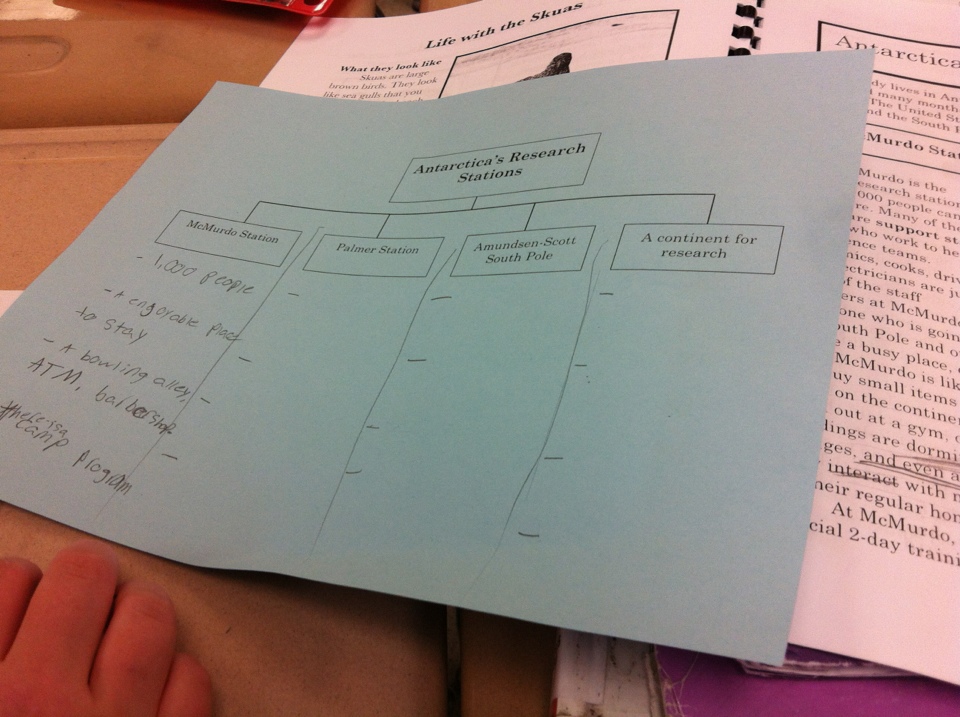
Students had their "Antarctica" booklets on their desks, as well as an assortment of other texts. (I just copy an assortment of articles on the topics into one handy booklet--this allows the students to have core readings at hand throughout the unit. I have the Antarctica texts that I've written in my various text structure packets, plus a few from Beyond Penguins and Polar Bears and Toolkit Texts.) And then we looked at the text features!

With each feature, I asked students, "What do you notice?" Intermediate readers have trouble separating topic from structure. At first, they focused on the words of the titles. With some guiding questions, they started to make some bigger generalizations:
-Titles are usually at the top of a page
-Titles have fancy writing
-Titles are usually big

From titles we moved on to looking at headings. Kids made the generalizations much more quickly with these:
-Headings are in bold print
-Sometimes they are in boxes
-They are usually short
-They show us topics (Some students couldn't produce the word "topic", but instead called it "what we're going to read about next". Good to know!)

My timer went off as we were concluding our discussion of headings, and I tried to wrap things up so that we could move on to class. But one student had her hand up. She urgently wanted to share! But was it related to headings? With some students, you can never be sure. It was with some hesitation that I asked, "Do you have something else to tell us about headings?"

"I wanted to say that titles are only in one place in the text, but you see headings throughout the text," she said.

Wow! Leave it to students to always surprise me with their thinking. What a neat observation, and a pretty nifty use of throughout.

Our next order of business was to introduce the reading homework for the week, which was an advertisement for an Antarctic cruise. I introduced the homework with this real advertisement:


I asked students, "What kind of text is this? What is it trying to get you to do?" We discussed the persuasive nature of the video and how the authors put together the message.

 I ended by showing students the website for the cruise company. "What text features do we see on this website? How are they different from the features that you saw in your Antarctica booklets?" I was curious to see how students would transfer what we had just talked about in traditional texts to a digital text.

I noticed that there was a lot of variation in what students called the various digital features--menus, places to click on, arrows down. However, they did manage to figure out how one would find the price of an Antarctic cruise. (And the price is just as breathtaking as the scenery...)  Students ended by partner reading the homework text, getting new vocabulary words for the week, and reading words with the teachers.

So tomorrow--have to squeeze in one more teaching day before the big storm!--we'll finish looking at the text features of bold print, italic print, photos, captions, and illustrations. Learning how these text features function in a text, however, will be the work of the next month.

(Assuming we have school.)


Thursday, October 24, 2013

Understanding Text Structure

Back in 2008, as I was doing presentations about summarizing, I was surprised that teachers wanted more about text structures--more examples, more resources, more teaching tools.

I created a PowerPoint to share some short paragraphs. This PowerPoint has been around for what seems like an eternity online, with 85,000 downloads on TpT and just about as many views on Slideshare. (I did take it down from Slideshare over the summer when I found it reposted all over the place, so it's starting fresh with the views.)

When I looked through it again a few months ago I thought...well, it was definitely due for an update. So I have refreshed it with new photos and some new paragraphs while still keeping many of the examples and review slides. Here it is:


You'll notice that I finally gave in with the text structure of "Description". Originally, I had called this "Statement and Support" or "Main Idea". However, the term description has come into more frequent use, and I decided to go with it. (I guess I really gave in to this two summers ago when I created the sets of Description texts.)

I put this back on Slideshare because I think it would be a great resource for a flipped classroom, or to embed on a classroom website. Do let me know if you are planning to use it in an interesting or exciting way!

News
-November homework will be coming soon!
-I used the story "Pumpkin Seeds" from the October Reading Homework this week. We had a great time acting out the story and finding the theme.
-I've updated the author links on my classroom blog ...kids said they had the best reading class ever when they visited the Jack Stalwart site, the Babymouse site, and the Skeleton Creek site! You'll find the author links over on the right side, under the popular posts.

Tuesday, March 5, 2013

Nonfiction Read-Aloud

Last week, I finished reading aloud There's A Boy in the Girls' Bathroom with my end-of-day class. It was a wonderful moment--we had been working through the book since Thanksgiving, squeezing in five minutes of reading here and there. Despite the fact that we didn't have long blocks of reading time, kids were still able to really identify with Bradley and his emotional journey through the book.

They couldn't wait to see what we were going to share next, and had plenty of suggestions. But my choice surprised them. Instead of diving into another novel, I pulled out Saving the Ghost of the Mountain: An Expedition Among Snow Leopards in Mongolia.

They were not happy.

"I don't like nonfiction," one boy grumbled. "This doesn't look good at all," sighed a girl.

But I have a real purpose for sharing this book.  The Quest for the Tree Kangaroo, also by Sy Montgomery, is an exemplar Common Core text for grades 4/5. When I saw that Sy Montgomery also had a book about the snow leopard--a big favorite at my house--I managed to get 10 copies of the book for my classroom.

I wasn't sure of what exactly to do with the book, however. What would be the best way to use it? How would kids react to it? Instead of jumping in blindly, I decided to start slowly. A read-aloud is the perfect way to get us all thinking about the text. I can really attend to the words and how the text is structured. Kids can share their thinking. And I can begin to figure out how this book will fit into my classroom instruction.

It's so important for kids to start reading long-format nonfiction like this! Left to their own devices, intermediate readers gravitate toward short nonfiction books like world record books, joke books, or animal books. These are all fun to read and not without merit. However, kids need the nudge to get into nonfiction that unfolds over multiple pages--that uses a variety of different text structures to explain ideas.

To help us all feel immersed in text, I project the text with the Elmo (my first year with a document camera--it's wonderful!) and have a student hand out the remaining copies for students to share.

We're already discovering a lot. In the first three pages, we noticed several examples of similes and metaphors. (This was neat, as we have just finished our poetry unit!) Montgomery compares the snow leopards to ghosts, and we talked about why she made this comparison and how she supports it. Now in Chapter 3, we are looking at how she juggles chronological order. Within the broad chronological  structure of telling about the expedition's journey to the Gobi, she employs a kind of micro-chronology of what a meal at Nadia's grandmother's house is like. This is real text complexity.

As we continue with text structure, I look forward to finding examples of the different structures within this book. Sharing it together is a good first step!

Notes
I have some Pinterest boards! Here they are:

Text Structure Books

Books for Teaching Figurative Language


Saturday, December 8, 2012

Finding Topics and Main Ideas

Kids have to be able to find topics and main ideas to understand nonfiction text. I look at these lessons as the foundation for all of our nonfiction work in the months to come. This week, I worked on topics and main ideas with several different groups of readers. Here are some thoughts on my experiences.

Do not: Assume that students already know how to find topics and main ideas in text
I've been teaching about this for more than a decade. Many kids are masters of skimming by when it comes to topic and main idea. They've learned to read the teacher, looking for the clues that you are subconsciously giving, instead of reading the text. I often resort to pretending that the text has a different topic to avoid giving these clues. Then the students have to convince me what the topic is!

Do: Look for repeated references in a text
To the adult reader, the topic of the text above just jumps right out: Weddell seals! But younger readers who are still reading word-for-word often do not take in the "whole view" of the text. For these readers, it's important to show them how to underline the repeated words in the text. We found every example of Weddell seal in the text above. As we did this, students saw quickly what the topic was.

Do: Look for multiple referents
Some texts, though, are tricky. Consider the text to the right. The topic, Southern elephant seals, is only mentioned once. The seals are referred to with the pronoun they and the referent these seals. Teaching topics with struggling readers is the perfect time to address multiple referents.

What did one of the readers suggest as the topic of this paragraph? Think about the way that struggling readers scan for words that they know. Yup--she said this paragraph was about elephants. On the one hand, this is a discouraging answer. On the other hand, it shows that she is trying to scan for a topic. She just needs more practice with going back to the text to refine her hypothesis.

Do: Have students work in pairs
Pairing students up to talk about their thinking is a great way to find out misconceptions. It's also a great way to find out new thinking tricks! My on- and above-grade level readers worked to sort cut-apart paragraphs. They had to read each sentence, and then determine the topic and the main idea. Listening in on the conversations was a fantastic way for me to hear what readers were thinking. For example, one pair was discarding the actual main idea sentences because they didn't sound "interesting" enough. (Main ideas often do sound boring, don't they? It's the details that are interesting.) This was a whole new way of looking at the task. I acknowledged their thinking, and then explained that main ideas often do sound boring. This helped them as they worked on their next paragraph.

In another group, I overheard a brilliant reader talking offhandedly as she sorted cards: "Detail, detail, detail, detail." When I asked her what she was doing, she said, "Well, first I just find the sentences that sound detail-y, the ones that have numbers and stuff. Those aren't going to be the main idea, so I set them aside." Again, this provided me with some insight about how students go about the task, and some good student language to use when helping struggling readers.

Do: Take it right back to text
I like to think of nonfiction instruction as following a whole-part-whole model. We look at a text and read it for an initial understanding. Then we look at a part--in this case, topics and main ideas. The next step is to take the idea back to the text.

For my struggling readers, I went right back to the familiar "Welcome to Antarctica" text that we had already read. We looked at the paragraphs and applied the same strategies to finding the topics and main ideas. Doing this with familiar text was helpful for them, as they could focus on the task instead of gaining an initial understanding.

For the other group of readers, we went right on to a new text, with the students applying the idea of topic and main idea to their work on a note-taking sheet. These readers thrive on novelty, so the challenge of a new text and a new concept really engaged them.

This is the first year that I have managed to pull together completely "united" activities, in that everything goes back to the Antarctica topic study we are doing this month. And I love it. The card match activity, the topics and main ideas paragraphs, and our core texts all reinforce one another, leading to great questions and use of vocabulary.

Additional Resources
Finding Topics and Main Ideas: Free Powerpoint from TeachersPayTeachers. (Note: My husband uses this, and always complains about the template that I used...one of these days I'll fix it up! The texts are good, and the sequence of instruction.)

Main Ideas and Details in Nonfiction Text: The Antarctica paragraphs are in here, along with many other items about supporting main ideas. A non-Antarctica version of the sorting sentences is included. (I'll get around to posting all of the Antarctica stuff eventually.)

Summarizing, Paraphrasing, and Retelling: I learned a great deal about main ideas and topics as I researched this book. You'll find more on implicit main ideas, as well as research on how readers process main ideas.

Monday, November 26, 2012

Planning for a Nonfiction Topic Study

As I've watched my sons develop into readers, I noticed how they both started to delve deeply into a preferred topic in second grade. My older son read about airplanes and the physics of flight, while my younger son has read everything about cats. Watching these two readers has helped me to think about how topic knowledge is inextricably linked to reading skills. Their background knowledge about a topic helped them to attack and read increasingly more difficult texts.

It seems logical, then, that we should try to replicate this in our classrooms. But topic studies have gone in and out of style. When I started teaching (in the 90s! imagine!), thematic units were popular. But they weren't really structured. The idea--at least as it was communicated to my inexperienced teacher brain--was to gather as many resources as you could on a topic or theme, and then have students create some big project related to the theme.

As time passed and guided reading became popular, themes fell out of favor. Leveling was everything. I was told that trying to gather resources on a topic was useless. We'd never be able to afford to get every book at the levels we'd need, and it was far more important for kids to be reading texts at their levels than it was for them to study a topic. I got around this by starting to write my own texts, apologetically at first. But the more that I watched my own children become readers, the more I realized that seeing the same topics over and over was really important.

Now, topic studies are in style again. Yay! What I like about topic and theme studies as discussed in the Common Core is that they are to be structured with increasingly complex text. This mirrors what I see with Zachary and Aidan...the facts they learn from the easy text become necessary background knowledge to help them comprehend more complex text.

As I plan for this year's version of the Antarctica nonfiction unit, I've tried to be more conscious of how students are building their knowledge. I'm hoping to marry certain concepts about Antarctica with concepts about nonfiction. Here is the plan.

1. Choose your nonfiction skills to teach.
This year, I'm starting with paraphrasing. Then I'll move on to topics and main ideas, text features, and finally synthesizing. In the past, I did text features first. But this year I decided to change it because I want students to see how text features help to convey topics and main ideas.

2. Choose core texts.
I'm a weekly planner, so I choose texts for each week. At the beginning, I'm using some texts that I've written. This will help to build up the background knowledge that kids will need to get to the ideas in the more complex texts. But I'll also be using Trapped By the Ice, texts from Beyond Polar Bears and Penguins, and the LTER blog. As you choose texts, it's important to consider how ideas appear again and again. What are the most important concepts you want to wring from the topic? How are these concepts represented in texts?

3. Create a unit anticipation guide.
I love anticipation guides for a unit. Many details about Antarctica are counterintuitive--for example, the fact that polar bears don't eat penguins, and that summer and winter in the Southern Hemisphere are the opposite of here. The anticipation guide is a concrete way for learners to recognize what they have learned from reading and how their ideas have shifted. Presenting learners with opportunities to "rewire" their background knowledge is vital for learning. (For more information on this, see the research by Graham Nuthall...his articles have been so influential to me!)

4. Gather guided reading and auxiliary texts.
This process may take a few years. I pick up books wherever I can. It becomes a sort of "stone soup" situation--everyone working on the unit has a few things to contribute. Surprisingly, even texts that seem only tangentially related often offer kids some little gems of knowledge that they can weave into their schema.

5. Create a list of unit vocabulary.
This year I've started to be much more intentional with my vocabulary teaching. What words do kids need? Which words show up again and again? I do a weekly homework packet in my classroom, and I've included five vocabulary words (along with a related text) in each packet.

It all sounds like a great deal of work, and it is. But it is so worthwhile to hear kids sharing ideas and reflecting on what they've learned across texts. Whether topic studies are in style or not, they are a wonderful way to help students learn.

I'm hoping to put together what I've done with the Antarctica unit into a file. Until then, write to me if you would like any samples. (Please include your email address if you leave a comment! Otherwise, it's tough to figure out how to respond.)

Wednesday, February 16, 2011

Scaffolding Summarizing, Teaching Text Structure

For the last few years, my text structure instruction has looked fairly similar:

1. Give an overview of what structure means
2. Help kids to understand the thinking behind the text structures
3. Work with students to use graphic organizers to depict information from different text structures
4. Help students to use text structure to ask questions and generate predictions

This year, though, I've been adding a step. While we work in each text structure, we've also been looking at how to summarize that text structure. For example, when we looked at chronological order text, we talked about how a summary of needs to reflect the chronological order structure. For cause and effect, we looked at how successful summaries include both the causes and effects.

But I can't think of anything worse than having students write a summary of every text, every day! To make the endeavor more interesting, I've been using a variety of scaffolds.

Choosing the best summary: This is a simple activity, but so effective! After we read a text, students have to choose the best summary, usually out of a choice of 4. The less successful summaries generally reflect errors that I see in my students' writing--summaries with the "copy and delete" method, summaries that include personal opinions, and summaries that just mention the topics instead of the actual information.

When students choose the best summary, they gain experience with the academic register of summarizing. I can also see what implicit rules they are using for summarizing and can correct any misconceptions. Luckily, kids find this a pretty interesting and engaging activity. Today they worked in groups of 3 to choose the best summary, cut it out, mount it to a piece of construction paper, and explain why it was the best summary.


Summary Frames: A summary frame is a skeleton summary. You provide the students with the introduction sentence and the framework. Students fill in the details from the text. These are especially helpful for students who might be able to pick out the important ideas from the text, but struggle with writing. To help these students to synthesize the text details with the framework, have them read the summary aloud to a partner or rewrite it.

Group Summaries: Try asking 2-3 students to work together to compose a summary and write it on a piece of large construction paper. As they get started, position yourself nearby. The conversation is fascinating! "How do we start?" one kid will ask, and then they'll take turns sharing the rules that they've generalized for how to start and then how to proceed. Sometimes, yes, they will squabble, but the disagreements are often productive in that one child will convince another to abandon an unworkable strategy.

What to do with groups that seem stuck? I'll usually go over with a marker and help them with a sentence. Often this is enough to pull them ahead and solve their problem.

What's been helpful is that students have had the chance to see how the different text structures are reflected in summaries. And we've had fun with different texts along the way!

Saturday, January 22, 2011

Creating a Nonfiction Summarizing Assessment

As a group of fourth, fifth, and sixth grade teachers planned for interventions for next year, we decided to try some work with nonfiction summarizing. One of our first tasks is going to be to create some assessments.

This isn't as daunting a task as it might seem. In fact, making your own summarizing assessments is much easier (and cheaper) than buying an expensive set from a publisher. And, while a summary is a useful indicator of reading comprehension overall, the very act of summarizing encourages students to think about important ideas and may actually improve comprehension. An assessment that instructs--just what every teacher needs!

Here's how you and a team of teachers can create your own assessments:

1. Find a suitable text. I consider length, readability, and topic. The best texts are about a page long for younger students, maybe 2-3 pages for older students. You can run it through this tool from Intervention Central to find the readability. As far as topics go, I like to find something that I know will have moderate familiarity--maybe something that is related to a topic that we have studied in science or social studies. If a text is too familiar, some students might be tempted to skip the reading and summarize based on their background knowledge.

2. Find the important ideas. For this part, you need a team of 3-5 people. Each person should read the text silently and write down the most important ideas. Then, compare your lists. By working together, you should come up with a list of about 7-10 ideas for a one-page text. It's so helpful to have multiple people working on this, as you will find that each person has slightly different ways of putting the information. It can provide you with some insight about how hard it is for kids to summarize! If you can't come to an agreement on important ideas, discard the text and try a different one.

3. Give the assessment.  I usually just hand out notebook paper for students to use for their summaries. When I make pages with lines, I'm giving students an indication of how long I expect the summary to be. I want to see what they think.

4. Create your scoring guide. The most basic scoring guide can just be a listing of the important ideas from the article. As you read a student summary, check off the important ideas that are included in the summary. Gather the team of teachers back together to read summaries and set performance levels. What do you want to call a proficient summary? An exceptional one? Be prepared for some interesting discussions as you look at the summaries.

You may also want to consider how to score the summaries that go way overboard and include too many details.  An extra box at the bottom of your scoring guide is an easy way to do this.

Over time, you may want to look at other finer points of summaries--putting the ideas in the order of the text,  reflecting the text structure, or using key words from the text. Be cautious, though. Sometimes adding too many parts to your scoring makes the process too overwhelming. (I know this from exhausted experience!)

5. Use the results. What do your students need? Based on your results, you might make groups of students who need help with locating the important ideas from the text. You might also have students who write too many details, or students who include only topics from the text.

Creating your own assessments is a great way to find out about where your students are. Give it a try!

Thursday, January 20, 2011

Science Reading and Learning

While I'm working on teaching nonfiction in my reading class right now, I'm still muddling along in science. This is our first year of working through the curriculum, and it's hard. Teaching the concepts requires a deep and well-developed knowledge--I often find myself reading and researching in the evenings and weekends!

Our textbook is glossy and beautiful. However, it is not always the best resource for my students. Often it defines words using other difficult words. Most pages breeze quickly through important content.

I've been working, then, to find other good resources. Reading A-Z.com has a few projectable books that fit in with our curriculum, and we have some choices in our bookroom. When I can't find what I'm looking for, I create things for my classes. This "Animal Adaptations" text is an example of a short article that I wrote. At the start of a unit on animal adaptations, it's vital that students know how to pronounce the word "adaptations"! I wanted students to read a text that uses the word repeatedly, over and over. This would give them the schema they would need to find success in the rest of the unit.

Sometimes, I do create a Powerpoint to illustrate the content. I don't like to do this for every concept, because I want students to have to cope with content area text. But some topics just lend themselves to teaching with bright, intriguing photos! The Behavioral Adaptations presentation below is an example. As we go, I encourage students to use the vocabulary as often as possible. Luckily, the room in which I teach science has tables, so students can talk with others and share their ideas. This makes the presentation less of a lecture and more of an interactive discussion.


Working on new topics is never easy. But at least it's interesting!

Thursday, January 13, 2011

More with Text Features

Here is a very simple Powerpoint that I used for teaching about text features.


As you can see, it's simple, but I found it pretty effective. Having students look at text features across multiple texts helps students to see all of the different ways that text features can be used.

Friday, December 10, 2010

Teaching Nonfiction: Antarctica

As the cold winds begin to howl, I like to bring an assortment of texts about Antarctica into the classroom. Antarctica is a great fit for fourth grade for several reasons:

Shared knowledge building-My students don't have much prior knowledge about Antarctica. As we learn about it, then, we can experience the feeling of adding to our schemas together. It's fascinating to see how kids pick up on new words and share their experiences. For example, the word "skuas" came up in two different texts. A skua is a kind of bird that lives in Antarctica, but most students had never heard of it before. When one student found a picture of a skua in a book, the others were eager to see it--I overhead one say, "Oh! A skua is a bird!"

As we read multiple texts, then, we all can experience adding to what we know. Students filled out an anticipation guide at the beginning of the unit. Then, after each text, we go back to see if our thinking has changed. Sometimes, what we find is surprising, like the fact that visitors to Antarctica need to wear sunglasses and sunscreen!

Interesting texts-In the Toolkit Texts from Heinemann, there is a nice nonfiction first-person piece about doing research at Palmer Station, as well as a map of Antarctica. (By the way, the map is available as a free sample on the website.) These texts started my unit. Since then, I've found additional books. Jennifer Owings Dewey's Four Months at the Bottom of the World is a nice example of personal journal text, while the Magic Treehouse Penguins and Antarctica book gives kids a thorough introduction to the continent.

Online resources-This blog is documenting the LTER Cruise that is about to begin for the new season. LTER means Long-Term Ecological Research, and these scientists return to the same places each year to see how things have changed. At this link, you can find other resources. And there are plenty of videos as well. When I have written to researchers with questions, they have responded...how neat!

Penguins and other cool animals- My students are fascinated by penguins each year. They like to pore over the encyclopedia of penguins that I check out of the local library, look at the names of the different types, and find out where they live. Not all penguins live in Antarctica, which is surprising for many of the students.

Antarctica is also home to some interesting invertebrates, like sea spiders and carnivorous sponges. (My students this year are especially intrigued by the carnivorous sponges. One said, "That's like my worst nightmare come true! A meat-eating sponge!")

My interest-When I started working with this topic, I knew very little about it. This helps to keep me interested! I admit to following the research season to try to learn more each year. I've learned all about the IceCube project at the South Pole and figured out how to tell the different kinds of penguins apart. This year, I want to try more of the resources from PolarTREC.

No matter what the topic, reading a series of interconnected texts helps students to make sense of nonfiction. Next week, kids are eager to read more about Antarctica--and I'm eager to help them!

Wednesday, November 17, 2010

Writing a Summary of Nonfiction: Powerpoint

Helping kids to summarize nonfiction is hard. Not only do kids have to read and understand the text, but they also have to figure out what's important, how to put ideas in their own words, and how to organize the summary. No wonder kids have so much trouble!

This Powerpoint can give you a place to start. (Some people watch late-night television when they're up in the middle of the night with a cold; I write Powerpoints!) It's short enough to do in just one class period, and can be either an introduction or a review. This slideshow presents four rules for summarizing, explains them, and models how to put them into practice with a short text.

And there are lots of pictures of butterflies, too.

Wednesday, November 10, 2010

Questioning with Nonfiction

Today, at the start of my whole group lesson, I held up the read aloud we've been working through over the past few weeks--The Magic Thief by Sarah Prineas. "Why do you want me to read this today?" I asked students. "Share your ideas with your partner."

Well, the general consensus was that they wanted to know what happened. And this is what makes stories so compelling for readers--in the effort to find out what happens, they want to read on.

When readers hit longer format nonfiction, however, they sometimes feel bored or disengaged. I'm not talking about the nonfiction with lots of big pictures and cool features. I'm talking about the longer articles and sustained text that transitional readers have to learn how to read. Many students aren't quite sure of how to negotiate the switch from reading to find out what happens to reading to learn something new.

"This is where our questions help us," I told students. Then, I shared a chapter from a book called The Pledge of Allegiance. It's one that I picked up at a used book sale, one of those nonfiction books that stays in pristine condition because no one ever reads it. "Even if you think that you're not interested in the topic, you can ask yourself questions about what you think you might learn. Then, you're reading to try to find answers to your questions."

I modeled with a chapter, showing how we can leapfrog from question to question, keeping ourselves interested even as the text got longer and more complex. Tomorrow, as students work on reading an article with a partner, we'll look at their questions and see if this strategy helped them to stay connected with the text. Going from reading to find out what happens to reading to learn new ideas can be a stretch...but it is a vital step for fourth grade readers.

Saturday, February 6, 2010

Finding main ideas


It's important for students to understand how to find main ideas. With my fourth graders, I am always fighting against their impulsive habits. If I give them paragraphs for practice, they often just circle the very first sentence.

How to change the activity? I've found some success with cutting apart paragraphs. Students have to read each sentence, figure out the topic, find the main idea sentence, and then try to put the paragraph in order. Sorting the cards and putting them in order keeps them more engaged than just reading sentences. As I watch them work with their partners and listen to their conversation, I can figure out what "rules" they're using and clear up any misconceptions. Students who can easily find the main ideas then concentrate more on putting the rest of the sentences in order, which requires them to think carefully about cohesion and how the ideas fit together.

These cut apart sentences are simple to make. For my first set, I just wrote the sentences on a sheet of paper. When I saw how well it worked, I typed the sentences into a Word table and copied them on cardstock. However you do it, this works well as a small group activity, partner activity, or center.

I've uploaded a document with some sentences to Slideshare. Here's the link:

Sentences for finding main ideas

Wednesday, January 13, 2010

Fun with Features


We're talking about text features! Today we started out by examining the word feature. I've noticed that students already know the term "text feature", but they tend to say it really fast, as all one word--textfeature.

But the word "feature" is a high utility word, one they will be able to use across disciplines and situations. I used a simplified definition for students, telling them that a feature is "a part that gets your attention." They did have experiences with the word, and we talked about a DVD's special features, their facial features, and a car's features.

Next came the fun part. I have two sons, so I have acquired a large quantity of Playmobil toys. I brought in five different boats. "These boats all have different features," I told students. Then, they got into small groups to examine the boats and label the features with notecards. The purpose here was twofold. I wanted students to practice looking closely at an object and analyzing the parts. I also wanted to look at how the different boats had different features. The fireboat, for example, has a hose, while the airboat has a fan.

It was so successful! Students were highly engaged in looking at the features, and they shared their knowledge. "I know a lot about boats, and this is a galley," one student told the others. Many of the students were familiar with a winch, but struggled with what to call the steering mechanism. Wheel? Joystick? Steering wheel? I just loved the conversation, because it really flowed from our work with paraphrasing. Students were working to name a concept and tossing out various words, judging them, and reshaping them.

Of course, I can't just teach about the features of boats. We had to apply this to text. "Just like the feature on a boat is something that gets your attention, something that makes it interesting, a text feature is something that gets your attention in text."

I had prepared envelopes with text features written on small cards. In new groups, students looked at high interest magazines and tried to match the cards to text features in the texts. "I don't know much about text features," one boy sighed. "I don't read those kinds of books." He stared down at the page of Kids Discover. "Are there any text features there?"

"Well, think about what you did with the boats," I coached. "You looked to see what got your attention. What gets your attention there?"

He looked down at the page. "An eel."

"Is an eel a text feature?" I asked, trying to get him to move beyond the image on the page to the name for the image.

"Well, I guess it's a picture," he said grudgingly, going to his envelope. "So that's a text feature?"

We had a great time with the text features, and students were more eager to learn about them than ever before. Starting out with the real, concrete features of the boats made everyone relaxed and interested. If you don't happen to have a fleet of plastic boats at home, this works just as well with other objects. A collection of coats would work, or holiday decorations, or really anything with lots of neat little parts.

Saturday, December 19, 2009

Learn About Light

Last year, our state science tests fell before our science teacher was able to teach her Light unit. She was worried that students would not know the words transparent, translucent, and opaque. I saw the opportunity to use this concept in reading class as a way to reinforce summarizing and teach students how to learn from nonfiction text.

Because I couldn't find any texts that suited my purposes, I wrote a short article to explain the concept. After we read it, students sorted ideas from the text as important or less important, and then used that sort to write a summary. It worked well! I decided to post it to help out those who are constantly scrounging for easy science text.

Saturday, October 24, 2009

Schoolhouses Book

One of my favorite books is The Teacher's Funeral by Richard Peck. However, after introducing it to several students, who promptly put it right back on the shelf, I realized that many students lack the background knowledge they need to make it through this book.

To develop their background knowledge about schoolhouses, I wrote this book, Schoolhouses of Long Ago. (I did the illustrations too--it was a fun Sunday project. My boys were doing watercolors, I was sketching pictures, and we were all working together.) It's formatted to copy double-sided. I wanted the headings and captions to be functional, so that I could use this to teach conventions of nonfiction.

Tuesday, August 11, 2009

Congratulations!

Five lucky readers were selected to receive a free set of Steve Jenkins books and a stuffed animals from Kohl's. The teachers are Nicole, Colleen, Sarah, Jesus, and Jean. Congratulations! The materials will be sent to your schools.

For everyone else, don't forget that the Steve Jenkins books are still available at Kohl's. These books are great for the primary and intermediate classrooms, as they feature interesting text structures, high-interest text, and wonderful pictures. Check out the Comments from the original post to get more ideas for teaching them.