Showing posts with label compare and contrast. Show all posts

Tuesday, November 3, 2015

Compare and Contrast Writing

 
 Teaching students how to effectively write to compare and contrast is so important for teachers of all grade levels. Comparing is important for test-taking, but it's important for life, too. Readers of wildlife blogs want to know how cottonmouths are different from copperheads, foodies want to know the difference between cassia cinnamon and ceylon cinnamon, and teachers want to know how different basal series stack up against each other.

    Kids can get better at writing to compare and contrast very quickly, making it a great writing project for November and December. Here are some suggestions for getting started.


1. Start by comparing real objects
    Even older kids need concrete experiences! By starting with real objects, kids of all ability levels can learn how to systematically compare. Because last week was Halloween week, we used Hershey Hugs and Hershey Kisses, but you could compare anything that kids find interesting.
    As kids compare, focus on using language such as similarities and differences to move kids away from terms like sames and differents.

2. When you move to text, discuss: What to compare?

    Begin this conversation by talking about how students compared the real objects based on their physical characteristics. What could we compare in text? Be aware that what kids say (and don't say) in this discussion will reveal the gaping holes in your reading instruction. And that's okay, because you want to know about those gaps, right?
    Hopefully, students respond with these kinds of ideas: form (poem, narrative, article, etc), author's purpose, topic, central idea/theme, point of view, tone, word choice, and so forth. Students probably won't know the exact words for all of these, but will remember talking about them at some point in time.
    The big goal here is to make the shift from the physical world to the abstract world of talking about texts. If you don't hear at least a few of these abstract concepts, you may want to hold off on comparing texts and deal with this issue.

3. Use a graphic organizer
   I've used them all: Venn diagrams, double bubble maps, charts. The actual organizer is not as important as the thinking that kids put into it and the modeling that you show. Right now, we are using Thinking Maps again at my school (yay!), so I am working with those.
   You will notice that my students have used lots of color in making graphic organizer. My students are very visual thinkers this year and LOVE using different kinds of markers as they work.

4. Show clustered and alternated styles of writing, but emphasize alternating

   There are two distinct methods of compare and contrast: clustered, in which details about each item are clustered together, and alternating, in which the details alternate back and forth. I like to show students each version, but focus more on the alternating style. This is more difficult to write, but easier for the reader to understand. (You can find detailed examples in my Sea Turtles Expository Text Mini-Unit)
    I wrote about two of my favorite restaurants for my example. I recommend that you write your own little paragraph example--kids love to find out details about their teachers! In my example, I underlined details about Chipotle yellow and details about Montezuma's blue. Details that refer to both are green. (I wish I'd come up with it, but it was a kid's idea...he liked it so much that he created a similar color scheme for making his own double bubble map.)

5. Work with topic and concluding sentences
     Kids will look at the topic sentences that you model and alter them for their own writing. Variations of the topic sentence that I used in my Chipotle/Montezuma's paragraph has turned up again and again in student writing. Something about this sentence (even though I only showed it on one day of instruction) was compelling and memorable for students. This shows that they are still shaky on writing topic sentences for compare and contrast paragraphs.
    I'm not surprised that kids are struggling with topic sentences for compare and contrast paragraphs. Many adults struggle with this, too. Are we just writing for the sake of comparing, or is there a point to this comparison? If the writer doesn't know, the reader won't, either!
    In my Montezuma's/Chipotle paragraph, I created the idea of "choosing" between the two as a reason for the comparison. This can be effective and easy for kids to understand.

6. Give kids lists of transitions to use as they write
    Without access to strong transitions, students will revert to a "also/but" pattern. Having a list of transitions available to students challenges them to try phrases like "however" and "on the other hand". Creating this list is a good activity to try with students.

Sunday, May 10, 2015

Sea Turtles and Expository Text: A Peek Inside

I love writing short expository texts, and I love sharing the texts that I create with other teachers. 

But I can't deny that there is always an uneasy tension between my inner writer and my inner teacher as I start a new project. The inner teacher says, "Wouldn't it be cool to have a set of texts with x, y, and z?" The inner writer groans--"You want what? Do you realize how hard that will be to write?"

So there is a sense of compromise between teacher and writer. I have seen enough hideously contrived texts to know that I shouldn't keep going if something isn't working. Teacher and writer must negotiate to come up with a workable compromise. (And all of this is going on in my head!)


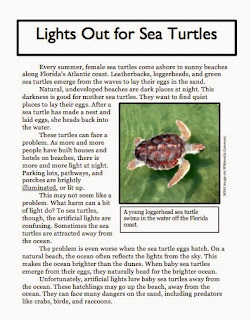
Lights Out: Problem/Solution


This spring, I started to write a series of texts about sea turtles. The project began with a problem and solution text about the importance of turning out lights during nesting season. I find problem and solution to be one of my favorite text structures, probably because it is inherently optimistic. I also love the symmetry of problem and solution. It's fun to write.

I generally prefer to do all of the writing first before I mess around with formatting. Adding the formatting gives me another chance to reread every bit of text. I often read everything aloud to my family as well--my ten year old is a great listener and offers useful criticism. 

After the text has been written, read, and reread, the teacher side takes over and works on questions and activities. Waiting several weeks between text and questions helps me to look at the piece as a teacher instead of as the writer. This year, I've been experimenting with adding synthesis tasks to reading sets. These are very similar to the performance assessments that we used in the late-90s, but with a Common Core twist. Yes, they tap some of the skills that will be needed for high stakes testing, but they are also activities that are real and relevant for students.


Compare and Contrast

After I finished the problem and solution texts, I moved on to the bigger challenge--two compare and contrast texts, each one about two different sea turtles. 

These texts were hard to write. The writer in me balked at writing them, but the teacher stood firm--these are necessary. Compare and contrast is one of the hardest text structures to use. There are two topics, and the writer must work hard to balance them and make clear transitions back and forth. All too often, compare and contrast ends up sounding choppy and awkward. And conclusions? Natural, fresh conclusions to compare and contrast texts are especially difficult.

Of course, this is the lesson that the teacher-me wanted! I saw the need for two texts, both compare and contrast, but using different styles of organization. Compare and contrast texts can be alternating or clustered. Before students look for these structures in the real world, it's helpful for them to see study texts that present each. Texts on similar topics will help them to focus on the structure of the text instead of the content.

The first text, "Loggerheads and Green Sea Turtles" is written in the alternating style. This took a great deal of research and many hours of time. I found conflicting information from various credible sources, and delved deep into Google Books and other sources to find the best information possible. From a writer's point of view, I did create a comparison chart to gather my details. (I hate Venn diagrams for writing.) 

The second, "Leatherbacks and Kemp's Ridley Sea Turtles", was a little easier. I used the clustered style, which deals with each topic in turn. Writing these two texts really helped me to see the strong similarities between description text structure and compare and contrast. After all, clustered compare and contrast could be looked upon as double description. 

The close reading activity that accompanies these texts is the one that my teacher self envisioned at the start of the project--using colored pencils to underline sentences referring to either kind of turtle. As I made the answer key, it clearly showed the difference between alternating compare and contrast and clustered compare and contrast. Victory!

The final activity of the unit challenges students to create their own compare and contrast text, using whichever style they would like. A chart of information is provided to make the task more of a writing task instead of a research task. 

Thank you!

Combining teaching and writing is a challenge. I'm so grateful to everyone who has purchased my texts on TeachersPayTeachers and offered such positive feedback. Thank you! 

You can find the texts and activities here:
Sea Turtles Expository Text


Friday, March 13, 2015

Teaching Compare and Contrast Text

This week I decided to turn text structure on its head and and start with compare and contrast! I made this decision to provide some additional continuity with our texts, and compare and contrast was the perfect bridge between our Antarctica theme set and text structure.


In the past, I've always started text structure with chronological order. This is the easiest text structure for many students to understand, as it is the structure of narratives and everyday living. But of course there is no rule for where to start, and I have to admit that I thought it would be fun to try things differently.

The teaching is much different, too, when compare and contrast is the first structure for careful examination. Here are some things that I've (re)discovered this week.

1. Not all transition words show similarities and differences.
Compare and contrast text is the perfect place to explore this! Teaching guides for text structure include lists of transition words...but these words often serve multiple purposes. Is the word while showing a similarity or a difference? Or is the author using it to connect two ideas? What about the word like? Even struggling readers can find looking for clue words and analyzing their use to be very meaningful and engaging.

2. Move to student-made charts as quickly as possible.

Beautiful graphic organizers just look so nice, don't they? But I've learned to get kids into making their own charts as quickly as possible. For looking at compare and contrast text, I prefer charts to Venn diagrams. This helps students to think more carefully about how information is organized in the text. Generating criteria for comparison gets readers looking more deeply at what aspects of the topics are being compared.

Student-made charts are gloriously messy. Kids think and rethink and change their columns. And that is all part of the process. When students decide, "I don't like the way I represented these ideas--I'm going to change it," major thinking has occurred! 

3. Connect, connect, connect!
Complex texts reflect complex thinking. Showing connections to the wider world helps students to see how ideas are reflected in the text.

After we read "Peregrine Falcons and Red-Tailed Hawks", we watched the peregrine falcon cam live from Harrisburg. This is always a student favorite. (I love it too!) Then we looked for sentences in the text to support what we were seeing. This got students diving once more back into the text, looking for connections between the live video view and the words on the page.

Our next text, "Vernal Pool or Puddle?", is the foundation text for a short text set about vernal pools. Students will read about vernal pools across several different text structures, hopefully helping them to see how content and organization connect.

Looking back
Teaching the text structure of compare and contrast turned out to be a great introduction to text structure. 

Have you tried changing up the order of any topics in your classroom? What have you noticed?

Texts mentioned
"Peregrine Falcons and Red-Tailed Hawks" is included in Introduction to Text Structure
"Vernal Pool or Puddle?" is included in Compare and Contrast Texts for Teaching Text Structure

Thursday, October 24, 2013

Understanding Text Structure

Back in 2008, as I was doing presentations about summarizing, I was surprised that teachers wanted more about text structures--more examples, more resources, more teaching tools.

I created a PowerPoint to share some short paragraphs. This PowerPoint has been around for what seems like an eternity online, with 85,000 downloads on TpT and just about as many views on Slideshare. (I did take it down from Slideshare over the summer when I found it reposted all over the place, so it's starting fresh with the views.)

When I looked through it again a few months ago I thought...well, it was definitely due for an update. So I have refreshed it with new photos and some new paragraphs while still keeping many of the examples and review slides. Here it is:


You'll notice that I finally gave in with the text structure of "Description". Originally, I had called this "Statement and Support" or "Main Idea". However, the term description has come into more frequent use, and I decided to go with it. (I guess I really gave in to this two summers ago when I created the sets of Description texts.)

I put this back on Slideshare because I think it would be a great resource for a flipped classroom, or to embed on a classroom website. Do let me know if you are planning to use it in an interesting or exciting way!

News
-November homework will be coming soon!
-I used the story "Pumpkin Seeds" from the October Reading Homework this week. We had a great time acting out the story and finding the theme.
-I've updated the author links on my classroom blog ...kids said they had the best reading class ever when they visited the Jack Stalwart site, the Babymouse site, and the Skeleton Creek site! You'll find the author links over on the right side, under the popular posts.

Monday, January 2, 2012

Teaching Text Structure: Spider Magazine

I'm always looking around for good examples of text structure to share with my students. (And, of course, when I can't find what I want, I write my own.)

As I was browsing at a new bookstore this week, I picked up the latest issue of Spider Magazine. (My youngest son, who used to subscribe, requested Ranger Rick for Christmas this year instead--oh, well!) I went ahead and bought the issue because it includes a short article about polar bears, "The Dark Past of the Polar Bear." I was excited to find several great features in the article:

Action lead: The first four paragraphs of the article introduce the reader to the polar bear by showing the polar bear in action, catching a beluga whale.

The sun rises above the Arctic Ocean, spreading a fiery glow over the pale ice. Across the frozen sea, a white bear lumbers.

Compare and contrast: Four paragraphs in the article compare the polar bear to the brown bear. Words like difference, better suited, and but help to make the differences easy to understand, while also serving as good examples of text structure cue words in real life text.

Cause and effect: Many real-life articles combine text structures. In this article, there are several examples of causes and effects both at the sentence level and the paragraph level. Several sentences in the compare and contrast section show why certain adaptations help the polar bear. At the end of the article, a cause and effect paragraph shows why changes in climate affect the polar bear.

As I'm just about to start teaching about animal adaptations in science and text structure in reading, I'm looking forward to sharing this text with students.

Monday, December 19, 2011

Text Structures: Compare/Contrast and Cause/Effect

This week, I've found two online texts to complement what I'm teaching in the classroom.

Compare and contrast: We are currently reading about Antarctica as we explore nonfiction texts. I have the MV FRAM Expedition Blog in my Google Reader, and I share it with students. It is well-written and interesting, and the kids are enjoying tracking the progress of each trip to Antarctica.

This post is a nice compare and contrast piece. The picture tells the story, and the text uses parallel structure and longer sentences to explain how the two days were so different. I like having quick little texts to show students as we transition from guided reading to core instruction, or to share during bus time and all of those extra minutes through the day.

Cause and Effect: We've been studying ecosystems in science. Last week, we studied how ecosystems change by reading A Place for Butterflies by Melissa Stewart. Then, we played the Project WILD game "Oh Deer!" to look at how a population can change.

Apparently, 2011 was a bad year for acorns. A lack of acorns will lead to changes in the populations of mice, squirrels, and deer, but may have other effects up the food chain.  I happened to come across this article a few weeks ago, and it turned out to be perfect for a discussion of cause and effect. It's a little difficult for my students, so I projected the printable view and summarized it. We made a chart to show the causes and effects

This is a nice counterpoint to the zoo mystery article from a few months ago. In that article, we had known effects, but questionable causes; in this one, we have a known cause, but anticipated effects.

I made a little debriefing sheet to talk about it with my students. Here it is on Slideshare.


Saturday, October 29, 2011

Compare and Contrast Text Structure: Cats vs. Dogs

This neat little book came free with my last Scholastic book order. Now that I have read it approximately 14,000 times to my first grade son, I have come to appreciate how it could be used to teach the text structure of compare and contrast.

As I've written before, it's tough to find entire compare and contrast texts in the real world. Usually authors will use this structure in a paragraph or two to highlight similarities and differences. But it's difficult to sustain over a long text.

This book, however, uses compare and contrast in a contest format. It works pretty well. Questions set up sections of text, such as "Who's got an ear for everything?" Then, the questions are answered in several paragraphs, which usually show the clustered style of compare and contrast. Compare and contrast cue words such as but, too, both, and also are used on just about every page. I didn't find any use of however, which was probably left out in an attempt to keep the reading level down. And it is a fairly easy read--not easy enough for my first grader to read alone, but definitely comfortable for the reader in grades 2-3. For teaching text structure, I like to introduce the structures with easier texts, so this would be just right for my struggling fourth grade readers.

Each section is boiled down to a winner for that section. The book's conclusion deals cleverly with the overall winner--it's a tie! (Not to my son, however--he decided that it's clear that the cat is the winner.)

All in all, this is a very economical book to obtain to teach compare and contrast text structure. I'm looking forward to trying it out this year!

More on compare and contrast text structure
Text Structure Picture Books: Owen and Mzee (blog post)

Text Structure: Compare and Contrast (blog post)

Compare and Contrast (blog post)

Compare and Contrast Texts ($3.00, 7 short articles with activities)

Thursday, June 9, 2011

Text Structure Picture Books: Owen and Mzee

Now that the school year is over, I'm reading to a very demanding young critic--my youngest son, who will be entering first grade. He is currently in an animal loving phase, which means that I'm combing the library shelves for anything that has to do with big cats, snakes, or African wildlife. His desire for information outpaces his independent reading ability...which means that I've been reading aloud a lot of expository text.

As I read many texts that deal with the same topics, it's interesting to see how different authors faced the challenge of writing for younger readers--how they organize information, how they explain ideas, how they keep sentences short.

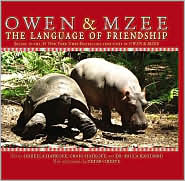
One of my recent favorites is Owen and Mzee: The Language of Friendship. This is on my list for a read aloud or shared reading with the document camera. You've probably heard the story--a young hippo named Owen becomes friends with a formerly grumpy tortoise named Mzee. (You can find out more at the website.)

What makes the book such a great read is the way that the authors harness and use text structures throughout the book. At the beginning, Owen's arrival at Haller Park is explained through cause and effect. A chronological order structure continues as Owen's friendship with Mzee is explained.

My favorite part is at the end. As I've written before, compare and contrast text structure is sometimes difficult to find in the wilds of real text. But there is a wonderful page that explains why Owen is not acting like a regular hippo. The authors compare and contrast Owen's behavior with that of typical hippos. Then this whole comparison becomes the problem for a problem/solution part of text. It's an easy introduction to the way that authors use multiple text structures to explain ideas.

As I look at books for the next school year, I want to find books that use academic patterns and structures, but have accessible topics. Kids who don't have their own personal readers at home are often unfamiliar with the way that expository text sounds. By finding lots of read alouds, I can help students to learn more about this kind of text.

Monday, February 7, 2011

Comparing Texts: Chronological Order

Today we finished our Chronological Order centers. Hooray! Interestingly, the kids liked the historical text (The Great Chicago Fire, from Toolkit Texts), the animal life cycle texts, and the procedural text. The biography--well, not so much. I'm still thinking about why this genre is such a stretch for kids.

Our last step was comparing two chronological order texts. Students worked with a partner to complete a chart with criteria such as topic, text structure, transition words used, and text features. Students could choose which texts they compared, and the classroom was filled with the quiet noise of engaged talk. "Why doesn't this one have any transition words?" one girl asked, pointing to the procedural text. "Good question," I replied. "Why do you think they're missing?" Working with her partner, the girl was able to recognize that a set of directions, organized in steps, doesn't need the same kind of linking words as a text written in paragraphs. Wow!

I had two reasons for moving into this activity. Our fifth grade teachers have commented that students have trouble comparing texts across topics. By looking at two texts with the same structure, I could help them to see one important criteria for comparison.

My other reason for having students compare two chronological order texts was as a kind of pre-assessment. By watching students work in pairs to complete the comparison chart and turn it into a paragraph, I could easily see what they knew about comparing and contrasting. Could they use any transition words? Could they craft a topic sentence? When I teach about compare and contrast text structure next week, we'll have a shared experience on which to build our learning. Hopefully, students will be able to remember the problems that they grappled with as they wrote compare and contrast text, and then examine how authors solve those problems.

Sunday, January 2, 2011

Writing Thank-You Notes

Thank-you notes are one of my least favorite writing genres. I always struggle with expressing my true appreciation in a way that does not sound stiff and over-formal. It's not surprising, then, that I often put off this rhetorical chore.

But thank-you letters are an important genre for students to learn. Even as other forms of writing become less formal, thank-you letters are still required in many situations. I decided that a quick dip into thank-you notes would make a nice transition back to school from the holiday break. 

But, given my own problems with the genre, I decided to do some research before I created the assignment. Why are letters put together as they are? How is the form changing?

I did some searching and found a treasure trove of old letters--the Paston letters, from five hundred years ago. These letters are from various members of a gentry family in England. Margaret Paston, even though she couldn't physically write, still composed many letters to others in her busy household, sharing news, asking questions, taking care of business. Letters from her children had much in common with what children ask of parents today. They are fascinating to read.

 After reading some of these letters, and commentary about them, I knew that I had to share these interesting details with students. I wrote a short article to explain to students how these old letters are similar to the letters of today, and how they are different. My fourth graders wouldn't get very far with the irregular spelling and archaic language of the letters, but I included some snippets of the texts so that they would get a feel for what this kind of writing sounded like.

I didn't stop there. As I was reading the Paston letters, I started thinking about levels of formality in writing. When students write thank-you letters, getting the right tone is essential. Tone is easy for kids to hear in speaking, but harder for them to notice in writing. The correct tone for a thank-you letter to Grandma is going to be different from the tone to use as a thank-you for an interview. To help students start to notice this, I wrote a few example letters using appropriate and inappropriate tones. By the time I was done, I had an entire mini-unit with a writing checklist, compare and contrast article, examples for students to rate, and a rubric.

I posted the entire unit at TeachersPayTeachers:
 http://www.teacherspayteachers.com/Product/Thank-You-Letter-Unit