Showing posts with label character traits. Show all posts

Thursday, January 24, 2019

Understanding Narratives: Story Events

    Supporting all learners in a mixed ability classroom can be a daunting challenge. Over the years,
I've found that having the right materials makes a huge difference! When I'm teaching narratives, my go-to tool is a simple set of events from the story.
    These event cards are so useful! Differentiation is quick, easy, and meaningful, as event cards have so much potential for helping students to zoom in on a story and read closely.

Preparing Event Cards

    Event cards are simple to prepare. Just make a single-column table in Word and type the events from the story in order. Use the same number of lines for each cell to keep your final cards the same size. (I find that a 16-point Georgia with three lines per cell work well.) Remember that it's almost impossible to cut a single line cell!
    Depending on your students, you may want to make your events simple, or more detailed. Be sure to include a sentence to establish the setting and the characters.
    When I'm ready to use my cards, I photocopy them on some cardstock and trim the edges at the paper cutter. The kids can do the rest of the cutting! I store cards in envelopes or clear plastic bags in the hopes that I will find them again the next year. (Narrator's voice: She won't.) I never make enough for everyone in the class, because I want students to have to share! Groups of 2-3 are best to make sure that everyone gets to handle the events.

Sequencing

    At the most basic level, the event cards are great for helping students to sequence the events in a story. This week, students read a drama from our literature anthology. Putting events from the drama in order helped students to piece together the action.
    Here's where these cards are great for differentiation! It's fascinating to listen in on the conversations that students have. As they argue about which event comes before that one, they often can't resist going back to the text to prove their points.
    Groups finish this task at different times, of course, and so I always put an extension question on the board. In this case, it was: "Read through the event cards with your partner. How is this reading experience different from reading the story in the drama format?"
   

Understanding Parts of a Plot

     Event cards are also perfect for talking about how a plot unfolds. This is an important standard for sixth grade, and one that requires lots of productive conversation.
     Using event cards is so much friendlier for students than filling out a plot diagram! A mistake in ordering doesn't mean tedious erasing and rewriting--instead, it's just a simple swap of the cards. Watching my students piece together the events of a story helped me to see how their understanding of plot is developing and how they see the different pieces come together.

Character Changes

     If students are having trouble talking about how characters change over the course of a plot, event cards can be helpful tools! Events provide anchors to help students recall the sequence and understand what happens when. Sometimes students who struggle to respond verbally can hold onto an event card and explain how the character changed in response to what occurs. For students with retrieval and executive functioning issues, having manipulatives for reading can be just the scaffold they need for higher order thinking.

Have you tried story event cards? What have you noticed with your learners?


Saturday, September 12, 2015

Flipping Lessons with Frolyc

In the early weeks of the school year, I admit to loving the computer lab. Not only is it equipped with great Macbooks for student use, but it is also air-conditioned! The cool air is a welcome respite from the heat and humidity of August and September.

Last week, I experimented with flipping a lesson. Instead of me standing up and teaching all students at once, I wanted to give them the flexibility to move through a lesson at their own pace. While they worked in the cool comfort of the computer lab, I could work one-on-one with students to complete our beginning of the year assessments.

Frolyc is the perfect tool for creating a flipped lesson. I can put all of the text, videos, and activities that I want students to use in one easy place. Even though my students don't all have computers at home, they still need to learn how to work through online content and learn from these kinds of lessons.

I started out by creating my classrooms. No need for student e-mail addresses or lengthy forms--I just had to type in student first names. Each student receives an individual code that they use to access their activities.

Next, I created my lesson through the authoring tool on Frolyc. We are working on story elements with a focus on protagonist, antagonist, and parts of a plot. I used a "Multimedia Text" activity to combine an image, a video from YouTube, and text. This is what it looked like on student computers:


I couldn't find a great video for parts of the plot diagram, so I adapted a few slides from a PowerPoint that I have already made (Story Elements) and did a screencast using QuickTime. Then I posted it to YouTube so that I could embed it in the next page of the Frolyc activity. (link to video)

The kids found it very amusing to listen to me! Even better, though, they had full control of stopping and starting the video. "Can we watch it again? I don't really remember all of the words," one student said. "Of course!" I replied. This is one advantage of a video!


After the video, students read a story, and then answered sequencing and multiple choice questions. These questions required students to apply the vocabulary that they had learned in previous pages. Some kids realized that they had to go back and reread, which was a great lesson for them.


 The lesson ended with a drawing activity. Kids enjoyed interacting with the drawing tool, and I loved watching the collaboration bloom--"How do you add a text box?"--and "How do I draw instead of erasing?"


I'm planning to continue creating flipped lessons for students in the weeks to come. These lessons are great for introducing vocabulary and helping students to experience content.

You can find the full activity here if you would like to try it out with your students.

If you would like to try to create your own flipped lesson, here is a story that you can use--for free! This retelling of "Stone Soup", told from multiple points of view, can be used for teaching about theme and point of view.

Sunday, September 28, 2014

Teaching About Character Traits

Right now I am deep into character traits in my classroom. And it is so delightful! I just love talking to students about characters and how we know what they are like. Discussions of character actions and dialogue and the traits they reveal are so enriching for our class.

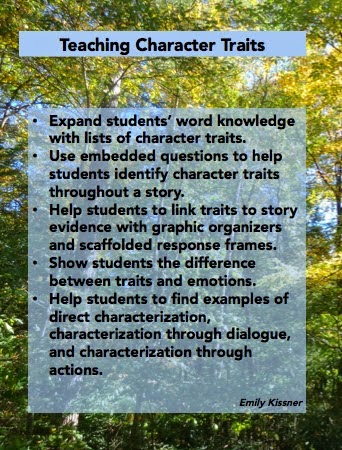
Each year I enter into these discussions in slightly different ways. However, some principles guide my lesson planning each year. Here is an overview of my thinking as I embark on a character traits unit.


Expand students' word knowledge with lists of character traits
Many of the words that we use to describe character traits are not common in everyday conversation. Rich, descriptive words like ruthless, impulsive, considerate, and stingy are new for many students. I like to use word lists that group words by common characteristics so that students can learn words efficiently. (A list of character traits is available in Character Traits and Emotions or here.)

Use embedded questions to help students identify character traits throughout a story
I love embedded questions! I remember days of standing by the copier, patiently cutting apart a story so that I could add questions throughout the text. Digital tools make the process much, much easier.

Embedded questions aren't about assessing students, but about guiding students toward making inferences. Transitional readers especially often think of reading a page of text as a monumental effort to be completed as quickly as possible. Embedding questions helps to break up the text and show readers what kinds of inferences they should make at which parts of the story. "Thomas and the Teapot", in Character Traits and Emotions, is an example of a text with embedded questions. However, you can use any text for this strategy.

Help students to link traits to story evidence with graphic organizers and scaffolded response frames
Support, support, support! This is my refrain as we talk about character traits. "What in the story makes you think that?" or "How did you come to think of this trait?"

Graphic organizers help students to collect character traits and text evidence as they go. Scaffolded response frames help students who are still learning the structure of formal academic responses. You can read more about response frames in this blog post.

Show students the difference between traits and emotions
Oh, I hate to see when well-intentioned people muddy the waters between traits and emotions! Traits usually don't change over the course of a story. When they do, the change is usually the main point of a story. Emotions, on the other hand, change frequently based on the events in the story.

Can students understand the difference? They most certainly can, and even readers who struggle can learn to distinguish between traits and emotions. (You can find lots more on character emotions in my book, The Forest AND the Trees, and in lots of other blog posts.)

Help students find examples of direct characterization, characterization through dialogue, and characterization through actions
This is where things get really interesting--as we move beyond just asking, "What are the character's traits?" and into "How does the author let us know about these traits?" For example, this week we started reading There's A Boy in the Girl's Bathroom as a read aloud. I love this book for characterization. In the first three chapters we find out a great deal about Bradley, from each one of these methods. (This book also does show us some examples of trait change, but it certainly doesn't happen in the first three chapters--Bradley's changes over time are part of the main storyline.)

Teaching character traits, just like teaching theme, helps students to see those parts of literature that make us more human. And the language of the traits becomes the language of our classroom. "That was foolhardy of the cricket, to try to escape," one student mused thoughtfully. I was watching the chaos of the escaped cricket (I finally had to stoop down and catch it myself, and I did teach for the next five minutes with a squirming cricket enclosed tightly in my hand) and I thought, "Wow! She used a character trait word!"

Other notes from the week
 -A slug escaped, and was nowhere to be found. How could a slug hide in the classroom? We are completely mystified. Just as a side note, the weight of the slug was 31 grams...we found this out shortly before he escaped.

-I am working on third grade homework sets. Their formatting is simpler than the 4/5 homework sets, and I'd love to have someone else look over them. There are currently 3 available with the fourth coming shortly.

-Character traits materials are available on Frolyc.com! If you have student iPads, these are a great way to build character trait knowledge.

-I'm adding some new materials to stories, but I probably won't have time to upload new sets this week. If you are teaching "Hans, the Princess, and the Golden Goose" from Teaching About Theme or "Painting Day" from Summarizing Stories, drop me a line at elkissn@yahoo.com and I'll send you some of the new materials.


Friday, September 19, 2014

Supporting character traits

If it's September, I must be teaching about story elements. This week, we have been taking a careful look at character traits. I had to do some quick edits to the classroom version of my Character Traits Powerpoint to delete the pictures of my son--after all, I can't embarrass him by having him on the screen during a lesson!

Traits vs. Emotions
One of the big lessons of fourth grade is getting students to see the differences between traits and emotions. As I was planning for the week of teaching, I was disheartened to see how much misinformation is floating around regarding character traits. A YouTube video started with the example of happy as a character trait. A case could be made that a character who is always cheerful is happy. However, most students apply this word as a fleeting emotion. It muddies the waters to start with such an example! As I teach traits, I try to make sure that students see that character traits are generally stable and unchanging. While emotions come and go, traits usually stay the same. (In stories for children, exceptions to this are highly explicit in how the character's traits change, and make the change in trait a huge factor in the story.)

Finding Traits
I started talking about traits about a week before we really worked with them in details. During our read-aloud, we talked about the character traits that we could apply to the main characters in the books. (With one class, I'm reading Tollins: Explosive Tales for Children; with the other, I'm reading The Talented Clementine.)

During each reading session, a student sits in the "place of honor" beside the large picture of the character and records the character traits that we develop during the reading. As you can see, Sparkler is clever, brave, curious, and protective. These were traits that students already knew and suggested on their own.

Collecting Textual Evidence to Support Traits
After our preliminary readings to test the waters, I was ready to introduce character traits more formally. I used my (edited) version of the PowerPoint to introduce traits and supporting traits with examples. I gave students a list of character traits. Then, we read more about Sparkler in the Tollins book. I modeled how to use this simple chart to record examples of traits and actions.

Writing Justification
Notice how this has the start of textual support, but is missing a key element: the rule, or the justification. The rule goes beyond the textual support to show how the text detail supports the inference. In the case of Sparkler, we had this information:

-Sparkler copied down every word and picture from the human medical books
-This shows that he is persistent

In our justification, we have to show how the two pieces of information go together.
Rule or justification: Someone who is persistent works hard and doesn't give up. Copying the books was hard work for Sparkler, but he didn't give up.

I showed students the response frame that includes a place for the character trait, character actions or word, and justification. After I introduced the task, I differentiated by student choice. Students who were ready to work on their own could go work quietly wherever they wanted in the room, while students who still needed some help could stay at the front with me. This was a very productive time for students.

Looking Back, Looking Ahead
This process requires a level of thinking that is tough for fourth graders! However, breaking the process down into the three different tasks was very helpful. It was also helpful to begin this tough level of thinking with shared, engaging text. Students could move through working with evidence, trait, and justification. While I would love to say that everyone got it perfectly after just one attempt, anyone who has actually been in a classroom knows that it is a long process. But it is a fruitful one--teaching students how to justify their text evidence in this particular case is easily transferable to other situations.