Showing posts with label story elements. Show all posts

Monday, July 16, 2018

Setting Graphic Organizer: When does the story take place?

In a previous post, I wrote about how students often find it helpful to collect details about a setting in a setting graphic organizer. An organizer that cues students to consider details of time as well as place helps them to come to a more sophisticated understanding of setting.

Sometimes, though, students have trouble figuring out the time in which the story takes place. It took me a few years to realize that these students don't have a strong internal model for a timeline!

For these students, the graphic organizer below is helpful:


Download a copy here: https://www.slideshare.net/elkissn/time-and-place-setting

The idea of a "fairy tale time" or something off the timeline helps students to realize that some stories don't take place on our regular timeline.

In addition, a classroom timeline really helps students to place historical fiction stories. I adapted this one from TpT to hang up in my classroom, making sure to add events for stories that we would be reading over the school year--for example, adding the Goryeo Dynasty in Korea to go along with A Single Shard, and the year that "Ozymandias" was written to go along with our study of sonnets.

Helping students to conceptualize setting as place and time really adds to our classroom conversations!


Thursday, July 5, 2018

Setting Graphic Organizer

As a reader, I love texts with rich, detailed settings. Talking about setting with readers leads to great conversations as we talk about:

-How does the setting contribute to the plot?
-Could this story have happened in a different setting?
-How do the characters interact with the setting?
-What is the mood created with the words describing the setting?
-How does the setting change over the course of the story?
-(For historical fiction) What details about the time period can you learn?

With older readers, it's hard at first to help them understand that setting includes both the time and place of the text. Students want to just name the first location mentioned in the story and be content with that as the setting. But often, it's more helpful to name a generalized location.

I like to use this setting graphic organizer to help students notice and collect setting details. It scaffolds students to think about both the time and the place, and helps students to think about how the details connect to the setting as a whole. It's marvelously adaptable because we can put in the time and the place first, and then look for details to support them. We can also find details first, and then use those details to infer the broader setting. (I wrote more extensively about making inferences about setting in The Forest AND the Trees)


Time and place setting from Emily Kissner

For classroom-ready activities dealing with story elements like setting, you might like:


Sunday, September 28, 2014

Teaching About Character Traits

Right now I am deep into character traits in my classroom. And it is so delightful! I just love talking to students about characters and how we know what they are like. Discussions of character actions and dialogue and the traits they reveal are so enriching for our class.

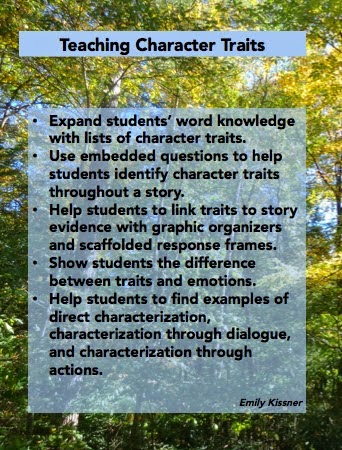
Each year I enter into these discussions in slightly different ways. However, some principles guide my lesson planning each year. Here is an overview of my thinking as I embark on a character traits unit.


Expand students' word knowledge with lists of character traits
Many of the words that we use to describe character traits are not common in everyday conversation. Rich, descriptive words like ruthless, impulsive, considerate, and stingy are new for many students. I like to use word lists that group words by common characteristics so that students can learn words efficiently. (A list of character traits is available in Character Traits and Emotions or here.)

Use embedded questions to help students identify character traits throughout a story
I love embedded questions! I remember days of standing by the copier, patiently cutting apart a story so that I could add questions throughout the text. Digital tools make the process much, much easier.

Embedded questions aren't about assessing students, but about guiding students toward making inferences. Transitional readers especially often think of reading a page of text as a monumental effort to be completed as quickly as possible. Embedding questions helps to break up the text and show readers what kinds of inferences they should make at which parts of the story. "Thomas and the Teapot", in Character Traits and Emotions, is an example of a text with embedded questions. However, you can use any text for this strategy.

Help students to link traits to story evidence with graphic organizers and scaffolded response frames
Support, support, support! This is my refrain as we talk about character traits. "What in the story makes you think that?" or "How did you come to think of this trait?"

Graphic organizers help students to collect character traits and text evidence as they go. Scaffolded response frames help students who are still learning the structure of formal academic responses. You can read more about response frames in this blog post.

Show students the difference between traits and emotions
Oh, I hate to see when well-intentioned people muddy the waters between traits and emotions! Traits usually don't change over the course of a story. When they do, the change is usually the main point of a story. Emotions, on the other hand, change frequently based on the events in the story.

Can students understand the difference? They most certainly can, and even readers who struggle can learn to distinguish between traits and emotions. (You can find lots more on character emotions in my book, The Forest AND the Trees, and in lots of other blog posts.)

Help students find examples of direct characterization, characterization through dialogue, and characterization through actions
This is where things get really interesting--as we move beyond just asking, "What are the character's traits?" and into "How does the author let us know about these traits?" For example, this week we started reading There's A Boy in the Girl's Bathroom as a read aloud. I love this book for characterization. In the first three chapters we find out a great deal about Bradley, from each one of these methods. (This book also does show us some examples of trait change, but it certainly doesn't happen in the first three chapters--Bradley's changes over time are part of the main storyline.)

Teaching character traits, just like teaching theme, helps students to see those parts of literature that make us more human. And the language of the traits becomes the language of our classroom. "That was foolhardy of the cricket, to try to escape," one student mused thoughtfully. I was watching the chaos of the escaped cricket (I finally had to stoop down and catch it myself, and I did teach for the next five minutes with a squirming cricket enclosed tightly in my hand) and I thought, "Wow! She used a character trait word!"

Other notes from the week
 -A slug escaped, and was nowhere to be found. How could a slug hide in the classroom? We are completely mystified. Just as a side note, the weight of the slug was 31 grams...we found this out shortly before he escaped.

-I am working on third grade homework sets. Their formatting is simpler than the 4/5 homework sets, and I'd love to have someone else look over them. There are currently 3 available with the fourth coming shortly.

-Character traits materials are available on Frolyc.com! If you have student iPads, these are a great way to build character trait knowledge.

-I'm adding some new materials to stories, but I probably won't have time to upload new sets this week. If you are teaching "Hans, the Princess, and the Golden Goose" from Teaching About Theme or "Painting Day" from Summarizing Stories, drop me a line at elkissn@yahoo.com and I'll send you some of the new materials.


Friday, September 19, 2014

Supporting character traits

If it's September, I must be teaching about story elements. This week, we have been taking a careful look at character traits. I had to do some quick edits to the classroom version of my Character Traits Powerpoint to delete the pictures of my son--after all, I can't embarrass him by having him on the screen during a lesson!

Traits vs. Emotions
One of the big lessons of fourth grade is getting students to see the differences between traits and emotions. As I was planning for the week of teaching, I was disheartened to see how much misinformation is floating around regarding character traits. A YouTube video started with the example of happy as a character trait. A case could be made that a character who is always cheerful is happy. However, most students apply this word as a fleeting emotion. It muddies the waters to start with such an example! As I teach traits, I try to make sure that students see that character traits are generally stable and unchanging. While emotions come and go, traits usually stay the same. (In stories for children, exceptions to this are highly explicit in how the character's traits change, and make the change in trait a huge factor in the story.)

Finding Traits
I started talking about traits about a week before we really worked with them in details. During our read-aloud, we talked about the character traits that we could apply to the main characters in the books. (With one class, I'm reading Tollins: Explosive Tales for Children; with the other, I'm reading The Talented Clementine.)

During each reading session, a student sits in the "place of honor" beside the large picture of the character and records the character traits that we develop during the reading. As you can see, Sparkler is clever, brave, curious, and protective. These were traits that students already knew and suggested on their own.

Collecting Textual Evidence to Support Traits
After our preliminary readings to test the waters, I was ready to introduce character traits more formally. I used my (edited) version of the PowerPoint to introduce traits and supporting traits with examples. I gave students a list of character traits. Then, we read more about Sparkler in the Tollins book. I modeled how to use this simple chart to record examples of traits and actions.

Writing Justification
Notice how this has the start of textual support, but is missing a key element: the rule, or the justification. The rule goes beyond the textual support to show how the text detail supports the inference. In the case of Sparkler, we had this information:

-Sparkler copied down every word and picture from the human medical books
-This shows that he is persistent

In our justification, we have to show how the two pieces of information go together.
Rule or justification: Someone who is persistent works hard and doesn't give up. Copying the books was hard work for Sparkler, but he didn't give up.

I showed students the response frame that includes a place for the character trait, character actions or word, and justification. After I introduced the task, I differentiated by student choice. Students who were ready to work on their own could go work quietly wherever they wanted in the room, while students who still needed some help could stay at the front with me. This was a very productive time for students.

Looking Back, Looking Ahead
This process requires a level of thinking that is tough for fourth graders! However, breaking the process down into the three different tasks was very helpful. It was also helpful to begin this tough level of thinking with shared, engaging text. Students could move through working with evidence, trait, and justification. While I would love to say that everyone got it perfectly after just one attempt, anyone who has actually been in a classroom knows that it is a long process. But it is a fruitful one--teaching students how to justify their text evidence in this particular case is easily transferable to other situations.


Thursday, September 18, 2014

Conflict and Climax: Thinking about Story Elements

Right now I'm working with teaching about stories and story elements in my classroom. This instruction has shifted a great deal in the last few years. As we've moved to the Common Core, I've taken on many topics that are new to fourth grade (like point of view) and delved more deeply into existing topics, like plot and conflict.

Event Cards

Some activities and strategies remain helpful for fourth graders. For example, I have always liked having students arrange story events. I type the events in a table, cut them out, and ask students to work with partners to put the events in order.


This simple activity shows me so much about what students can do. Sometimes they struggle to put the events in order. I encourage them to look back to the text.

When students don't have trouble putting the events in order, I ask, "Which ones could we leave out?" This prepares students for summarizing, when they will need to select the most important events and leave out events that are not important.

New Applications

This year, I used the sorting activity to frame a discussion about the parts of the story. Students worked with partners to put the events from the story in order. Then, we quickly talked about the climax of the story. This was a new word for many students.

Many typical definitions for climax say that it is the most intense part of the story, or the part that has the most action. Definitions that show climax in terms of "excitement" often set kids up for frustration--after all, many stories do not have an exciting battle! Instead of defining climax in terms of excitement, I told students that the climax is the turning point--when the conflict begins to be resolved.

Believe it or not, this commercial from Chipotle is actually an excellent illustration of this. Notice how the climax is not a grand or exciting battle, but a change of heart:


 After we watched the commercial, we tried to examine where we saw the climax. Partners quickly realized that in order to describe the climax, they needed to have an understanding of the conflict. They tried to hash out whether the conflict was the farmer's use of the land ("Maybe he doesn't have enough food, now that it's winter?" one student guessed) or the farmer's feelings about what has happened.

On the second viewing, they were able to find the climax. One student put it succinctly: "The farmer is like, 'Oh, no, what have I done?'" Another student pointed out that the music reveals the climax: "They give it away! It's in the words of the song!"

Applying learning to text

Students then took their new understanding of climax back to their sorted story events. I asked, "Which event from the story is the climax? Why do you think this?" Students then discussed their ideas...and there was a wide variation of choices.

We were working with a retelling of a fairy tale, "The Miller's Boy". Some students chose events from the beginning of the story, which seemed quite off at first until I realized that they were drawn to what I'd call the initiating event--the event that introduces the conflict of the story. Once I suggested that they look closer to the end of the story, most groups were able to find and support an event that they called the climax. One group noticed that the author (me, but they didn't really know it) had added a secondary conflict related to the character of Tobias. Looking through this lens, the climax came at a slightly different point. I love it when an activity presents several equally plausible answers!

Listening to the conversations was fascinating. I realized that an understanding of plot structure depends on a clear understanding of the conflict of a story. Without knowing the protagonist's goal, readers can't pin events to an over-arching structure. I ended by asking, "What will you do differently when we read our next story? What will you look for? What will you consider?" Some students said they would look for the climax of the story. Others said they would look more carefully for the conflict.

I'm looking forward to our conversations about both.


Sunday, July 27, 2014

Story Elements: Looking at Characters


This summer, as I've listened to the last of the Harry Potter series and started The Lost Hero with my family, I've enjoyed our conversations about the characters, the conflicts, and the setting. Each year, I try to replicate these kinds of conversations in my classroom.

Teaching story elements is a great way to begin. When kids can identify story elements, they can pick out the parts of the story that fit together and start to talk about them coherently. Who are the characters? What is the setting? What is the main problem in the story?

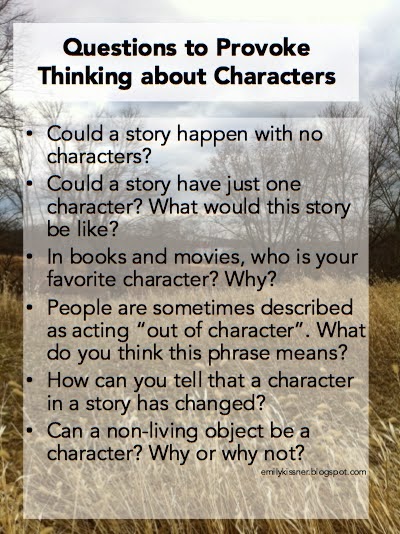
Of course, teaching story elements needs to go much deeper than simple identification. Filling out a story map quickly becomes a dull classroom routine without an inspiring conversation to go along with it. In fourth grade, I like to ask students provoking questions about characters. These questions stimulate our discussion and help students to see story elements as being more than just disassembling a story.


When we have these conversations, I can judge from student responses where to go next. Sometimes I do hear the sound of crickets. This tells me that I've tried to move too far too fast, and that kids need some time before we can have this particular conversation. Sometimes their responses remind me of a fabulous book that I just have to share--a character who is similar to one of their favorites, or a character who acts the opposite of what is expected.

Most importantly, these kinds of questions bring a spark of "what if?" to our classroom...a spark that lights up the room with the love of reading.

Notes
-My Story Elements PowerPoint is a classic that I do come back to, year after year.
-I wrote some fun Story Elements Readers Theatre scripts for my students to share. 
-You can try out the activity Camping Together for free over on Frolyc. Try it out if you have student iPads! (The story is also available in my Visualizing packet.)
-Analyzing Story Elements is finally ready. Four new stories with before reading pages, questions, and activities to help students understand and analyze story elements.


Sunday, July 20, 2014

Start the School Year with a Focus on Dialogue

In our curriculum, we start the school year with stories and story elements. I love this beginning as it helps us to talk about big ideas like theme and summarizing. But I also realize that, to help students figure out these big ideas, sometimes we need to focus on smaller details.

One of these small details is dialogue. In a story, dialogue can serve many purposes. Sometimes dialogue shows us insight into a character's personality or motives. Dialogue can also move the story forward and reveal information. Skipping over dialogue would lead to a fractured reading experience.

And yet...many young readers have great trouble in figuring out who is speaking in dialogue! The tiny clues to skilled readers use to match speaker to speech are invisible to many young readers. They don't notice the paragraph breaks or the empty white space at the end of lines. They can't track split dialogue. When speaker tags are not included, they have trouble following the back-and-forth of a typical conversation.

Figuring out who is speaking is a kind of text-based inference. Readers need to combine the clues in the text with their background knowledge of how text works. And this is hard! Even readers who are on and above grade-level can struggle with dialogue. 


1. Find out what kids can do with reading dialogue
I like to sit with kids as they are reading. Sometimes I listen to students read, and sometimes we read aloud together. During these conversations, I ask, "Who is speaking?" or "How do you know who is talking at this point?" These conversations help me to figure out the sub-conscious rules that students are or are not using to figure out who is speaking.

2. Model understanding who is speaking by displaying read-aloud text
With a document projector or overhead projector, show students the text that you are reading aloud. I like to make little sticky note tags or even little sketches of the characters to display at the same time. Then, I go back and forth to show who is speaking at each point. It's fun to engage students in this as well.


3. Label dialogue in text
This requires some colored pencils. Give students a copy of a short piece of text, and talk explicitly about the rules of dialogue. What does it mean when a new paragraph begins? How can we tell that a person is still speaking? Underline dialogue by different characters in different colors. 

You can extend the conversation by talking about what the dialogue reveals. Does it show us what characters are like? Reveal details of the plot? An example of this activity is included in the Literature Circle Materials below.


In the past I saved some of these lessons for later in the year. This year, though, I think that I will face them early on. Understanding the little rules of print and the conventions that authors follow will only help us as we begin our exploration of stories and narratives.

Some other lessons for teaching about text-based inferences and understanding dialogue can be found in my book The Forest and The Trees.

Character Traits and Emotions: Making Inferences: This unit includes an activity in which students write dialogue to show character traits.

Text-Based Inferences and More: This pack includes more resources for teaching text-based inferences.


Thursday, July 17, 2014

Picture Books for Teaching Theme

I like to use picture books to teach theme--just as I like to use picture books to help students summarize stories. Here are some of my favorites. (Yes, I use the same books year after year. We don't have much of a book budget, and I order a few more copies of my favorites every year to build up to a class set. For that reason, I'm drawn to paperbacks.)

Can you just take any book off the shelf and use it for teaching theme? Yes and no. Every story has some kind of theme, but some are harder to find than others. Also, some stories point to only one theme. I prefer to teach with stories that have multiple themes. These stories yield some rich discussions as students try to support their thinking.

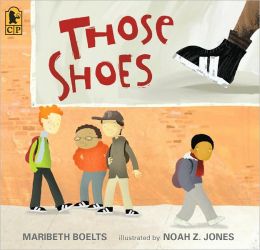
Those Shoes
This is a sweet story of a boy who wants "those shoes", but can't afford them. It resonates with my students and is an example of how a small, slice-of-life story can still carry a theme.

Students like to try to wordsmith different themes for this story, but the concrete plot line makes it easy for them to support a theme that works. This inexpensive paperback is a great choice for a classroom library or teacher bookshelf.


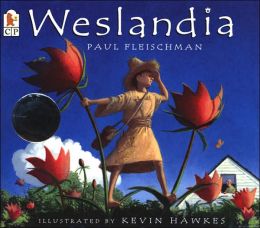
Weslandia
Every time I teach this book I love it a little more! Wesley's journey from tormented victim to intrepid adventurer is a wonder to behold, and Paul Fleischman is just an amazing writer. The kids love the illustrations as well.

Just looking at Wesley's changes in the pictures gives readers a strong insight into the theme of the story. This is another book that resonates with students, and leads to some interesting discussions about the theme.  (I also have a set of resources for this book over on TpT.)


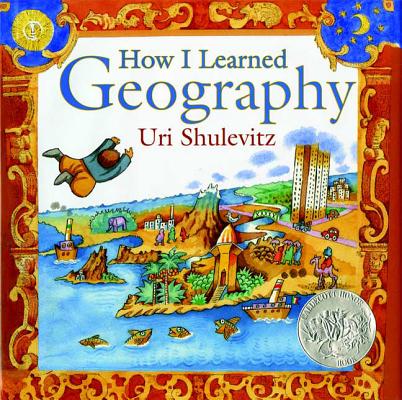
How I Learned Geography
This book is one that I revisit throughout the year, as we look at maps in our geography unit, as we work on personal narratives, and as we explore theme. It is more of a memoir and is alternately classified as "autobiographical" or a "fictional recasting".

Whatever the line between fiction and reality, this book is great to share. My kids think it is interesting that our home state of Pennsylvania is included in a list of faraway places--they have never considered that their everyday ordinary is someone else's distant exotic. Students often have different ideas about the theme. Some bring up the event of the father buying the map instead of buying food, while others focus on the narrator's use of imagination.

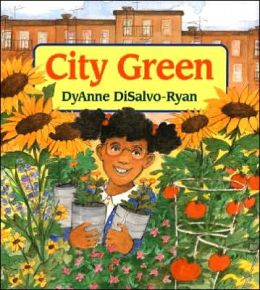
City Green
This is another book which has character change at the heart. It would make a nice companion book to Weslandia, as City Green also shows plants making a difference to people's lives. Students passionately argue for various themes in this story, depending on whether they focus on the character of Old Many Hammer or Marcy. I love it when they can support their thinking!

Beautiful Oops
Students love this book! It really shows how a mistake can be turned into something positive. This book has a stated theme, which leads us into a discussion of paraphrasing versus quoting. Should we put the theme into our own words? Should we use quotation marks to show that we are stating the words of the author? These questions are just perfect for beginning of year fourth graders.


There are so many other great books that you can use to teach theme. What are your favorites?