Showing posts with label revising. Show all posts

Monday, May 19, 2014

Writing, Revision, and Peer Response

At the end of the year, fourth graders are confident writers who long for independence. They no longer come up to brainstorm every sentence with the teacher--instead, they want to sit down and get to work on a piece of writing.

My goal as a writing teacher early in the year is to provide as much support as possible in the early stages of writing. By May, I have pulled back on the level of support.

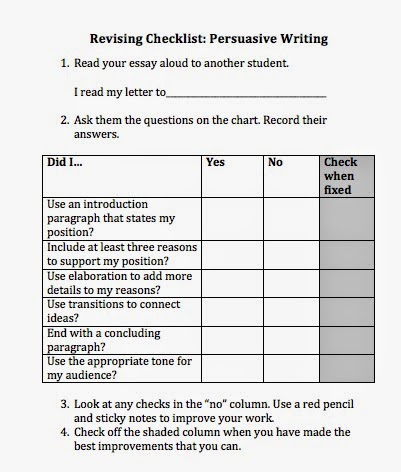
However, clear directions are essential to successful peer response. Last week, students worked with partners to revise their persuasive letters to third graders. I used a peer response frame that follows the pattern we've used all year.

The best part of May, however, is that students will check off "No" and have conversations with their partners. Several students discussed their conclusions: Are two sentences enough? They tried to bring the question to me to referee, but I sent it right back to them. What do you think? What is the job of a conclusion? How should a conclusion fit in with the rest of the piece?

Students have finally learned where to find all of the materials and move around the room to gather what they need. (We're running out of sticky notes and pencils, though!) They don't mind when I assign them partners and work readily with everyone.

And I watched this unfold last week with a bittersweet satisfaction. This little civilization that we've created together is coming to an end. Just as it comes into full flower, the last days of the school year loom over us like a shadow.

Oh, well. These final writing pieces, the artifacts of our classroom, are going to next year's students--a little piece of the civilization handed from one group to another.


Saturday, September 3, 2011

The Year Begins!

Well, that was tiring. Three days down, a whole bunch more to go!

The beginning of a new year is exhausting and exhilarating all at once. It's exhausting because, in those first few days, I have to teach so many routines and procedures. It's exhilarating because we are making something completely new--a class of individuals that has never existed before. It's so neat to watch it unfold. Already we have our first class jokes and shared annoyances. (Joke: The closets go to another dimension after homeroom, so you can't get anything from your backpack during the rest of the morning. Shared annoyance: The pencils that won't sharpen evenly.)

We had fun going on a world tour (remember, my tables are continents) and learning how to track hurricanes. I consciously tried to make those first few days content-rich, with lots of detailed pictures and real-time data. Each day at 11 am we've enjoyed looking at the updated information from the Hurricane Tracker.

I've been trying to get everything situated for the new year. This weekend, I've found some items that I started working on last year, formatted and tweaked them, and posted them to share.

Revising and Editing Checklists: This is a collection of checklists and activities for making clear the differences between revising and editing. Four sets of checklists (perfect for copying back to back), some editing practice, a list of revising strategies, and a revising activity. ($2)

Nouns and Word Choice: I'm trying to tie grammar instruction to the 6 Traits. This one shows how nouns can help with specific word choice. (Free)

Beginning of Year Lesson Plans for Reading: This explains how to begin your reading class and set up reading journals--5 days of lesson plans, blackline masters for the reading journal, and a fun get-acquainted activity. (The get-acquainted activity is in the free preview, so feel free to download it and use it!) Last year, this reading journal worked so well and we're already off to an impressive start this year. It's so nice to have those first few days figured out and taken care of. ($3)

I'm also teaching social studies for the first time...how exciting!


Wednesday, March 31, 2010

Delayed Revising

Like many students, fourth graders are reluctant revisers. Part of this is because they are still stuck in the knowledge-telling mode. As knowledge tellers, these young writers look at writing as a translation exercise--they are just recording the thoughts that are in their brains, in the order in which they think them. From their point of view, revising is pretty pointless. They wrote what they know and they know what they wrote. Why should they read it again?

Of course, teachers can think of MANY reasons for students to revise their pieces of writing! But our exhortations to revise, revise, revise often fail to sink in. This year, I've worked on several different strategies to help students revise. I've used checklists, modeled, and made revising glamorous. All of these have been successful, to some degree.

Now I'm trying yet another strategy--delayed revising. I read a short study about this, in which third, fourth, and fifth graders wrote a text and then revised later in the same day or the next day. Not surprisingly, the delayed revision condition led to more revising, especially more meaning-based revising.

I'm trying a two-week span. Students have put aside the rough drafts of their personal narratives, and we'll revise them shortly. I'm hoping that this will make it possible for students to see the difference between what they thought they wrote and what they actually wrote.

Thursday, February 4, 2010

Adding Glamour to Revising


Revising! I always find this step of the writing process frustrating. So many of my students just want to rush headlong through the writing process, scribbling out a final draft so they can say that they're "done". When I ask them to revise, they might circle a word, find a punctuation mistake, or half-heartedly reread their piece.

Part of this is developmental. See, most of our writers are still at the "knowledge-telling" phase, in which they think that their purpose for writing is just to take what is in their head and copy it onto the page. (See The Psychology of Written Expression by Carl Bereiter and Marlene Scardamalia for more on knowledge telling.) To a knowledge-teller, revising is boring and redundant. They already wrote what they know. Why should they read it again?

In the past, I've made the earnest appeal for revising. I modeled revising with sample drafts. I've shown them how revising leads to a stronger piece of writing. I took a thoughtful, reasoned approach to convince students that revising is more than just adding a word. I told them, honestly, that revising is hard.

Well, the earnest approach wasn't working with my students. Instead, I decided to try a different approach--the glamour approach. For fourth graders, nothing is more glamourous than new and different materials. After introducing the revising checklist, I gave students the choice of three revising strategies. None of these are earth-shattering or new. What made it work, though, is the use of the materials.

1. Add details with sticky notes: I've used this strategy for years, but I've only recently started to offer a wider variety of sticky notes. A choice of color and size makes this much more engaging and fun for students. I keep a few of the special shapes on hand to give out to students as I circulate around the room.

2. Add details with red or blue pencils: Last year, I think that I accidentally put my regular pencil order on the lines for the red and blue checking pencils. While this has led to an alarming shortage of pencils in my room (and serious pencil rationing!), I am liking the supply of red and blue pencils! Somehow just using the different colors--and even using them in combination--leads to better revising. And I make sure to keep these put away so that they are "special" for revising.

3. Surgery! This has been especially successful with the boys in my class who really resist revising. Of course, I make a big deal about it--"Don't worry. The patient's in good hands. We'll pull this through!" And then I cut apart the rough draft and tape it down on a new piece of paper.

Sometimes we need to leave big spaces between sections so that the student knows where to add more. In some drafts, details need to be rearranged and reorganized. "I'd just like you to know that the surgery has been successful," I'll say in a hushed voice. "I think your piece of writing just might live." The surgery banter has been flying thickly through the room this week, with some kids choosing to use it as a revision strategy probably for the sole purpose of being able to pretend to do an evil laugh as they cut their writing apart. I can live with this.

I haven't earnestly showed the students how they can improve their writing by revising. They are showing each other. I've overheard students talk about how they need to add more. One boy said to another, "Look, what you have doesn't match your graphic organizer. You need to do surgery."

How do you add glamour to revising?

Sunday, December 6, 2009

Revising


How do we get kids to revise? This is often a matter of great frustration for teachers. Instead of really jumping back into a text, many students just halfheartedly circle a misspelled word here and there.

As I started revising this week, I decided to add some glamor. I handed out "Magic Microphones" to the students. Really just rolled up pieces of paper, these microphones were supposed to make reading their pieces aloud more engaging for students. (Yeah, the special educator who co-teaches with me for the first class thought it was a ludicrous idea as well!) Why? As I've watched my students, I have noticed that they make more changes when they read their text aloud than when they just look at it silently.

After the Magic Microphones, I introduced the Revising Checklist. My revising checklist was very specific, directing students to look for an introduction, a topic sentence for each paragraph, and a conclusion. Then, students had to find one place to ADD a detail and one place to CHANGE something. These very explicit words make the nebulous idea of "revising" more concrete.

Was it perfect revising, all over the room? No, of course not! But I saw progress. I saw lots of Post-Its being passed around. I realized that a small group of students in each class were still not entirely sure of what a topic sentence is. And I noticed many students going back to our example essays--and even Surprising Sharks--to find out what an introduction and conclusion should be like.