
Showing posts with label writing process. Show all posts
Showing posts with label writing process. Show all posts
Sunday, January 8, 2017
Managing the Writing Classroom
Most of the popular teaching techniques for teaching of writing are predicated on delightful optimism and rose-colored glasses. Don't worry about teaching to the test! Help every child discover the writer within! Everyone can be a great writer! If you just work on finding the joy in writing, every child will spontaneously write meaningful essays with sophisticated transitions!
Being the deeply pessimistic person that I am, I can't believe these truisms. I have trouble getting to the end of an article about the teaching of writing without becoming consumed by guilt and worry, toxic feelings that I'm not covering enough, that I'm not keeping on pace with grammar, and that my students will do horribly on the next round of standardized testing.
BUT I do have an optimistic inner voice, buried very deep and speaking very quietly. If I stand still enough and listen carefully enough, this optimistic voice tells me that there are some parts of my writing classroom that work, even for someone as deeply flawed as me, and that may be of use to other writing teachers.
I'm going to write them down very quickly before I convince myself otherwise.
Clipboard Cruise
While students are writing, I like to walk around the room with a clipboard. I write down different kinds of notes. Sometimes, I'm doing a progress check to see where students are in the writing process. On other days, I'm looking for patterns of student weaknesses or errors.
I should probably put these notes in an organized form, or keep them in color-coded binders. Usually they just accumulate on my clipboard for me to peruse and consider as we move on in the writing project. Sometimes I forget about them until months later and find them and feel badly about myself.
But my voice of optimism says that maybe the important part is not what I do with the notes, but that I take them at all. Taking the notes means that I am noticing what is going with the writers in my room. They are important in the moment, and I use each day's notes to plan for the next day's instruction.
Slow Writing
In the traditional model of teaching writing, forms of writing steadily come down a conveyor belt of curriculum. The dutiful teacher looks to see what is next on the conveyor belt and teaches it.
In slow writing, I still have to look at the conveyor belt to see which forms must be taught. However, I structure the class to work on several forms at the same time. Right now, for example, my students are doing background research for an explanatory essay about biomes. This essay won't be written until January, but students started researching biomes after Thanksgiving.
The idea is that good writing can only happen with a wealth of knowledge and expertise, and that students need time to research and think about a topic before they produce. This is a slow method of writing, but it can help students to understand what it is to be a writer.
As students were researching biomes they were also writing a narrative and doing some summarizing. Writers like to have several projects at a time to work on, because then they can procrastinate productively!
Insistence
I've worked with editors who have absolutely insisted that I make certain changes to my writing. As a teacher I do the same. There is a place for insistence, even nagging, in the writing classroom.
For example, in our work with narratives, I had a student who didn't add any dialogue. This wasn't a stylistic choice, but a stubborn one. This student wanted to be done with the assignment and didn't want to add dialogue.
I'm sorry, but no. I insisted. I made him un-submit his piece of writing to add dialogue.
Twice.
Reflective teachers of writing are sometimes hesitant to insist that students add or change things in their writing. "It's their writing--I don't want to interfere too much," is something that I probably said fifteen years ago.
But nope. I need to find the right way to interfere. I don't want to be a hated editor, but I need to be a meddling teacher.
Looking Busy
Any writing teacher will attest to the value of this! Sometimes during writing sessions I need to get out of the way to let kids write. However, students often want to talk with me or ask for help. I don't like to tell kids that I won't help them, so I get out work to do and sit at a student desk. For some reason, the fact that I look busy encourages students to go back into themselves and use their inner resources to solve a problem that they may have asked me about.
You have to be cautious with this one, though. Look too busy and you'll find that there's a student on the other side of the room who has gone fifteen minutes without writing a word. I like to punctuate periods of "looking busy" with clipboard cruises to keep students guessing.
Closure
I like to end writing sessions with two questions:
Can anyone tell us about a writing problem that they solved today?
Does anyone have a writing problem that they couldn't solve today?
These questions never fail to lead to interesting discussions. As I hear students talk about how they solved writing problems, I can start to feel--maybe-- a bit less pessimistic.

Sunday, March 13, 2016
Building Recursive Processes for Essay Writing

Writing passage-based essays and other synthesis tasks are important for students. However, these tasks can be very frustrating for teachers! The frustration comes from the issue of how classroom work is accomplished versus how creative work is accomplished.
Linear Process
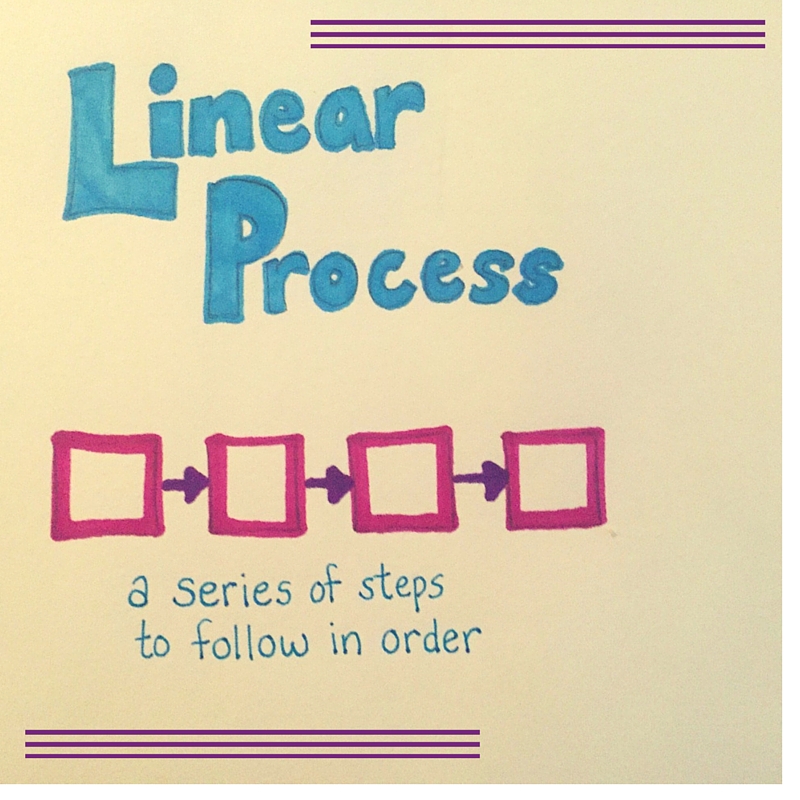
In the classroom, a linear workflow rules. I write these kinds of directions on my board every day: First complete step one, then go on to step two, and so forth.
Linear processes work well for managing many students and many assignments. A linear workflow shapes a task into approachable chunks.
Unfortunately, a linear process just doesn't work for high-quality writing. In fact, a study of synthesizing found that a linear writing process is associated with lower quality synthesis (Sole et al, 2013). Readers who follow a linear process, with each step following the other, miss connections between ideas. They fail to follow up on key concepts and don't show as deep of an understanding of the text.

The best process for a synthesis task like a passage-based essay, as it happens, is a recursive process. A recursive process sees a student shifting flexibly back and forth between tasks. Step two doesn't always follow step one, and sometimes step three leads back to the beginning.
It's easy to see how this kind of process can be tough to manage in the classroom. Many traditional classrooms are built on an assembly line model: Get a task, finish it, get the next.
But it's worth the time and effort needed to move to more recursive processes in the classroom. It's worth it to think about:
-How can I help students to revisit key steps in the writing process?
-How can I model a recursive process as a reader and writer?
-How can I structure my classroom to allow more time for synthesis tasks?
The answers to these questions aren't easy! I'm still struggling with them myself. I like to think that this productive struggle on my part as a teacher will lead to productive struggle--and creative benefits--for my students.
Sole, Isabel, Miras, Mariana, Castells, Nuria, Espino, Sandra, Minguela, Marta. 2013. Written Communication, v30 n1, p 63-90.
Monday, May 19, 2014
Writing, Revision, and Peer Response

My goal as a writing teacher early in the year is to provide as much support as possible in the early stages of writing. By May, I have pulled back on the level of support.
However, clear directions are essential to successful peer response. Last week, students worked with partners to revise their persuasive letters to third graders. I used a peer response frame that follows the pattern we've used all year.
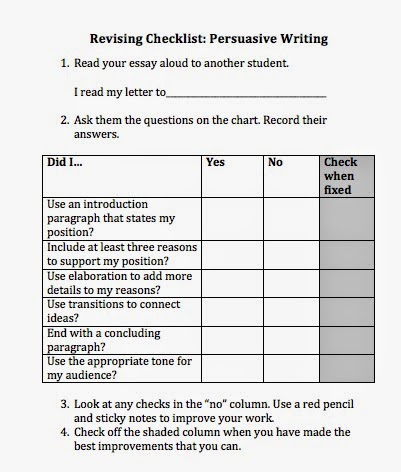 The best part of May, however, is that students will check off "No" and have conversations with their partners. Several students discussed their conclusions: Are two sentences enough? They tried to bring the question to me to referee, but I sent it right back to them. What do you think? What is the job of a conclusion? How should a conclusion fit in with the rest of the piece?
Students have finally learned where to find all of the materials and move around the room to gather what they need. (We're running out of sticky notes and pencils, though!) They don't mind when I assign them partners and work readily with everyone.
And I watched this unfold last week with a bittersweet satisfaction. This little civilization that we've created together is coming to an end. Just as it comes into full flower, the last days of the school year loom over us like a shadow.
Oh, well. These final writing pieces, the artifacts of our classroom, are going to next year's students--a little piece of the civilization handed from one group to another.
Tweet
Saturday, May 17, 2014
Formal Academic Writing + Student Creativity
The Common Core expectations are high for student writing. Students in third, fourth, and fifth grades are expected to write formal informational and persuasive pieces, using introduction and conclusion paragraphs. As a teacher, I appreciate the need to help students write longer and more complex pieces...but I also want to help them expand their creativity! To teach some of the basics of formal essays, I love to use the genre of expository fiction.
Expository Fiction
Expository fiction is text written using expository text structures, but with fictional details. Your students are probably reading these books without even realizing it! Star Wars: Epic Battles is one common example--this book explains the epic battles from the Star Wars universe in an informational way. Fictional battles, expository structure. Many of the Pokemon handbooks are the same way, as are books like The Care and Feeding of Sprites.
Expository fiction is fun. The details are interesting and imaginary, but the structure is real-world and businesslike. What better way to introduce the conventions of academic writing?
Design A Land

I first started doing this project years and years ago, and I've refined it over time. The basics are simple: Students create their own imaginary country, and then write an essay to describe it.
But this simple description can't capture what really happens during the experience. Students go deeper with their details, collaborating with each other to dream up new ideas. Students try out different genres, writing narratives to tell stories about their lands and travel brochures to invite tourists. Students learn new vocabulary words as they describe the features of their lands and how they came to be. It is the perfect extension of early childhood play into middle childhood academics.
Even better, this project also helped to integrate some important skills and concepts into language arts. Middle level writers are still struggling with capitalization of place names (for example, Chocolate river is a common transcription) and this project lends itself to repeated practice with this skill. Students write the place name on their maps, on their outlines, and in their rough drafts...I remind them to capitalize both words over and over and they get instant feedback.
This also helped students to become more interested in landforms. During the mapmaking process I walked around with copies of United States maps to demonstrate landforms. "What is a bay, really?" was a common question, and I showed bays on the map. I also spotted a major misconception about rivers--students thought that they went from ocean to ocean--and we were able to look at some maps and talk about how rivers flow.
Fashion-A-Fish
 This activity from Project WILD (you can find one version of the lesson plans here, although there are many others if you search) is another fun project for expository fiction. Students create their own fish by combining characteristics. Different characteristics are best suited for different habitats and habits, and students then dream up more details to describe their fish. When I did this project several years ago, students pretended that they were biologists who had discovered a new species of fish and wanted to share their discovery with the world.
The Writing Lessons
Throughout the entire process, my lessons focused on aspects of expository writing, such as topic sentences, transitions, and introductions. Because students had a deep understanding of their topic (it was their own creation!), they had more processing power to focus on these aspects of writing. Of course, they were motivated to write a strong piece of writing. I told them, "You are the only expert on your land! If you don't write about this, no one will ever know these details."
Expository fiction is a wonderful way to engage young writers in formal writing. They can experiment with the forms and conventions of this kind of writing in a fun and engaging way.
Design-A-Land: Introducing Formal Essay Writing with Creativity is available from TeachersPayTeachers. It includes lesson plans, troubleshooting guides, and handouts to help students write strong essays.
Tweet
Expository Fiction
Expository fiction is text written using expository text structures, but with fictional details. Your students are probably reading these books without even realizing it! Star Wars: Epic Battles is one common example--this book explains the epic battles from the Star Wars universe in an informational way. Fictional battles, expository structure. Many of the Pokemon handbooks are the same way, as are books like The Care and Feeding of Sprites.
Expository fiction is fun. The details are interesting and imaginary, but the structure is real-world and businesslike. What better way to introduce the conventions of academic writing?
Design A Land
I first started doing this project years and years ago, and I've refined it over time. The basics are simple: Students create their own imaginary country, and then write an essay to describe it.
But this simple description can't capture what really happens during the experience. Students go deeper with their details, collaborating with each other to dream up new ideas. Students try out different genres, writing narratives to tell stories about their lands and travel brochures to invite tourists. Students learn new vocabulary words as they describe the features of their lands and how they came to be. It is the perfect extension of early childhood play into middle childhood academics.
Even better, this project also helped to integrate some important skills and concepts into language arts. Middle level writers are still struggling with capitalization of place names (for example, Chocolate river is a common transcription) and this project lends itself to repeated practice with this skill. Students write the place name on their maps, on their outlines, and in their rough drafts...I remind them to capitalize both words over and over and they get instant feedback.
This also helped students to become more interested in landforms. During the mapmaking process I walked around with copies of United States maps to demonstrate landforms. "What is a bay, really?" was a common question, and I showed bays on the map. I also spotted a major misconception about rivers--students thought that they went from ocean to ocean--and we were able to look at some maps and talk about how rivers flow.
Fashion-A-Fish
This activity from Project WILD (you can find one version of the lesson plans here, although there are many others if you search) is another fun project for expository fiction. Students create their own fish by combining characteristics. Different characteristics are best suited for different habitats and habits, and students then dream up more details to describe their fish. When I did this project several years ago, students pretended that they were biologists who had discovered a new species of fish and wanted to share their discovery with the world.The Writing Lessons
Throughout the entire process, my lessons focused on aspects of expository writing, such as topic sentences, transitions, and introductions. Because students had a deep understanding of their topic (it was their own creation!), they had more processing power to focus on these aspects of writing. Of course, they were motivated to write a strong piece of writing. I told them, "You are the only expert on your land! If you don't write about this, no one will ever know these details."
Expository fiction is a wonderful way to engage young writers in formal writing. They can experiment with the forms and conventions of this kind of writing in a fun and engaging way.
Design-A-Land: Introducing Formal Essay Writing with Creativity is available from TeachersPayTeachers. It includes lesson plans, troubleshooting guides, and handouts to help students write strong essays.
Tweet
Friday, May 9, 2014
Writing Introductions: Persuasive Text
Now that we are well into the month of May, students are working on persuasive writing. My fourth graders are writing to third graders who are coming to our school next year. It's a great focus for us as students have an authentic audience and a real reason to write.
Today we worked on writing introductions. Fourth graders can learn some key ideas about introductions, and can use good models to write strong introductions of their own. This page outlines the first part of the lesson:
I don't assign this as a standard worksheet--instead, it is the student text for our lesson. Having everything written down in one place is necessary for me, as students are often in and out for various reasons. A shared student text with all of the key vocabulary means that I can easily ask an instructional assistant or another student to highlight the key points from the lesson with anyone who has been absent.
After students learned about the parts of an introduction, they started to write their own. We are writing letters to incoming fourth graders right now to persuade them that they will enjoy our school. (Kids are very excited to write for this audience about this timely topic!) Some students jumped right into the introduction, describing our playground, lunch, or intramurals in detail. Others had more difficulty.
I turned these struggles into our closure for the session. Students love bringing their writing up to the document camera to display to everyone. Today I asked, "Let's hear from those of you who struggled a bit as you worked."
I wasn't sure how many students would want to share their struggles, but about 10 raised their hands. One student said, "I had trouble with the concession bit, because I couldn't imagine what a tiny person would think." (Ah, looking back on the end of third grade with the lofty maturity of a fourth grader!) After students shared, they could call on other students to share comments or questions. A girl said, "I had trouble with the concession part too."
Another student volunteered to share his difficulty with writing a position statement, and another stood up to share her efforts to write an interesting hook. "I finally wrote something down, it's basic, but I think it will work," she said after she read her piece aloud.
It was a lovely writing session and a pleasant debriefing time, the kind of moment that exemplifies end-of-year fourth grade. And it was a little bittersweet for me because I know that our little classroom community is coming to an end...only 20 more days to have conversations like this.
Notes
-The entire persuasive writing unit can be found here.
-This Frolyc activity, ready to send to student iPads, helps students to analyze persuasive text. Tweet
Today we worked on writing introductions. Fourth graders can learn some key ideas about introductions, and can use good models to write strong introductions of their own. This page outlines the first part of the lesson:
I don't assign this as a standard worksheet--instead, it is the student text for our lesson. Having everything written down in one place is necessary for me, as students are often in and out for various reasons. A shared student text with all of the key vocabulary means that I can easily ask an instructional assistant or another student to highlight the key points from the lesson with anyone who has been absent.
After students learned about the parts of an introduction, they started to write their own. We are writing letters to incoming fourth graders right now to persuade them that they will enjoy our school. (Kids are very excited to write for this audience about this timely topic!) Some students jumped right into the introduction, describing our playground, lunch, or intramurals in detail. Others had more difficulty.
I turned these struggles into our closure for the session. Students love bringing their writing up to the document camera to display to everyone. Today I asked, "Let's hear from those of you who struggled a bit as you worked."
I wasn't sure how many students would want to share their struggles, but about 10 raised their hands. One student said, "I had trouble with the concession bit, because I couldn't imagine what a tiny person would think." (Ah, looking back on the end of third grade with the lofty maturity of a fourth grader!) After students shared, they could call on other students to share comments or questions. A girl said, "I had trouble with the concession part too."
Another student volunteered to share his difficulty with writing a position statement, and another stood up to share her efforts to write an interesting hook. "I finally wrote something down, it's basic, but I think it will work," she said after she read her piece aloud.
It was a lovely writing session and a pleasant debriefing time, the kind of moment that exemplifies end-of-year fourth grade. And it was a little bittersweet for me because I know that our little classroom community is coming to an end...only 20 more days to have conversations like this.
Notes
-The entire persuasive writing unit can be found here.
-This Frolyc activity, ready to send to student iPads, helps students to analyze persuasive text. Tweet
Saturday, February 22, 2014
Three ways to move beyond "I'm going to tell you about..."
When I taught seventh grade, I couldn't believe how many students used this phrase as a topic sentence. Was someone teaching this?
Moving to fourth grade gave me a new perspective. As I worked with younger writers, I saw how "I'm going to tell you about..." develops, and why some teachers may let it slide now and then. Some young writers jump right into the details of a topic, without any introduction or preface.
Writers with a stronger sense of audience awareness know that they have to do something to introduce the topic. "I'm going to tell you about" is then a logical way of beginning a paragraph. Like many young writers, this structure is terse and to the point. When it first appears in a student's writing, it represents a valid way to solve a problem. As a fourth grade teacher, I feel a grudging respect for what I despised so much in seventh grade.
While I acknowledge the utility of "I'm going to tell you about," I know that I need to help students move forward. Here are three ways to help students move into more sophisticated expository writing.
1. Use writing frames
 I love writing frames because they help students to see the language of academic writing. When students have to write to respond to reading, they often fall into an "I'm going to tell you about" pattern because they have trouble generating the abstract language they need. A writing frame can show students one way to enter a response.
Of course, the risk develops that students will see a writing frame as a simple "fill in the blanks" activity. When I introduced the frame to the right this past week, I had students read it aloud together, inserting the word "blank" at every blank. It was fun. Then we highlighted the topic sentence and talked about how it worked for the paragraph. (This activity is part of January homework and texts if you are interested.)
2. Write topic sentences together
We are currently working on a month-long (decade-long? It sure feels like it with all of the snow days!) writing project. Students are designing their own island countries, and then writing an expository essay to describe it. So many different skills intersect in this project, from the art of creating the maps to the writing of the essay.
Often, the writing of an essay becomes independent classwork or even (gasp!) homework. I never send writing home for homework. Sometimes students love to write and want to write at home, which is awesome. But the writing of topic sentences, especially for students in grades 4-7, is too important to send home. Students need lots of models and lots of support for this.
 I model the writing of a topic sentence with sample details. Here is one that we tried on Friday.
I designed it so that the space for us to write our main idea is above the details. This matches the way that main ideas are usually at the beginnings of paragraphs.
I read the details aloud to students, and then asked, "What do you think this says about the weather of Delphinium?" I asked students to work with partners to come up with one word to describe the weather--awesome, horrible, dreadful, bananas, delightful, and so forth.
After this, I called on a few students to share. One said, "The country of Delphinium has interesting weather." This is a very basic topic sentence, but it is a step beyond "I'm going to tell you about.." The next student arranged ideas in a different order: "Delphinium's weather is pretty unusual." Having students come up with one word was very helpful.
Some students have resisted this--"Isn't that an opinion? A teacher told me I shouldn't write opinions." I'm pretty sure that no teacher has ever said this. After all, writers take positions and then support those positions. A piece of writing that is only facts would be very dry indeed.
...And this process takes longer than you may ever dream possible. The more examples, the more opportunities to talk through details, the better. As we research Antarctica, students will use the same process to write about their research. Over time, the topic sentences break out of the "____ is interesting" mold and become more lively.
3. Showcase mentor texts
Showcasing mentor texts also helps to speed up the process. Choosing texts, however, requires some care. Often the expository picture books that get published and publicized are the ones that mix up the traditional format. Where are the topic sentences? Where are the paragraphs? While these are great to read and share with students, some nice mid-level models are helpful too. The books of Franklyn M. Branley are excellent, as are articles from Ask and Muse.
While sharing these texts, I like to talk about them in terms of problems and solutions. How did the author deal with the details? Where is the topic sentence in the paragraph? How does the author move from one paragraph to the next? After these discussions, students often start to experiment with their own topic sentences. By the end of fourth grade, a few of them are using pretty strong transitions between paragraphs, and using the topic sentence to move from one idea to the next.
Integrate all of these strategies
All of these strategies can be used concurrently! Last week we created main ideas in the morning and wrote to a writing frame in the afternoon. Next week we'll look more at mentor texts while students will be creating their own main ideas. The more that students see and talk about main ideas and topic sentences, the more likely they will be to internalize this kind of structure and move beyond "I'm going to tell you about."
Notes
-If you're looking for more on main ideas, you may like this: Main Ideas and Details in Nonfiction Text.
-This slideshow about Topics and Main Ideas can help students to understand topics and main ideas in reading.
Moving to fourth grade gave me a new perspective. As I worked with younger writers, I saw how "I'm going to tell you about..." develops, and why some teachers may let it slide now and then. Some young writers jump right into the details of a topic, without any introduction or preface.
Writers with a stronger sense of audience awareness know that they have to do something to introduce the topic. "I'm going to tell you about" is then a logical way of beginning a paragraph. Like many young writers, this structure is terse and to the point. When it first appears in a student's writing, it represents a valid way to solve a problem. As a fourth grade teacher, I feel a grudging respect for what I despised so much in seventh grade.
While I acknowledge the utility of "I'm going to tell you about," I know that I need to help students move forward. Here are three ways to help students move into more sophisticated expository writing.
1. Use writing frames
I love writing frames because they help students to see the language of academic writing. When students have to write to respond to reading, they often fall into an "I'm going to tell you about" pattern because they have trouble generating the abstract language they need. A writing frame can show students one way to enter a response.Of course, the risk develops that students will see a writing frame as a simple "fill in the blanks" activity. When I introduced the frame to the right this past week, I had students read it aloud together, inserting the word "blank" at every blank. It was fun. Then we highlighted the topic sentence and talked about how it worked for the paragraph. (This activity is part of January homework and texts if you are interested.)
2. Write topic sentences together
We are currently working on a month-long (decade-long? It sure feels like it with all of the snow days!) writing project. Students are designing their own island countries, and then writing an expository essay to describe it. So many different skills intersect in this project, from the art of creating the maps to the writing of the essay.
Often, the writing of an essay becomes independent classwork or even (gasp!) homework. I never send writing home for homework. Sometimes students love to write and want to write at home, which is awesome. But the writing of topic sentences, especially for students in grades 4-7, is too important to send home. Students need lots of models and lots of support for this.
I model the writing of a topic sentence with sample details. Here is one that we tried on Friday.I designed it so that the space for us to write our main idea is above the details. This matches the way that main ideas are usually at the beginnings of paragraphs.
I read the details aloud to students, and then asked, "What do you think this says about the weather of Delphinium?" I asked students to work with partners to come up with one word to describe the weather--awesome, horrible, dreadful, bananas, delightful, and so forth.
After this, I called on a few students to share. One said, "The country of Delphinium has interesting weather." This is a very basic topic sentence, but it is a step beyond "I'm going to tell you about.." The next student arranged ideas in a different order: "Delphinium's weather is pretty unusual." Having students come up with one word was very helpful.
Some students have resisted this--"Isn't that an opinion? A teacher told me I shouldn't write opinions." I'm pretty sure that no teacher has ever said this. After all, writers take positions and then support those positions. A piece of writing that is only facts would be very dry indeed.
...And this process takes longer than you may ever dream possible. The more examples, the more opportunities to talk through details, the better. As we research Antarctica, students will use the same process to write about their research. Over time, the topic sentences break out of the "____ is interesting" mold and become more lively.
3. Showcase mentor texts
Showcasing mentor texts also helps to speed up the process. Choosing texts, however, requires some care. Often the expository picture books that get published and publicized are the ones that mix up the traditional format. Where are the topic sentences? Where are the paragraphs? While these are great to read and share with students, some nice mid-level models are helpful too. The books of Franklyn M. Branley are excellent, as are articles from Ask and Muse.
While sharing these texts, I like to talk about them in terms of problems and solutions. How did the author deal with the details? Where is the topic sentence in the paragraph? How does the author move from one paragraph to the next? After these discussions, students often start to experiment with their own topic sentences. By the end of fourth grade, a few of them are using pretty strong transitions between paragraphs, and using the topic sentence to move from one idea to the next.
Integrate all of these strategies
All of these strategies can be used concurrently! Last week we created main ideas in the morning and wrote to a writing frame in the afternoon. Next week we'll look more at mentor texts while students will be creating their own main ideas. The more that students see and talk about main ideas and topic sentences, the more likely they will be to internalize this kind of structure and move beyond "I'm going to tell you about."
Notes
-If you're looking for more on main ideas, you may like this: Main Ideas and Details in Nonfiction Text.
-This slideshow about Topics and Main Ideas can help students to understand topics and main ideas in reading.
Saturday, October 2, 2010
Acrostic Poems
I am not a huge fan of acrostic poems. In my experience, they often lead to young writers valuing form over ideas--trying to cram words into the set form without really saying anything fresh or new.
Silver Seeds, though, has changed my mind. This beautifully illustrated book of acrostics, written by Paul Paolilli and Dan Brewer, is a collection of lovely acrostics. Each one is about something related to nature. They go beyond the usual one word per line and share fresh, interesting comparisons and descriptions. I would enjoy reading the poems even if I didn't know that they were acrostics!
I shared this with my students as we were finishing up our process paragraphs. Many students had already finished their final drafts, so I wanted to introduce a different form of writing for them to try out in their journals while the rest of the students continued to finish. This book was perfect--an introduction to a form of poetry, a chance to see how they understood metaphors (surprisingly well), and an invitation to try out a different form of writing.

Silver Seeds, though, has changed my mind. This beautifully illustrated book of acrostics, written by Paul Paolilli and Dan Brewer, is a collection of lovely acrostics. Each one is about something related to nature. They go beyond the usual one word per line and share fresh, interesting comparisons and descriptions. I would enjoy reading the poems even if I didn't know that they were acrostics!
I shared this with my students as we were finishing up our process paragraphs. Many students had already finished their final drafts, so I wanted to introduce a different form of writing for them to try out in their journals while the rest of the students continued to finish. This book was perfect--an introduction to a form of poetry, a chance to see how they understood metaphors (surprisingly well), and an invitation to try out a different form of writing.
Wednesday, September 15, 2010
The Writing Process and Academic Vocabulary
Every fall, I spend time teaching my writers about the writing process. They've experienced it before, of course, but I like for all students to experience the process and learn how it can help them to create stronger pieces of writing.
But the word process is an important academic vocabulary word for students to learn. It's not only important for them in writing class. The word process is also important in science, as students learn about natural processes. Students also need to use this word in math, to explain how to solve problems. Process is an important word!
This year, I started out with "process charades". Students completed a vocabulary word map with the definition of process, examples, non-examples, and a picture. We used the definition that a process is a set of steps. Then, we took turns acting out processes that we know how to do. I illustrated our processes (pretty poorly!) by putting pictures of the steps on the board. Kids were pretty ingenious with the processes that they chose.
Once students had a good handle on the process charades, I gave them a set of notecards. They could think of any process that they knew how to do, from brushing their teeth to mowing the lawn. They illustrated the cards with one step on each card. (Little note: I've taken a cue from the kindergarten teacher and started giving students thin black markers and colored pencils for these sorts of activities. The quality of their work really improves.)
Finally we were ready to move into the writing process! I had already made a simple checklist of steps in the writing process, along with a short writing prompt guiding students to write a paragraph about a process that they know how to do. Now, students saw the writing process, and they were pretty excited that they got to check off a step right away. (They had already done the planning step of making their notecards.)
Yes, following a process to write about a process...it's tough to say, and gets the kids giggling, but they are learning the word.
But the word process is an important academic vocabulary word for students to learn. It's not only important for them in writing class. The word process is also important in science, as students learn about natural processes. Students also need to use this word in math, to explain how to solve problems. Process is an important word!
This year, I started out with "process charades". Students completed a vocabulary word map with the definition of process, examples, non-examples, and a picture. We used the definition that a process is a set of steps. Then, we took turns acting out processes that we know how to do. I illustrated our processes (pretty poorly!) by putting pictures of the steps on the board. Kids were pretty ingenious with the processes that they chose.
Once students had a good handle on the process charades, I gave them a set of notecards. They could think of any process that they knew how to do, from brushing their teeth to mowing the lawn. They illustrated the cards with one step on each card. (Little note: I've taken a cue from the kindergarten teacher and started giving students thin black markers and colored pencils for these sorts of activities. The quality of their work really improves.)
Finally we were ready to move into the writing process! I had already made a simple checklist of steps in the writing process, along with a short writing prompt guiding students to write a paragraph about a process that they know how to do. Now, students saw the writing process, and they were pretty excited that they got to check off a step right away. (They had already done the planning step of making their notecards.)
Yes, following a process to write about a process...it's tough to say, and gets the kids giggling, but they are learning the word.
Subscribe to:
Posts (Atom)