Showing posts with label teacherspayteachers. Show all posts

Sunday, May 10, 2015

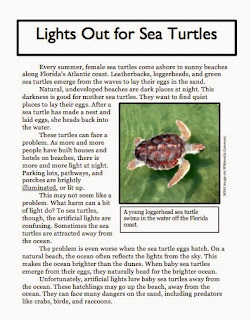
Sea Turtles and Expository Text: A Peek Inside

I love writing short expository texts, and I love sharing the texts that I create with other teachers. 

But I can't deny that there is always an uneasy tension between my inner writer and my inner teacher as I start a new project. The inner teacher says, "Wouldn't it be cool to have a set of texts with x, y, and z?" The inner writer groans--"You want what? Do you realize how hard that will be to write?"

So there is a sense of compromise between teacher and writer. I have seen enough hideously contrived texts to know that I shouldn't keep going if something isn't working. Teacher and writer must negotiate to come up with a workable compromise. (And all of this is going on in my head!)


Lights Out: Problem/Solution


This spring, I started to write a series of texts about sea turtles. The project began with a problem and solution text about the importance of turning out lights during nesting season. I find problem and solution to be one of my favorite text structures, probably because it is inherently optimistic. I also love the symmetry of problem and solution. It's fun to write.

I generally prefer to do all of the writing first before I mess around with formatting. Adding the formatting gives me another chance to reread every bit of text. I often read everything aloud to my family as well--my ten year old is a great listener and offers useful criticism. 

After the text has been written, read, and reread, the teacher side takes over and works on questions and activities. Waiting several weeks between text and questions helps me to look at the piece as a teacher instead of as the writer. This year, I've been experimenting with adding synthesis tasks to reading sets. These are very similar to the performance assessments that we used in the late-90s, but with a Common Core twist. Yes, they tap some of the skills that will be needed for high stakes testing, but they are also activities that are real and relevant for students.


Compare and Contrast

After I finished the problem and solution texts, I moved on to the bigger challenge--two compare and contrast texts, each one about two different sea turtles. 

These texts were hard to write. The writer in me balked at writing them, but the teacher stood firm--these are necessary. Compare and contrast is one of the hardest text structures to use. There are two topics, and the writer must work hard to balance them and make clear transitions back and forth. All too often, compare and contrast ends up sounding choppy and awkward. And conclusions? Natural, fresh conclusions to compare and contrast texts are especially difficult.

Of course, this is the lesson that the teacher-me wanted! I saw the need for two texts, both compare and contrast, but using different styles of organization. Compare and contrast texts can be alternating or clustered. Before students look for these structures in the real world, it's helpful for them to see study texts that present each. Texts on similar topics will help them to focus on the structure of the text instead of the content.

The first text, "Loggerheads and Green Sea Turtles" is written in the alternating style. This took a great deal of research and many hours of time. I found conflicting information from various credible sources, and delved deep into Google Books and other sources to find the best information possible. From a writer's point of view, I did create a comparison chart to gather my details. (I hate Venn diagrams for writing.) 

The second, "Leatherbacks and Kemp's Ridley Sea Turtles", was a little easier. I used the clustered style, which deals with each topic in turn. Writing these two texts really helped me to see the strong similarities between description text structure and compare and contrast. After all, clustered compare and contrast could be looked upon as double description. 

The close reading activity that accompanies these texts is the one that my teacher self envisioned at the start of the project--using colored pencils to underline sentences referring to either kind of turtle. As I made the answer key, it clearly showed the difference between alternating compare and contrast and clustered compare and contrast. Victory!

The final activity of the unit challenges students to create their own compare and contrast text, using whichever style they would like. A chart of information is provided to make the task more of a writing task instead of a research task. 

Thank you!

Combining teaching and writing is a challenge. I'm so grateful to everyone who has purchased my texts on TeachersPayTeachers and offered such positive feedback. Thank you! 

You can find the texts and activities here:
Sea Turtles Expository Text


Saturday, July 12, 2014

Picture Books for Summarizing Stories

Picture books are a great way to help students summarize. After an engaging shared read, teachers and students together can work to summarize the story. This helps students to learn about how to find important events, which details to include (and which ones to skip!), and how to use academic language to write a skillful summary.

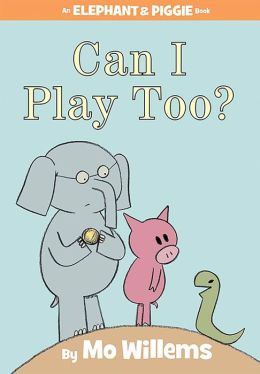
Can I Play Too? by Mo Willems is fun for readers of all ages. There is a problem presented in the story, an attempted solution that doesn't work at all (kids love this page), and a happy ending.

The combination of dialogue and pictures removes all temptation for kids to copy events from the text. Instead, they need to translate what happens on the page into new words. Perfect for summarizing!

With older students, this book is a great way to introduce theme and try to weave a theme into a summary. Would it be best to put the theme at the beginning? Or at the end?


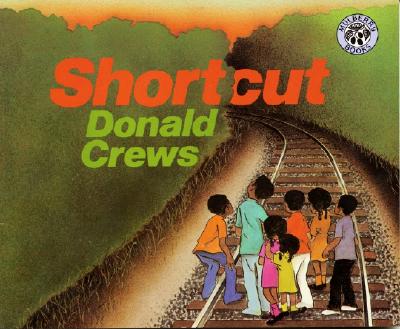
Shortcut by Donald Crews is one book that I would not be able to teach without. I use it for so many things--personal narratives, character emotions, point of view, and summarizing. Like Can I Play Too?, the pictures carry a great deal of weight in the story. This book really shows the flatness of a summary versus a narrative as a finished summary of this book includes the main events, but carries none of the suspense and excitement of the original. This is definitely a book that you will love to have on your bookshelf.

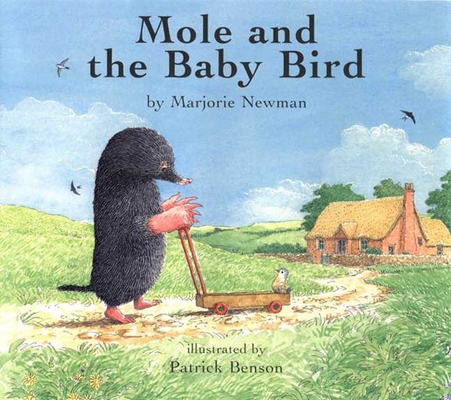
Mole and the Baby Bird by Marjorie Newman looks as if it is meant for a very young reader. However, many readers can identify with the main character's desire to keep a wild bird as a pet. This is a good book to read with students who are struggling with how to represent dialogue in a summary. How can we translate the character's words into sentences? This book is also helpful to use to review the difference between summarizing and retelling. Many students identify so closely with the events in the book that they want to include every detail in a summary. Which events can be deleted, and why?


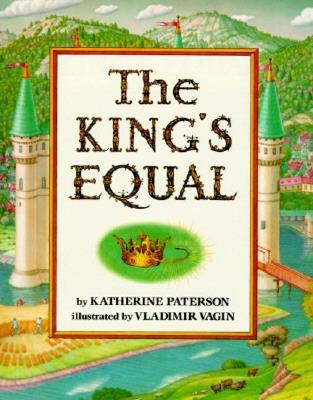
The King's Equal by Katherine Paterson is one of the first "magic books" that I shared with groups of children. I read it aloud to campers at bedtime during one of my three summers as a camp counselor...it was the perfect length to read a chapter each night. Written like a fairy tale, this story is a perfect length for chunk summarizing, or summarizing bits of a story at a time. Try writing a summary of each chapter with students. Then, at the end of the book, look at the chunk summaries all together. Do they represent the entire book? Would it be better to rewrite a summary of the text as a whole? These questions help readers to think deeply about how a story unfolds, and how to represent these plot complications in a summary. (I wrote an entire set of activities for this book--you can find it here.)

You can find more activities for summarizing stories in this unit, Summarizing Stories, from TeachersPayTeachers. For more on summarizing, check out my book, Summarizing, Paraphrasing, and Retelling.

What books do you like to use to teach summarizing stories?

Wednesday, January 2, 2013

Main Ideas: Two Ways, One Day

Today was our first day back to school after the holiday break.

Sigh.

I jumped right into the instruction, taking advantage of the mini-honeymoon period after the break to do some tough teaching. Today we looked at main idea from two different perspectives--creating details to support a main idea, and writing a main idea to fit the details.

Creating details to support a main idea
In writing class, students started writing paragraphs about their holiday break. They chose whether their holiday break was relaxing, eventful, or exciting. Then, they used a graphic organizer to collect details to support that main idea.

In this case, students were working from main idea to small details. (The entire lesson is free over at TeachersPayTeachers.) It went surprisingly easily. Students eagerly got to work, and were able to choose the details from their holiday break to support the main idea that they had chosen.


Writing a main idea to fit the details
In reading class, students went in the opposite direction. We've been researching various topics related to Antarctica. Today, students put together their notes and created main ideas based on the information they had collected.

I modeled the process with an example sheet that I had created. Here, we looked at the details. Red salamanders:

-Can be found under rocks
-Can be found under logs
-Build burrows underground
-Live in the water in winter

In typical fourth grade fashion, many students jumped into writing, "Where the red salamander lives."

"No," I said. "Remember, a main idea needs to be in a sentence! What is the sentence that you could write?"

"Um--this is about where the red salamander lives?"

It took a little bit of pulling teeth, but one student finally suggested, "Red salamanders live in different places." Great! This is definitely supported by the details. Another one said, "Red salamanders live under a variety of things." I liked this main idea sentence because every one of the details does relate to that idea of under, and the sentence showed that pretty nicely.

In the next example, students showed a little more independence. We read the details aloud and talked about how they all related to the appearance of the red salamander.

"What the red salamander looks like," one student wrote. I sighed, thought of the lost holiday break, and jumped in again. "Remember," I said, "A main idea needs to be stated in a sentence."

"The red salamander is colorful," another student wrote. This main idea is very much supported by the details--notice that all of the details have color words!

Some students noticed that the red salamander is not always red. They struggled with how to put this idea into words. After looking at various examples of a main idea, I modeled the use of the word despite.

Despite its name, the red salamander can be may different colors.

I'll be curious to see if the word despite makes its way into any of their finished reports!

Next, of course, the students will be using the same graphic organizer that they used for the holiday writing prompt to organize their research notes. Notice how this is the opposite of the first activity. Instead of choosing details to support a main idea, students will be crafting a main idea to fit the details.

Writing with main ideas in two different ways in one day--that day being the first one back from break--was actually easier than I thought. Both lessons strengthened one another. The message of supporting main ideas with details was clearly conveyed in two different ways.

And now it's just two more days until the weekend!


Saturday, December 10, 2011

Before, During, and After Reading: Before

Over the past few years, I've come to a comfortable pattern for planning reading experiences. The pattern is simple--before, during, and after. When I have all of this planned and worked out, my task as a teacher is so much easier. Here is how I frame texts to share with my students.

Before Reading
This is a harder list of words from "The Adventures of Isabel"
What will students do before they read the text? I like to make a table with key words from the text. This makes a quick and easy speed drill that we can read together before students encounter the words in the text. I like to read the words aloud to students, and then have them say the word back to me. I change my voice for each word and make it really dramatic, so kids find this enjoyable. As we come back to the text over multiple days, we return to the speed drill each day. (Cute story: We were working on The Adventures of Isabel on Friday. I accidentally called a student by the wrong name, and he looked at me and said,  jokingly, "I am really cross with you."

I also use this opportunity to talk with kids about the words. This isn't a full-blown vocabulary lesson, but a quick discussion of the words. Sometimes we act them out; sometimes I draw a picture; sometimes I show kids how a derived word relates to a base word. In the case of the word cross, I drew their attention to the fact that it is a multiple meaning word.

I've learned that it's best to limit these words to 15-20. I look for words that are important to the content of the text, as well as words that may be difficult for students. Sometimes, these difficult words are short, like "scarce"; sometimes, they are longer words that are related to words they already know, like "professionally".

After we look at vocabulary, I ask kids to use the words to make a prediction. This may take different forms. In fiction, I often have kids sort words according to story elements--which words will relate to the characters? The setting? The conflict? In nonfiction, we often write 3 prediction sentences, with at least one of the practiced words in each one. Sometimes we ask questions--for example, in a recent text, kids were intrigued to find out how the word "powerful" would relate to a text about Antarctica. And sometimes we draw pictures, doing a sketch-to-stretch kind of activity.

The goal in all of these activities is to equip kids with as much as possible before they enter the text. When I have it all planned and copied for kids, we can all immerse ourselves in our preparations for reading. I project it on the board, kids can make notes and predictions on their own copies, and we work together to get ready to read.

Free texts and activities
Adventures of Isabel: Activities to go along with the classic poem. It's a challenge for kids, but they absolutely love it, and it's a perfect choice for repeated readings. You can find the poem online.

Animal Adaptations: Science text and activities suitable for grades 4-5.

Decomposers Article and Activity: I loved reading this with kids. It worked so well to change their ideas of what decomposers are. This text includes an anticipation guide, another of my favorite before-reading activities. Good for grades 3-5.

The Acorn Mystery: I wrote this based on a real experience! It shows how these ideas can be used with fiction stories for younger readers. Good for grades 2-3.

Retelling Nonfiction: This includes a text about how painted turtles survive the winter, with directions for retelling nonfiction.


Saturday, November 19, 2011

Science: Understanding Food Chains

I love teaching science. Last year, I had the chance to pick it up again after a few years away from it. I had forgotten how much I enjoy talking with kids about their science understandings and planning lessons to help them grow.

For the past week, we've been looking at food chains. My students don't have much prior knowledge about food chains and food webs, so I pretty much started from scratch. I created this Powerpoint to introduce the basics.


Another wonderful tool for teaching about food chains is the book Who Eats What? Food Chains and Food Webs by Patricia Lauber. Patricia Lauber is so skilled at explaining difficult concepts in a clear, easy-to-understand way. I used a document camera to project the book for my class. They loved seeing the underwater food chain and thinking about how it related to our lunch that day (fish sticks!)

While I was in college, I worked as a camp counselor and naturalist. It was as a naturalist that I first discovered one of my favorite games for teaching about food chains--Into the Forest: A Food Chain Game. Since then, I have used the game multiple times in both formal and informal situations. It never fails! The kids love the beautiful illustrations. They marvel at the lists of what creatures eat others. "I never knew that skunks eat insects" or "What is a shrew, anyway?" The game works just fine with a whole class, with each kid having 2-3 cards. At first, everyone works to get the high order predators. Who doesn't want to be top of the food chain? But then I add the wrinkle of the energy points at the top of each card. While the owls and the bobcats are really awesome, they only have 1 energy point--while the less exciting plants have 10. The game changes for everyone, and we play another round before we talk about what we have learned. It becomes a favorite for indoor recess.

No discussion of the food chain is complete without a discussion of decomposers. Last year, I had trouble getting together some simple and quick materials to teach about decomposers. I wrote a short article and created an anticipation guide for it. This year, the article and anticipation guide went wonderfully. Kids were surprised to find out that they have indeed seen decomposers--and that decomposers may not be so disgusting after all!

Link to decomposers article and activities (free)

And then I finally got around to setting up an account on PBS Learning Media. This was the find of the week! Short videos on various topics are easy to find and favorite, with none of the horrible ads of those other video sites. With one search, I found a 3-minute video on the food chain to reinforce everything that I wanted students to know. Magical!

I'm actually sorry that our study of the food chain is coming to an end. But I'm excited, too, because our next unit is adaptations--and that is even more fun.

Do you have any great science resources to share?

Saturday, September 3, 2011

The Year Begins!

Well, that was tiring. Three days down, a whole bunch more to go!

The beginning of a new year is exhausting and exhilarating all at once. It's exhausting because, in those first few days, I have to teach so many routines and procedures. It's exhilarating because we are making something completely new--a class of individuals that has never existed before. It's so neat to watch it unfold. Already we have our first class jokes and shared annoyances. (Joke: The closets go to another dimension after homeroom, so you can't get anything from your backpack during the rest of the morning. Shared annoyance: The pencils that won't sharpen evenly.)

We had fun going on a world tour (remember, my tables are continents) and learning how to track hurricanes. I consciously tried to make those first few days content-rich, with lots of detailed pictures and real-time data. Each day at 11 am we've enjoyed looking at the updated information from the Hurricane Tracker.

I've been trying to get everything situated for the new year. This weekend, I've found some items that I started working on last year, formatted and tweaked them, and posted them to share.

Revising and Editing Checklists: This is a collection of checklists and activities for making clear the differences between revising and editing. Four sets of checklists (perfect for copying back to back), some editing practice, a list of revising strategies, and a revising activity. ($2)

Nouns and Word Choice: I'm trying to tie grammar instruction to the 6 Traits. This one shows how nouns can help with specific word choice. (Free)

Beginning of Year Lesson Plans for Reading: This explains how to begin your reading class and set up reading journals--5 days of lesson plans, blackline masters for the reading journal, and a fun get-acquainted activity. (The get-acquainted activity is in the free preview, so feel free to download it and use it!) Last year, this reading journal worked so well and we're already off to an impressive start this year. It's so nice to have those first few days figured out and taken care of. ($3)

I'm also teaching social studies for the first time...how exciting!


Tuesday, July 5, 2011

Differentiated Spelling: Revised!

Back in 2008, I posted a differentiated spelling program that I had created for my sixth grade class. I've revised some parts and added the missing "Assignment #2" for each list. Here's the link to the revised program:

Differentiated Spelling Program

It turned out to be over 75 pages long--enough to get anyone started with spelling for the 2011-2012 school year. Enjoy!

Monday, November 8, 2010

Thinking Ahead

When my youngest son was three, the phrase "think ahead" really baffled him. What does it mean to think ahead?

I wrote a little book about this to share with him, and sent it along to a kindergarten teacher friend. I had forgotten about it until Aidan started kindergarten himself this year. I dredged it up from the computer archives, added some illustrations, and turned it into a projectable book. Instant gratification!

You can download the compressed file, including the Powerpoint and the printable version, here.

Saturday, August 22, 2009

Back to School Poems...

Just three more days until my room is filled with students! I have a new way of thinking about being "ready". There is no magical ready moment. For the last several years, I have worked through August, trying to make things neat and tidy and perfect. And the first few days still hit me like a ton of bricks. Even worse, I had worked so hard ahead of time that I was exhausted and drained before my students even walked in the door.

So, since I cannot be absolutely ready, I'm saving my strength. I'm saving my enthusiasm, my excitement, and my energy for my time with the students. This means that I won't have a tabbed binder of student names ready for the first day of school, won't have every student name written neatly on every folder, won't have an organized library. But I will have more emotional resources to learn names, play games, and eat lunch with my students. These are the things that will be more important in the long run. My students don't ever come to me and say, "I'm so glad that you have an organized tabbed binder with all of our names in it!" But they do say, "Could you eat lunch with us? I'm a little nervous about the first day."

How will this approach work? I'll find out this week and report!

Of course, I haven't stopped thinking about school. I've just decided to focus on doing what I like. And what I like is planning. We're doing found poems and sharing some poems together on the first day. On the second day, I'm going to introduce a set of point/counterpoint poems that I wrote last year and posted over on TeachersPayTeachers. These two poems showcase two opposing feelings about coming back to school. One speaker is excited and enthusiastic, while the other wishes for more weeks of summer. Kind of the way I'm feeling right now! I hope that this will generate some good discussion with the students, and maybe lead into us writing point/counterpoint poems together.

Friday, August 7, 2009

Expository Fiction

Since I first discovered the fun of reading The Onion, I've enjoyed expository fiction. Even if you're not aware of the term (which I may have made up), you've probably read this kind of text. Expository fiction is written like an expository piece, but includes entirely made-up details.

Kids enjoy this kind of text, too. It's even more fun when the expository fiction goes along with an interesting fiction text. For example, the authors of The Spiderwick Chronicles also wrote an "actual" field guide to the magical creatures. It has all of the conventions and features of a regular field guide--entries, habitat notes, captions, and the like--for all that it is completely made up. Readers can follow up with The Care and Feeding of Sprites. Written like a typical guide to pets, it tells kids how they can capture and keep sprites!

More recently, DK Readers published Star Wars Epic Battles. From the outside, this looks like a regular DK Reader, the kind that might tell about vehicles, space travel, or interesting jobs. But on the inside, it explains various battles from Star Wars. And it uses a variety of text structures to do so, explaining how the battles were fought and won. I can see this as a book that will hook even the most reluctant reader.

What can you do with expository fiction? For one thing, it's another great way to teach text features. As I read aloud the novels from the Spiderwick Chronicles to my students, they passed around the Field Guide to find pictures of the creatures that were mentioned. They quickly learned to use the Table of Contents to help them navigate through the book!

Expository fiction also has great applications as a tool for helping students to write quality expository text. Writing a research report is a tough task for a young learner. Not only does she have to read and understand the new information, but she also has to put that information into an unfamiliar genre. Expository fiction relieves some of this pressure. Instead of having to learn and remember new information, the learner just has to make up some details. What fun! Kids can learn how to write cohesive paragraphs by putting together their own field guides to imaginary creatures, writing their own pet care guides to imaginary creatures, or making imaginary newspapers.

I started using expository fiction with my sixth graders several years ago. Students created their own country, and then wrote a five-paragraph essay to describe the features of that country. It was a fun and interesting way to introduce expository writing. If you'd like to take a look, the entire unit is posted for free at TeacherPayTeachers.com.

Wednesday, July 22, 2009

New presentations to share


I started making Powerpoints last fall, when I inherited a (slightly) broken LCD projector. I figured out the secret to making it work, and I haven't looked back. With two children and a somewhat hectic lifestyle, I find that Powerpoints help me to keep my teaching points organized and my brain in order.

One of my first presentations, "Understanding Text Structure" is nearing 3000 downloads at TeachersPayTeachers.com. It's available for free at http://www.teacherspayteachers.com/Product/Understanding-Text-Structure-Powerpoint. It's an overview of the different common text structures, with examples and explanations.

Lately I've started making some presentations for younger readers. Instead of emailing them to workshop participants, I've been experimenting with posting over at Slideshare.net. The latest one is called "Comparing is a Kind of Thiknking" and shows students how to compare. Here is the link: http://www.slideshare.net/elkissn/comparing-is-a-kind-of-thinking. Downloads are quick and easy.

And, in between cross-posting and blogging and getting into Web 2.0, I've also squeezed in visits to our local state parks...the frog picture on this post is from Kings Gap State Park, where Zachary counted 33 frogs from one location. Pretty neat!