Thursday, June 17, 2021

Looking Back: Classroom Libraries and COVID


This year has been tough! My school was face-to-face with the entire class for almost the entire year. Last year, I wrote about plans for a classroom library in the face of a pandemic. Now, I'm at the happy point of looking back on the year and thinking about lessons learned.

Taking Books from Room to Room

   Because I moved about this year, I couldn't have a typical classroom library. Instead, I had to take a bin of books with me from room to room. (By the end of the year, I was carting a tall table and an overhead cart with handouts and books!) 

    I expected this to be harder than it was. My start of year book survey helped me to do first day book assignments. Then, I could pick out follow-up books to put into my book bin to cart from place to place. I did make many trips back and forth to my classroom to get books that I'd forgotten; luckily I had a co-teacher for two classes and a lunch break in the middle of the other.

   I had some tried and true books that went with me and were in almost constant circulation! Because of this year's overall atmosphere, I found that kids gravitated toward quick and fun graphic novels. These were the all-time favorites from the year.

Teacher Sign-Out Book

    In the past, students have been responsible for signing out books. This year, I needed to keep the sign-out book myself. Returned books went into a quarantine bin, while I checked books in and out with a sign in book.

   And this worked out wonderfully! In fact, I think that I will clear the first 10 minutes of every class this year to do this again. I kept better track of books than ever before. Previously I had thought that I absolutely could not handle writing down student book checkouts, but I learned otherwise. It worked out well and helped me to have short conversations with readers every day. 

No Browsing

   At the start of the year, I worried about the lack of browsing in my classroom library. However, this turned out to be less of an issue than I thought. Between the book survey and my traveling book bin, I managed to get kids set up with the next book they'd like pretty easily. Each morning, I would sort the quarantined books that were ready to be returned, check my notes for what to take the next day, and get my book bin set up.

   In fact, I noticed that no browsing meant that more time was spent reading. Students became more skilled at asking me for the kinds of books they'd like ("Mrs. Kissner, I want something that's sad and long") and I got better at making recommendations. I did sometimes give students three books that I'd selected for them to look through. They could choose one and return the rest to the quarantine bin.

   I don't think that I will disallow browsing for the future, but I think that I will limit it. I always have a core group of students who like to avoid reading, and too much freedom to browse gives them time to do this. Finding a balance between browsing and teacher recommendation is my task for next year!

Outdoor Reading Time

   This isn't something new for the pandemic...but wow, does some outdoor reading time brighten everyone's mood! In the first few weeks of school, I had students bring along a beach towel to sit on outdoors. Our bright and sunny courtyard was the perfect place for fresh air, reading time, and much-needed social distancing.

   In my end-of-year survey for students, independent reading time rated highly as one of the favorite activities for students. In fact, several students suggested that I give more time next year! This just goes to show that independent reading is important no matter what. 

Lessons for Next Year

   What will next year bring? I can't even begin to guess. But I have learned some new tricks for my classroom library and figured out how to make daily reading time work in a wide range of situations.

Tuesday, June 15, 2021

Why You Should Teach Emily Dickinson's Poems in Sixth Grade

 In looking for poems to share with students, I love to go with the work of Emily Dickinson. Here's why!

Her life story is intriguing to students

Today's students find Emily Dickinson's life fascinating. Her reclusive nature and quiet life are mysterious, and counter to what many students experience. Teaching about Emily Dickinson helps students to consider how an author's life experiences impact their work.

Emily Dickinson's poems are great for teaching theme

Helping students to identify themes in poems and to write to explain those themes is a big task in sixth grade! Luckily, Emily Dickinson's more popular poems have fairly transparent themes. "If I Can Stop One Heart from Breaking" and "I'm Nobody! Who Are You?" are two that work especially well.

Emily Dickinson's poems appear on standardized tests

I know that this isn't a reason to teach a particular author's work, but the fact that Emily Dickinson's poems frequently appear on tests is important to me. I always emphasize to students that they should try to enjoy what they read on tests...and if they can recognize an author's name and meet the text as if they are greeting a friend, then that makes the testing experience much more pleasant for them. 

You can sing them!

I frequently torment my students by singing to them, and the poems of Emily Dickinson work really well for this. In "Crash Course," (which is a great resource for teacher background!) John Green sings Dickinson's poems to "I'd like to teach the world to sing," but I prefer to sing the poems to "The Addams Family." It works because of the meter of Emily's poems...and is also a great way to show students what meter is.

Ready to use resource

This spring, I made a hybrid resource for my students to showcase the life of Emily Dickinson. I like to have a weekly assignment for students to work on, and this resource includes activities for vocabulary, informational text comprehension, and poetry.


Monday, July 27, 2020

Classroom Libraries and COVID

The coming school year will be different from any other. As teachers prepare physical and virtual classrooms for the start of the year, many questions loom.

One of my favorite rituals for a new school year is preparing my classroom library. I love selecting new books, organizing the space, and thinking about what my new students will like best. But what will this year bring? 

A lot of questions, that's what! I've been thinking about these questions for the last few weeks (much to the annoyance of my family, especially on a beach vacation!) While I don't have definitive answers, I hope that my thought processes may be helpful to others who are dealing with these same issues.

What about the classroom library space?

Usually I devote about 20 square feet of my classroom to the classroom library. This year, I can't afford that space. With trying to maintain 3 feet between 24 students, I need to use the physical location of the classroom library for student seating.

And this is fine, because the usual social activities of the classroom library (browsing, chatting, sitting on soft furniture) are not safe right now. Better to not even introduce the classroom library than to put strict limits on how it can be used. 

This is one time when moving classrooms is going to help me! My books are already packed (and half are at my house), so it won't be hard for me to adjust my space. If I had carpets and soft furniture in my classroom library, I would probably bring them home or put them into storage for the year. 

Where will books go?

In my classroom....I'm not sure yet. New classroom, right? I'll have the books on the shelves (where else could they go?), but I may cover the shelves with tablecloths as we do during standardized testing to help reinforce the idea that kids can't be taking and replacing books at will. (Sad but necessary!) I will be pulling the most popular, best books to prepare to hand out to students.

How can I help kids to select books?

When everyone needs books at once, it's always been easier to get the decentralize the books. Usually, I pull out my top 100 books into bins for the first two weeks of the year. Then, I put one bin at each table to allow for easy student browsing. My goal is to get every kid into a book within the first two days of school, and I'm usually successful!

This method won't work for the 2020 school year! Once a book is touched by a student, I will have to set it aside for at least a week (see guidance here). This means that I'll have to use other methods for students to sample books. I'm going to have to be  more firm with keeping a lid on the "flitting" habits that students have early in the school year. Once a student selects a book, that book will be out of circulation for at least two weeks (one week to read, one week for quarantine)...so I need to help students make thoughtful choices instead of just grabbing a book at random.

Book trailers: Trailers are highly effective and motivating for students! I'm already starting a

First chapter reads: For books that don't have strong trailers, reading a portion or a section aloud can help to build student interest. I'm going to count on the document camera to help me out here! This is especially useful to help readers gauge the difficulty of a book.

Book survey: This Google Form (Book Survey) can help you to collect information about student preferences.

What should I do with returned books?

Ugh. This is the hardest question of all, isn't it? Right now, I'm thinking about going with a one-week quarantine for books and using a two crate system. In the first week, I'll have one return bin out; at the end of the week, I'll put it aside (or probably cover it) and pull out the second bin. Once that week is over, I'll replace the books from the first week and put aside the second bin. (This might change if I get different guidance from the school or state guiding me toward a longer quarantine period for materials.)

I always spend time working on library management at the start of the school year. This year, I'll have to add directions about how to return books safely and why students shouldn't share books. It will be an adjustment, as will everything this year!

Shouldn't we be worried about bigger issues?

Yes! There are so many issues surrounding the restarting of school. I'm so anxious, all the time! However, making plans helps me to soften the anxiety and focus on what I can control.

Getting books into the hands of kids has always been one of my main goals. This year, I have to expand my thinking to plan how to do this safely. What changes will you be making to your classroom library?


Thursday, May 7, 2020

Reading Activities for Distance Learning

Reading activities for distance learning should be more than just glowing worksheets! In fact, distance learning offers us some fascinating affordances in terms of what kinds of activities we can create for our learners.

Read along activities

Having students read along with a text can be a great way to build automaticity with new texts. In this reading selection, I have chunked the text so that students can pause to read along.  This kind of shared reading would also work well for distance tutoring sessions.


A printable version of this reading selection can be found here.

Adding videos to reading selections

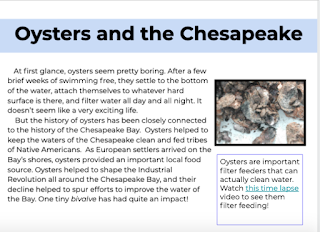
Sometimes a short video can do wonders for building background knowledge. When I create digital reading activities, I like to add links to short videos. For example, in this text about oysters and the Chesapeake, I added a time lapse of oysters feeding. This visual imagery helps readers to visualize the way that oysters filter water--a key idea in the text that they are reading.

https://www.teacherspayteachers.com/Product/Informational-Text-for-Distance-Learning-Oysters-and-the-Chesapeake-5531162

Questions on the same page as the reading selection

For students who aren't used to working digitally, managing multiple tabs can add an extra layer of difficulty. Putting questions and activities on the same page as a set of Google Slides can make it easier to go back to the text.

https://www.teacherspayteachers.com/Product/Monarch-Life-Cycle-A-Distance-Learning-Text-5493640


I'm working on making some digital reading activities. Many of them will be free until June 30. Feel free to try one out! And if you do...leave a message to let me know how it worked out!

Monarch Life Cycle: Distance Learning
Informational Text for Distance Learning: Oysters and the Chesapeake
Tulips Through Time: Paired Passages for Distance Learning
Groundwater: Resources for Google Classroom
Weather Sayings: Paired Passages for Google Classroom


Tuesday, August 6, 2019

Reading and Writing Handbook

Papers can quickly become overwhelming in the ELA classroom! I've learned that if I don't have a plan for where students will put their papers and when these papers will become obsolete, folders quickly fill up with extraneous pages. No one can find anything!

For easy classroom organization, I provide my students with a one-inch binder. This binder becomes a place to store ongoing ELA work as well as to keep texts and resources. However, this hasn't always worked perfectly. Despite my exhortations to "Clip papers at the back of your binders!", sometimes papers just don't end up where I had intended.

For the past two years, I've been planning to create a Reading and Writing Handbook--a one-stop shop of resource pages for students to keep at the front of their binders. After months of planning and thinking, I finally put together 30 pages of my favorite resources for students!

My goal is to be able to say, "Let's turn to page___" and discuss whatever is on that page. Sometimes the pages will be for instruction; sometimes I'll just put the page number on the board as a reference. If your students are like mine, they probably ask again and again for the definition of theme. Now I can just say, "Remember, if you'd like to review what theme means, turn to page 13 in your Reading and Writing Handbook."

I'm really excited to try out this handbook and see how it works in the classroom! If you have any questions or would like to see a resource added, please let me know. I'd love to hear what works and what is needed in other schools.


Monday, August 5, 2019

Classroom Jobs for Sixth Grade

      When I first moved from middle school to elementary school, I debated whether or not to have classroom jobs. Aren't assigned jobs a little too childish for sixth graders? Would they roll their eyes at the very idea?
      I quickly learned two important lessons:

  • Sixth graders enjoy having jobs, and
  • Classroom work has to get done!

     But what jobs to have? And how to select them? Over the years, I've asked myself this question again and again, finally settling on a pretty easy and manageable system that requires very little of my input through the year.

The job chart

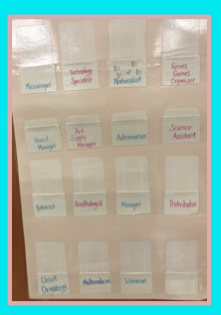
I used library pockets on a big piece of poster board. Students write their names on the top of an index card, and then I or someone else chooses cards at random and students place their cards in the pocket of their choice.

I have enough jobs for half the class. If I have too many jobs, then there are too many jobs that simply just don't have enough to do. With student input, we also double up on some jobs as we see fit.

Messenger: Takes the attendance folder in the morning, runs other errands as necessary
Technology Specialist: Moves the mobile lab in and out as needed, hands out and collects computers
Naturalist: Depending on what animals we have in the classroom, this person feeds the fish and handles other animal care
Recess Games Organizer: This person manages recess equipment for indoor and outdoor recess
Pencil Manager: Makes sure that there are sharpened pencils available and handles pencil sharpener care
Art Supply Manager: Hands out and organizes art supplies like colored pencils and markers
Astronomer: Changes the moon phase posters
Science Assistant: Helps with whatever science experiments are going on in a given week
Botanist: Waters the plants
Ornithologist: Refills the birdfeeders and makes sure that bird data is being kept
Manager: Makes sure that everyone is doing their jobs! The manager also substitutes for other jobs if students are absent
Distributor: Hands out papers
Closet Organizer: Student belongings are kept in a closets that quickly get messy! The closet organizer checks the closets and makes sure that things are kept neat
Mathematician: We find that we have many math tasks, including adding minutes for Preferred Activity Time, charting temperature data, and making a Calendar Math Schedule
Librarian: Puts up book displays, manages the book sign out binder

Be sure to leave an empty pocket or two to add jobs as needed!

Changing Jobs


I like to change jobs every week. Usually, we end up with Wednesday or Thursday as the rotation day. Because I pair this with my classroom economy, students get a salary for completing a job. (Last year I made the salary be $100, but this led to ridiculous inflation. I'm thinking I'll start at $25 this year.) The manager hands out the salaries by taking the index cards from the pockets to use as a reference. While this is happening, someone else is handing out the cards for the half of the class that hadn't had a class that week.

I have experimented with job applications, but I've found that they take too much time when I'm trying to run the classroom jobs in the background of our other classroom activities.

Besides, with an open job policy, students can try out all kinds of different jobs. Do students gravitate to certain favorites? Of course! However, by handing out the cards randomly, I try to control for this.

Class Culture


The jobs chart becomes an integral part of who we are as a class. One student, trying to read the chart from across the room, misread "Distributor" as "Disruptor". He thought it was hilarious that I would have Disruptor as a job! From then on, when students spoke out of turn everyone always chided them, "It's not your turn to be the Disruptor this week."

The job chart is also a chance for vocabulary building. It takes time for students to sort out Botanist vs. Ornithologist, but these are great real-world experiences for them.

Are there times when students don't do their assigned jobs? Yes, it happens. The Manager usually does a good job of reminding people what to do.

I find that this method of managing jobs leaves plenty of room for students to take over the system and turn it into their own. Some years they do, and the jobs morph into something amazing. Some years they don't, which is fine as well...every class is different.

What jobs do you have in your classrooms?

Monday, July 22, 2019

Reading Comprehension: The Qualitative Reading Assessment

If you're looking for a quick and easy reading assessment that yields a great deal of information, you can't go wrong with the QRI. Short for the Qualitative Reading Assessment, this assessment is my go-to for start of year assessment.

Because this is a commonly used text for professional classes, it's easy to pick up a used one for an affordable price. I'm still using the 5th Edition, although there is a more recent one available.


Because you get a spiral book, there is a bit of test set up required. However, it's all easy to manage with a school copy machine and some basic supplies.

The QRI consists of two parts: Word Lists and Comprehension Passages.

Word Lists

My co-teacher and I administer the word lists as soon as possible in the first few days of school. Like many other reading tests, students move through sets of words that get more and more difficult. For students with known past reading problems, I start at the Pre-Primer or Primer level. For students who are likely to be on grade level, I start at Level 2 or 3. Each list has 20 words, and I usually stop when students fall below a 14/20 or seem to be getting frustrated. Because I teach sixth grade, I rarely go past the Upper Middle School list.

As you can see in the photo, I give kids a copy of the words on the a word ring. Copied onto cardstock, the word lists are durable and last for years. I used a clipboard to lean on. If the weather is nice, we go outside! (Other students are doing independent reading during this time.)

After I've heard students read, I always give a bit of positive feedback about what I heard. "I liked hearing how you tried some tricky words," or "It was fun to hear you read a word list with
expression!"

I can learn so much from hearing kids read lists of words aloud! I do write down missed attempts at word solving because these attempts help me to see patterns of decoding and figure out the best ways to help students.

Because it's so early in the year, I keep the entire interaction upbeat, fun, and most of all, brief. We get through the word lists within 3 days.

Comprehension Passages

I've learned to really like the comprehension passages from the QRI. There are multiple options for each grade level labeled as narrative and expository, giving me a wide range of options from which to choose.

Where do I start students? Because I'm doing the QRI for my own purposes, I get to decide! My co-teacher and I usually look at the students' word list results and go with the student's instructional level. However, this is not a hard and fast rule. For a shy or timid student, we might choose a text at an independent level to build the child's confidence. I know that I can always go and pull another passage if I need to.

I keep passage copies in a file box and add more copies as needed. (This is a great copying task for a volunteer or a substitute!) Because I've switched grade levels a bit, my file box is a mish-mash of recycled folders. Oh well.

Each comprehension passage includes 6-8 comprehension questions, sorted as literal and inferential. I do a timed reading, prefacing it by saying, "I will have the timer going, but I'm much more interested in hearing your expression and your word-solving than in seeing how fast you can go." (I hate it when I go to listen to a student read and they take a big gulp of air before starting. That's so not the point!)

The QRI includes a retelling section. I'm often tempted to skip it, because it does take some time, but it's a useful tool to help students think about how much they remember from a selection. Also...well, as the author of a book called Summarizing, Paraphrasing, and Retelling, I feel that I shouldn't skip a retelling task!

My favorite part of the QRI is that I write down the student's answers, which means that I'm getting a clear picture of the student's reading and not their writing.

I also like to see the breakdown of student scores on inferential vs. literal questions. A student who does well on one but not the other will need some different instruction than a student who misses questions equally from both areas.

Sometimes a first assessment doesn't answer our questions about a student's reading. In this case, my co-teacher and I will often move up or down.

All in all, the QRI is my favorite start of year reading assessment! What's yours?