Monday, June 22, 2015

Building Content Area Reading Skills: Nominalizations

This summer, I'm reading The Tale of the Dueling Neurosurgeons at the recommendation of my 16-year-old. While I would never use this with elementary students, reading this book helps me to think about content area reading and the challenges that our students face as they read in the content areas. As I look toward a switch to sixth grade, I'm looking at more sophisticated content area reading selections, and so I want to be ready! 

Content area reading brings some big challenges for readers. Readers have to learn new vocabulary, figure out the style of the writer, and understand new concepts. One aspect of content area reading that I find especially intriguing for readers is the idea of nominalizations. 

Here is an easy example of a nominalization:
nominalization
Northern water snakes can be brown, gray, or reddish. These differences in coloration can cause confusion among wildlife viewers.

In this sentence, the word coloration refers to the different colors that are possible for the northern water snake. Nominalizations are great for writers. Writers can change a verb into a noun and flexibly refer to a whole range of concepts. This is why we see nominalizations so often in formal, content area text--they are efficient, they are precise, they carry loads of meaning in a little space.

However, nominalizations can be tough for readers, especially when they refer to an abstract concept. Consider this example:


The word "restoration" is important to the text. However, readers may have trouble making the connection between the previous sentence and the meaning of restoration. Instead, they may think that the paragraph beginning with restoration is introducing a new topic. An entire section of the text will be fuzzy for them, which will cause problems for making inferences later in the text! 

Clearly, teaching content area text means that we need to find and teach these tricky words. Here are some ideas to remember.


For further reading:


Bergen, Benjamin, Shane Lindsay, Teenie Matlock, and Srini Narayanan. 2007. “Spatial and Linguistic Aspects of Visual Imagery in Sentence Comprehension.” Cognitive Science  31: 733-764.

Fang, Zhihui, Mary Shleppegrell, and Beverly Cox. 2006. “Understanding the Language Demands of Schooling: Nouns in the Academic Registers.” Journal of Literacy Research  38:3, 247-273.


Friday, June 12, 2015

Close Reading and Textual Analysis

    This week I had the pleasure of talking about close reading and textual analysis with some of my colleagues. It's been a topic that I've been working with all year, as I have helped my fourth graders to analyze texts and create passage-based essays. Here is the presentation if you would like to check it out. 

Close Reading and Textual Analysis

 I've also been working with using short videos in class. I love short videos because they are so engaging for students, and they really help students to sharpen their analysis skills. For this workshop, I created a playlist of some videos that are short, yet offer a great deal of depth and complexity.


Creating the playlist took some time. My family is used to me spending hours watching the best and worst of YouTube's educational offerings as I work on Frolyc activities...and I often call them over to see my favorites! Many of these come from Ads Worth Spreading. It's interesting that these advertisements operate on multiple levels--they are ads, so they are selling something, but they are also well-produced and thoughtful.


Close Watching of a Video

Because I'm moving to sixth grade next year, I decided to take the time to create a start of year activity. I made this textual analysis activity to go along with the video Saroo Brierley: Homeward Bound ad.


Textual analysis gives us so much to talk about! 

Friday, June 5, 2015

Making Inferences: Resources for Teaching

"What do you have for making inferences?"

When I read this question, coming just at the end of school, I knew that I needed to create a post to gather together all of the resources that I've made for teaching inferences. And there are quite a few! Over the years, I've found that teaching students how to make inferences is essential for building reading skills. It's fun, too!

I have another reason for wanting to look over my inference resources--I'm moving to sixth grade next year! I'm excited to move down the hallway and see some of my former students again. I'm also excited to look at the resources that I have and think about what I'd like to use with older students.

Making Inferences, Making Meaning Presentation (free)
This presentation is a great place to start. In the slides, I explain different kinds of inferences with examples and teaching tips.


Building Mental Models (free)
This printable is a great tool to use to see how students in grades 2-4 are doing with making inferences. Should Zomack put liquid on the box with the moving pictures? Watch kids carefully as they work on this with a partner--kids who laugh and say "No way!" are visualizing, while kids who struggle may need some more work on this skill.

Visualizing PowerPoint and Activities ($)
With students, I love to start teaching about inferring with visualizing. Think about it--writers never tell every single detail needed to imagine a place. Instead, they rely on the background knowledge of the reader to fill in some of the necessary information to make a visual image.

This resource pack includes teaching tools for teaching about visualizing, as well as stories and activities for independent practice.

Making Inferences with Transitional Readers ($)
This unit includes texts for readers in grades 2 and 3. The texts are easy to decode, but require some level of inferring to figure out what is going on. I've had really great experiences with teaching "The Magic School", a story with embedded questions. These questions help students to see where they should be making inferences.


Making Inferences: Antarctic History (free)
I created this resource to help my students as we learned about Antarctica. This text includes both text-based inferences (like pronoun/antecedent) and more complex reader-based inferences that depend on a reader's background knowledge.


Character Traits and Emotions: Making Inferences ($)
I've loved putting this resource together, and I love teaching it. Making inferences about character traits and emotions is an important skill, made even more so by the current emphasis on complex text and more sophisticated literature. In this resource, you'll find lots of teaching materials that you can use to help students realize that they can make these inferences "online"--while they're reading--and that their understanding of the text will be enriched by these inferences.


Figurative Language PowerPoint and Activities ($)
Interpreting figurative language requires some strong inference skills! This resource includes lots of practice to help readers understand how to interpret figurative language.

Text-Based Inferences and More ($)
This resource pack includes a set of texts which require readers to make specific text-based inferences, as well as some assessments and PowerPoints. Kids have really enjoyed the "Max Mission" spy texts. Similar formatting and storylines across four short texts help students to quickly transfer skills from one text to another.

Blog Posts

Here are some blog posts that I've written over the years.

Making Inferences in Nonfiction
Questions Lead to Inferences: I firmly believe this. If kids aren't making inferences, guiding them to asking questions of text is a great place to start.
Visualizing and the Common Core
Scaffolding the Inference Process: Lots of suggestions for picture books
Inferences with the Inference Chart
Suffixes and Inferences: Surprisingly, they can go together!


Wednesday, May 20, 2015

Summer Literacy Plan

The clock is counting down to the end of the school year! When the smell of honeysuckle floats through the air and the sounds of "Slap Billy-Ola" echo at recess, I know that summer is coming.

My readers this year have been such a wonderful, engaged group. I wanted to create something that would keep them reading and writing all summer long. I created this Summer Literacy Plan for them!


Today, I introduced the summer literacy plan in class. The students were eager to think about it and make great summer reading plans. The plan suggests that students create at least one goal for each area (literature, informational text, writing, and fluency). To my delight, many students were making multiple goals for each area!

After students talk about their plans with parents and return the plans with parent signatures, I will make copies to give to their next teacher, who is also excited about summer literacy. Plans and record sheets will go home in report card envelopes, which I think will make them seem more "official". I'm looking forward to great things!

Helping students to plan for summer literacy is so important. How are you getting students ready for summer reading?

Sunday, May 10, 2015

Sea Turtles and Expository Text: A Peek Inside

I love writing short expository texts, and I love sharing the texts that I create with other teachers. 

But I can't deny that there is always an uneasy tension between my inner writer and my inner teacher as I start a new project. The inner teacher says, "Wouldn't it be cool to have a set of texts with x, y, and z?" The inner writer groans--"You want what? Do you realize how hard that will be to write?"

So there is a sense of compromise between teacher and writer. I have seen enough hideously contrived texts to know that I shouldn't keep going if something isn't working. Teacher and writer must negotiate to come up with a workable compromise. (And all of this is going on in my head!)


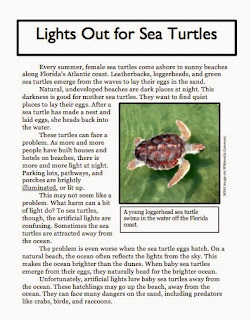
Lights Out: Problem/Solution


This spring, I started to write a series of texts about sea turtles. The project began with a problem and solution text about the importance of turning out lights during nesting season. I find problem and solution to be one of my favorite text structures, probably because it is inherently optimistic. I also love the symmetry of problem and solution. It's fun to write.

I generally prefer to do all of the writing first before I mess around with formatting. Adding the formatting gives me another chance to reread every bit of text. I often read everything aloud to my family as well--my ten year old is a great listener and offers useful criticism. 

After the text has been written, read, and reread, the teacher side takes over and works on questions and activities. Waiting several weeks between text and questions helps me to look at the piece as a teacher instead of as the writer. This year, I've been experimenting with adding synthesis tasks to reading sets. These are very similar to the performance assessments that we used in the late-90s, but with a Common Core twist. Yes, they tap some of the skills that will be needed for high stakes testing, but they are also activities that are real and relevant for students.


Compare and Contrast

After I finished the problem and solution texts, I moved on to the bigger challenge--two compare and contrast texts, each one about two different sea turtles. 

These texts were hard to write. The writer in me balked at writing them, but the teacher stood firm--these are necessary. Compare and contrast is one of the hardest text structures to use. There are two topics, and the writer must work hard to balance them and make clear transitions back and forth. All too often, compare and contrast ends up sounding choppy and awkward. And conclusions? Natural, fresh conclusions to compare and contrast texts are especially difficult.

Of course, this is the lesson that the teacher-me wanted! I saw the need for two texts, both compare and contrast, but using different styles of organization. Compare and contrast texts can be alternating or clustered. Before students look for these structures in the real world, it's helpful for them to see study texts that present each. Texts on similar topics will help them to focus on the structure of the text instead of the content.

The first text, "Loggerheads and Green Sea Turtles" is written in the alternating style. This took a great deal of research and many hours of time. I found conflicting information from various credible sources, and delved deep into Google Books and other sources to find the best information possible. From a writer's point of view, I did create a comparison chart to gather my details. (I hate Venn diagrams for writing.) 

The second, "Leatherbacks and Kemp's Ridley Sea Turtles", was a little easier. I used the clustered style, which deals with each topic in turn. Writing these two texts really helped me to see the strong similarities between description text structure and compare and contrast. After all, clustered compare and contrast could be looked upon as double description. 

The close reading activity that accompanies these texts is the one that my teacher self envisioned at the start of the project--using colored pencils to underline sentences referring to either kind of turtle. As I made the answer key, it clearly showed the difference between alternating compare and contrast and clustered compare and contrast. Victory!

The final activity of the unit challenges students to create their own compare and contrast text, using whichever style they would like. A chart of information is provided to make the task more of a writing task instead of a research task. 

Thank you!

Combining teaching and writing is a challenge. I'm so grateful to everyone who has purchased my texts on TeachersPayTeachers and offered such positive feedback. Thank you! 

You can find the texts and activities here:
Sea Turtles Expository Text


Sunday, April 26, 2015

What Happened When I Said, "No More Graphic Novels!"

    First of all, let me just say that I love graphic novels. This year, the books of Kazu Kibuishi, Ben Hatke, Michael Rex, and Raina Telgemeier have been hugely popular with my fourth graders. As is to be expected--they are gorgeous, well-written, and totally engaging. I have encouraged students to make graphic novels a part of their reading experience, and allowed independent reading time in my classroom to be pretty free and open to most books (with the exception of Garfield and World Records books--arrghh.)

    However, as I fielded requests for the missing copy of Amulet 3 and watched students flit restlessly as they waited, I started to think about what kids haven't read this year. The list was alarming. No one has picked up the Dragon Shoes series by Jessica Day George. A few students read Frindle, at my suggestion, but never moved on to the other Andrew Clements books. The series Among the Hidden, which has been a perennial favorite of fourth grade, was virtually untouched.

    So I did it. I said, "Between now and May 18 you must all read one chapter book, approved by me. Not a graphic novel."

    I expected resistance. I expected sulking. I expected anything except what I got.

    Because what I got was--total acceptance. "Can you help me find a chapter book?" one student asked.

    In two weeks the reading of the classroom changed. I have students on the fourth book of the Among the Hidden series. The One and Only Ivan has changed hands twice. Students have brought in their own books, from home or from the library, books that they have had and have been planning to read but never did. Kids who thought that books with no pictures were too hard for them or no fun are liking what they find.

    And they are still reading graphic novels, only now they are using them at extra times throughout the day--before school, in between classes, whenever they have an extra minute. In fact, my decree seems to have only increased demand for graphic novels.

    I love the surprises in teaching. In this case, a restriction led to more reading. Instead of feeling deprived, my students seemed to thrive. Would this have happened at the beginning of the year? I don't think so. I think that the experiences students had with graphic novels have gotten them ready for reading all of these other books. They just needed my nudge to get them there!

    Have you ever done something like this--something that surprised you? What were the results?

Tuesday, April 21, 2015

Animal Adaptations Synthesis

    What kid doesn't love learning about animal adaptations? In this age of Wild Kratts and Nat Geo Wild, it seems as if students know more about animals than ever before. An animal adaptations unit is the perfect way build on this background knowledge and encourage students to consider topics more deeply. It is also the perfect springboard for overlapping cycles of inquiry.

Animals in the Classroom

    I've never had hamsters, gerbils, or other typical classroom pets. But the classroom is always filled with animals! We've had mealworms, crickets, visiting toads and salamanders, tadpoles, and of course the birds who visit our feeders.
    The different animals have appealed to different groups of students. One boy (who happened to sit near the window) took an especial interest in recording the numbers of birds that we saw. He learned to identify the common species and started giving lessons to other students. Over the course of the last few months, students have noticed that different birds prefer to feed in different places. "The chickadee and the tufted titmouse both come to the feeder, but the robins never do." 
    Just a few weeks ago a student brought in some wood frog eggs, which have hatched into tadpoles. Students noticed that the tadpoles stay still most of the time. "Are they dead? They're not moving," was a common comment of the first few days. 
    These experiences with watching and noticing were vital for our later talk about animal adaptations. Students began the formal lessons with their own firsthand experiences instead of just having secondhand experiences. These firsthand opportunities to observe and talk about animals in an informal way built a firm foundation for our later lessons.

Adaptations Lessons

    Several weeks ago I started more formal science lessons about animal adaptations. I started with a text that I wrote  few years ago, a text designed to get kids saying the word "adaptations" over and over again! 
    Then, students participated in a bird beaks demonstration activity. Using simple household materials, students tried out different model bird beaks. (Directions for this activity are easy to find; my set of full instructions with student pages is available here.) 
    During and after the activity, students mentioned birds that they knew: "This is like a cardinal," they said confidently at the sunflower seeds station. "Do any of our birds eat bugs in bark?" a student asked at the other station. (I loved the use of our birds!)
    Students also used an embedded presentation on my student blog to take notes about camouflage. I've gone back and forth about categorizing examples of camouflage. On the one hand, it seems like going into too much detail. On the other hand, giving students lots of examples and strong vocabulary really enhances their conversations later.
    Right away, students were applying the ideas from the formal lessons into their daily observations. "The tadpoles don't move, probably because they blend in with the bottom of the pond," one student said.
    Looking out the window, another student reflected, "The robin's beak is like a set of chopsticks! I just saw it get a worm!" 

Synthesis

    With all of these experiences, it became time to synthesize and put it all together! Students were asked to choose an animal and find information about its adaptations. 
    This wasn't a normal animal report--students were specifically looking for information about the animal's adaptations. Some students chose to look back to animals they have previously studied. "I did a report on the red panda in third grade, can I work on it again?" one student asked. Other students took the opportunity to research new and unusual creatures. I offered a coupon bounty to students who would agree to study invertebrates--hey, invertebrates need some love! 
    By this point in the year, students should be capable of conducting a simple Internet search and using the application of their choice to create a product. For the most part, things went smoothly. Questions came from students who needed some more help with crafting search terms or wondered how a feature helps an animal to survive. My hardest challenge? Keeping up as kids called my name from around the room--not for help, but because they wanted me to see the cool information they were finding. 
    It was nice to see the synthesis of content and process in this stage. We have come so far as a community that whenever there was a question of "How do I...?" multiple hands went up to help.  The conversations also centered firmly on the learning, as students were engaging with Internet resources to find adaptations that helped their creatures to survive. Yes, they loved it, but even more importantly, it was an activity that highlighted key learning for our grade level.

    Informal experiences can have a huge impact on more formal units. When working with animal adaptations, I saw that our work all year led to serious thinking about animal adaptations.
   And this is not bad for Day 5 of PSSA testing!