Wednesday, January 16, 2013

Wrapping up nonfiction

We're getting ready to finish our introduction to nonfiction unit. I'm looking forward to a short poetry unit before plowing forward into text structure. Here are some things that I've added to my nonfiction teaching over the past two months.

End of Unit Reflection
For my reading classes, each student has a folder that stays in the classroom. This helps to keep everyone organized from day-to-day. However, these folders can get very full by the end of a unit! This year, I've started doing an end of unit reflection page before we clean out our folders. As students fill in the blanks on the reflection page, they reflect both on the content of the unit and on the reading skills that we've worked on. It's a nice but low-key way to add some closure to the unit and send home all of the classwork that we have accomplished.

Firsthand accounts
This year I jumped into looking at the differences between firsthand and secondhand accounts. How interesting! Luckily, when learning about Antarctica, great firsthand accounts are easy to find. We started by looking at the LTER blog. This year's author has an easy, kid-friendly style. Kids were excited to see such recent blog posts! As we read the projected blog on the screen, I experimented a bit to see how kids were processing the text.
-How do we know that this is a firsthand account?
-Can we figure out the author's attitude toward the events? Which words convey her feelings?
-How do the pictures add to the information?
We also played around a bit with how to navigate a blog and what all the different links mean. Overall, this part of the class was successful and I felt as if starting with a blog was a good idea.

Then they moved on to reading a firsthand account, "The Chilling Fields", a story about a fire aboard the Aurora Australis. This text is a little harder for them, and they are having some trouble piecing together what happened. I'm listening in on their conversations to help me figure out how to adapt the process of reading and thinking about a firsthand account to younger readers. Tomorrow they'll be looking closely at word choice to figure out the author's attitude toward the events. It will be interesting to see what they come up with.

I am working on a sheet to guide readers through the process...write to me if you'd like a copy! It's still very much in its early stages.

Vocabulary quizzes
I'm still experimenting with this. You may be familiar with the weekly homework packets that I've been making. This year, I'm adding a vocabulary quiz to try to boost student accountability. I like the quizzes in that they are increasing word consciousness and helping students to pay more attention to vocabulary activities that we do together. You can find the winter homework packets here. Topics include polar bears and penguins, the LTER cruise, birds at a birdfeeder, and the flu!

Looking forward to poetry
I can't wait to start poetry. In the past, I've gone right from this introductory nonfiction unit to text structure. I think that poetry will be a fantastic break for us and a nice way to look at very different texts.


Tuesday, January 8, 2013

Test Taking Strategy: Key, Magnifying Glass, Ruler

This is a fun strategy for teaching students to attack multiple choice questions. I created it last year when I saw that many of my students were impulsively circling any old answer that kind of went along with the text. For these students, the task of reading the multiple choice question is a huge cognitive load. How could I help them?

I decided to create a simple mnemonic tied to concrete objects. Just like the "click and clunk" strategy, I wanted something that would teach itself. Once students know the objects, they can draw them at the top of every test. Then they can use the objects to help them as they answer the questions.
These strategies work for most questions. Best of all, they give kids a place to start when confronted with a page of multiple choice questions!

Because I wanted to give students some practice, I made up some daily warm-up activities. There is one text per week, with a question for each day. So far, it's just the right amount of test prep--about 5 minutes each day, with a short discussion, and then it's on to better things!

Wednesday, January 2, 2013

Main Ideas: Two Ways, One Day

Today was our first day back to school after the holiday break.

Sigh.

I jumped right into the instruction, taking advantage of the mini-honeymoon period after the break to do some tough teaching. Today we looked at main idea from two different perspectives--creating details to support a main idea, and writing a main idea to fit the details.

Creating details to support a main idea
In writing class, students started writing paragraphs about their holiday break. They chose whether their holiday break was relaxing, eventful, or exciting. Then, they used a graphic organizer to collect details to support that main idea.

In this case, students were working from main idea to small details. (The entire lesson is free over at TeachersPayTeachers.) It went surprisingly easily. Students eagerly got to work, and were able to choose the details from their holiday break to support the main idea that they had chosen.


Writing a main idea to fit the details
In reading class, students went in the opposite direction. We've been researching various topics related to Antarctica. Today, students put together their notes and created main ideas based on the information they had collected.

I modeled the process with an example sheet that I had created. Here, we looked at the details. Red salamanders:

-Can be found under rocks
-Can be found under logs
-Build burrows underground
-Live in the water in winter

In typical fourth grade fashion, many students jumped into writing, "Where the red salamander lives."

"No," I said. "Remember, a main idea needs to be in a sentence! What is the sentence that you could write?"

"Um--this is about where the red salamander lives?"

It took a little bit of pulling teeth, but one student finally suggested, "Red salamanders live in different places." Great! This is definitely supported by the details. Another one said, "Red salamanders live under a variety of things." I liked this main idea sentence because every one of the details does relate to that idea of under, and the sentence showed that pretty nicely.

In the next example, students showed a little more independence. We read the details aloud and talked about how they all related to the appearance of the red salamander.

"What the red salamander looks like," one student wrote. I sighed, thought of the lost holiday break, and jumped in again. "Remember," I said, "A main idea needs to be stated in a sentence."

"The red salamander is colorful," another student wrote. This main idea is very much supported by the details--notice that all of the details have color words!

Some students noticed that the red salamander is not always red. They struggled with how to put this idea into words. After looking at various examples of a main idea, I modeled the use of the word despite.

Despite its name, the red salamander can be may different colors.

I'll be curious to see if the word despite makes its way into any of their finished reports!

Next, of course, the students will be using the same graphic organizer that they used for the holiday writing prompt to organize their research notes. Notice how this is the opposite of the first activity. Instead of choosing details to support a main idea, students will be crafting a main idea to fit the details.

Writing with main ideas in two different ways in one day--that day being the first one back from break--was actually easier than I thought. Both lessons strengthened one another. The message of supporting main ideas with details was clearly conveyed in two different ways.

And now it's just two more days until the weekend!


Thursday, December 27, 2012

PowerPoint: Finding Topics and Main Ideas

I've updated the Topics and Main Ideas PowerPoint that was previously on Slideshare. It covers finding the topic of a text, looking at multiple referents, and finding main ideas.

You can view it at Slideshare, or download the updated version at TeachersPayTeachers.


Thursday, December 13, 2012

Going back, back, back to the text

This year, I'm really focusing on helping my readers to return to the text to find answers. Intermediate readers often have a once and done philosophy--"I've read it, I'm done, let's move on." But returning to the text is often essential for deeper reading and thinking tasks.

How does this skill develop? Like summarizing, it's not something that we can just tell students to do. There are two main ways to help students learn to return to the text. The first way is to help them navigate through a text, so that they realize they can find answers efficiently. The second way is to give readers meaningful literal tasks that require them to return to the text.

Navigating a text
This is the first page from a collection of
Problem and Solution texts.
As soon as we start with nonfiction, I coach students to find their way through a text. At first, this is very directed. "Put your fingers on the second heading," I'll say, or "Use your pencil point to touch the third paragraph under the first heading. What word do you see?" It's easy for me to see who is using the headings and who is not.

After a first silent read of a text, I also like to have readers partner-read a text by sentence. Many struggling readers do not notice sentence and paragraph boundaries. When they read sentence-by-sentence, these boundaries matter! "Hey, it's my turn!" a partner will say indignantly.

What if you only have texts that don't have headings? Use different texts for instruction. For example, many popular Seymour Simon books have neither headings nor page numbers nor captions. These are fine to have in my classroom library, but not very useful for instruction. It takes a long time just to get everyone (literally) on the same page.

Finding words in a text
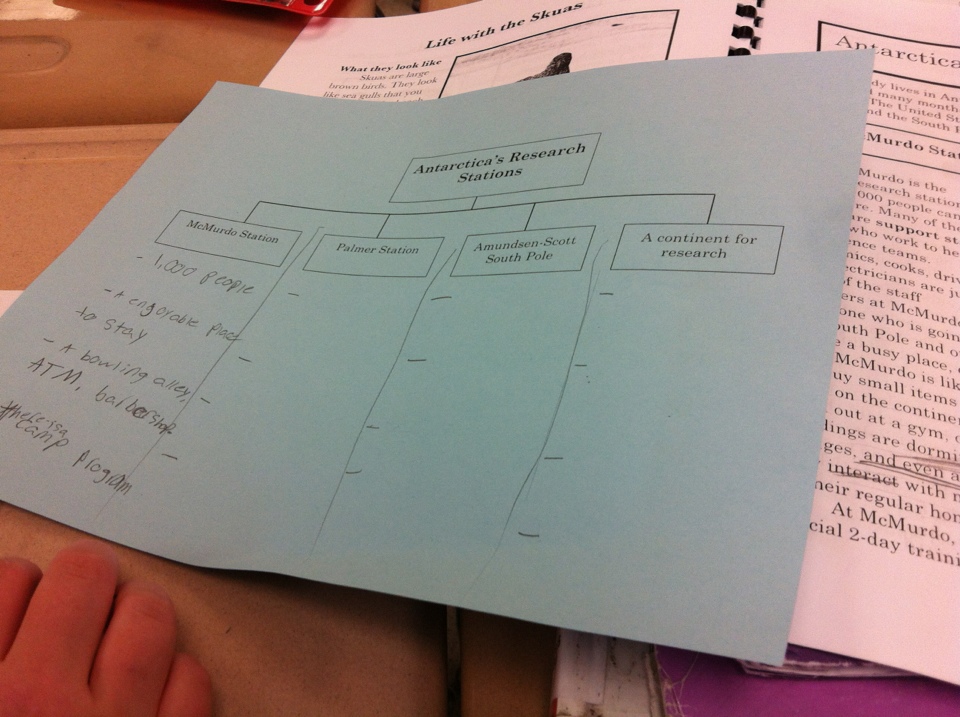
Readers often scan for specific words in a text. Simple vocabulary activities can be engaging and help students to become better at finding specific words. In the activity above, readers had to make predictions for how a word might be used in the text "Research Stations of Antarctica". Notice that I gave them the definitions.

Before they read, students had to make a prediction for how the words would be used. "Dormitories" was a word that they had learned in a previous text, so many predicted that the text would show that researchers or scientists sleep in dormitories in Antarctica. "Souvenirs" was a new word. Many students predicted that students would take rocks or ice back to their homes as souvenirs of Antarctica.

After reading, students went back to the text to find how the words were actually used. (I gave students the choice of whether to do this as they did their initial read, or whether they wanted to just read first and then look for the words; most students chose the latter.) Some of the words were in bold print, while others were not. It was fascinating to listen to them talking with each other about how to find the words! In some cases, they needed to read the sentence containing the word and the previous sentence to figure out how the word was used.

This activity is good for intermediate readers because there is a clear goal, and because they can judge their success (Did I find the word or not?) fairly easily. This provides a foundation of searching skills for students to use as they encounter more difficult tasks in text.

Other updates
Introduction to Text Structure: I've posted a new collection of text structure texts. This includes five texts about chinstrap penguins, five texts about peregrine falcons, and two assessments. My "Text Structure for Young Readers" PowerPoint is also included, along with a study guide that includes all of the texts in the PowerPoint.

Writing a Summary of Nonfiction: This PowerPoint is available free once more. (It is also included in Paraphrasing and Summarizing Lessons.) I took it down a few months ago in frustration at how my free things have been showing up re-posted under other people's names on docstoc and authorstream. However, I've gotten a few emails inquiring about it, so I'll give it another try. Case in point: My entire Understanding Text Structure PowerPoint is on Prezi, with new graphics, under someone else's name. Sigh.

Spelling: New spelling units are done. If I've been sending them to you, drop me a line at elkissn@yahoo.com and I'll send them your way.


Saturday, December 8, 2012

Finding Topics and Main Ideas

Kids have to be able to find topics and main ideas to understand nonfiction text. I look at these lessons as the foundation for all of our nonfiction work in the months to come. This week, I worked on topics and main ideas with several different groups of readers. Here are some thoughts on my experiences.

Do not: Assume that students already know how to find topics and main ideas in text
I've been teaching about this for more than a decade. Many kids are masters of skimming by when it comes to topic and main idea. They've learned to read the teacher, looking for the clues that you are subconsciously giving, instead of reading the text. I often resort to pretending that the text has a different topic to avoid giving these clues. Then the students have to convince me what the topic is!

Do: Look for repeated references in a text
To the adult reader, the topic of the text above just jumps right out: Weddell seals! But younger readers who are still reading word-for-word often do not take in the "whole view" of the text. For these readers, it's important to show them how to underline the repeated words in the text. We found every example of Weddell seal in the text above. As we did this, students saw quickly what the topic was.

Do: Look for multiple referents
Some texts, though, are tricky. Consider the text to the right. The topic, Southern elephant seals, is only mentioned once. The seals are referred to with the pronoun they and the referent these seals. Teaching topics with struggling readers is the perfect time to address multiple referents.

What did one of the readers suggest as the topic of this paragraph? Think about the way that struggling readers scan for words that they know. Yup--she said this paragraph was about elephants. On the one hand, this is a discouraging answer. On the other hand, it shows that she is trying to scan for a topic. She just needs more practice with going back to the text to refine her hypothesis.

Do: Have students work in pairs
Pairing students up to talk about their thinking is a great way to find out misconceptions. It's also a great way to find out new thinking tricks! My on- and above-grade level readers worked to sort cut-apart paragraphs. They had to read each sentence, and then determine the topic and the main idea. Listening in on the conversations was a fantastic way for me to hear what readers were thinking. For example, one pair was discarding the actual main idea sentences because they didn't sound "interesting" enough. (Main ideas often do sound boring, don't they? It's the details that are interesting.) This was a whole new way of looking at the task. I acknowledged their thinking, and then explained that main ideas often do sound boring. This helped them as they worked on their next paragraph.

In another group, I overheard a brilliant reader talking offhandedly as she sorted cards: "Detail, detail, detail, detail." When I asked her what she was doing, she said, "Well, first I just find the sentences that sound detail-y, the ones that have numbers and stuff. Those aren't going to be the main idea, so I set them aside." Again, this provided me with some insight about how students go about the task, and some good student language to use when helping struggling readers.

Do: Take it right back to text
I like to think of nonfiction instruction as following a whole-part-whole model. We look at a text and read it for an initial understanding. Then we look at a part--in this case, topics and main ideas. The next step is to take the idea back to the text.

For my struggling readers, I went right back to the familiar "Welcome to Antarctica" text that we had already read. We looked at the paragraphs and applied the same strategies to finding the topics and main ideas. Doing this with familiar text was helpful for them, as they could focus on the task instead of gaining an initial understanding.

For the other group of readers, we went right on to a new text, with the students applying the idea of topic and main idea to their work on a note-taking sheet. These readers thrive on novelty, so the challenge of a new text and a new concept really engaged them.

This is the first year that I have managed to pull together completely "united" activities, in that everything goes back to the Antarctica topic study we are doing this month. And I love it. The card match activity, the topics and main ideas paragraphs, and our core texts all reinforce one another, leading to great questions and use of vocabulary.

Additional Resources
Finding Topics and Main Ideas: Free Powerpoint from TeachersPayTeachers. (Note: My husband uses this, and always complains about the template that I used...one of these days I'll fix it up! The texts are good, and the sequence of instruction.)

Main Ideas and Details in Nonfiction Text: The Antarctica paragraphs are in here, along with many other items about supporting main ideas. A non-Antarctica version of the sorting sentences is included. (I'll get around to posting all of the Antarctica stuff eventually.)

Summarizing, Paraphrasing, and Retelling: I learned a great deal about main ideas and topics as I researched this book. You'll find more on implicit main ideas, as well as research on how readers process main ideas.

Sunday, December 2, 2012

Update on Spelling

Over the summer, I wrote about making a master word list and creating our own grade-level spelling list. We're now a few months into the project and I thought I'd take a moment to reflect on our progress.

The Master List
I started the master list last year. My goal was to create a list that could be filtered and arranged to find the absolute best words for vocabulary study. I took words from the Academic Word List, the Fry Words 200-500, the Common Core, and several other sources. Then, I gathered data on the words--how many syllables? What is the root? Is it a compound word? What syllable type is the first syllable? What phonograms does the word contain?

The result is an Excel spreadsheet of over 1,800 words. It's been useful for making spelling and vocabulary lists. For example, when I wanted to teach the root fin, I could quickly find important words that had the root. To teach words with long vowels, I looked under the open syllables category. (I am still sending out copies of the list if you'd like one.)

Our Fourth Grade Topics
We created a list of fourth grade spelling topics based on the Common Core and the Fountas and Pinnell Literacy Continuum. Here is an overview of the lists that we selected:

-Long/short vowel sound review
-Greek and Latin roots
-Silent letter combinations
-Contractions
-Homographs and homophones
-Multiple meaning words
-Synonyms and Antonyms
-Prefixes
-Noun forming suffixes
-Adjective forming suffixes
-Other suffixes
-Compound words

You'll notice that it's heavier on word meanings than spelling patterns. This is a tough issue. But with limited time for instruction, we decided to lean more heavily toward the vocabulary and look at spelling patterns as they fit into the words we selected.

To adjust for varying ability levels, we have two "tiers" within each list. Our words were selected from the Master Word List. The first tier includes words with more basic spellings. The second tier includes words that are more complex. Students are assigned a list based on their pretest score. Right now, we're at the silent letter combinations.

How it's going
We're moving along! It is a challenge for students. I'm glad to come back to self-corrected pretests, as I think that this is a really meaningful activity for students. I think that I have some of the old-fashioned country schoolma'am within me. I like the structure of a list, a set of homework activities, some carefully planned lessons, and a test. I think that there is some value to memorizing spelling words--as long as the words are carefully selected to be relevant and meaningful.