Showing posts with label main_ideas. Show all posts

Sunday, February 16, 2014

Graphic Organizers for Representing Ideas

Now that students have an introduction to text features, they will have a real reason to use these text features to navigate text as we dive into texts about Antarctica. Over the next few weeks, students will be exploring topics, main ideas, details, and text features. And we'll be looking at these from two perspectives--that of writer, and that of reader. Cool!

Expository writing requires writers to sort ideas into categories. Instead of telling a story, writers think about topics and how the details related to those topics fit together. Expository writers take concrete details and dream up an abstract main idea.

This year, I'm trying out three different ways to help students visualize the sorting of ideas and topics.

Outlines
In writing, students have created their own island countries and will be learning the basics of formal academic writing as they create essays about their countries. Here's the example that I made to show students:

I do love to play with fine point pens.

After students had spent 1,127 days creating their countries (I may be exaggerating--it was probably closer to 3. They loved it so much and they learned so much about landforms and capitalization), I introduced them to the outline. I started by projecting this example and asking them, "What do you notice?"
It was so interesting to listen to their responses. Like all intermediate readers, they wanted to first focus on content. I tried to move the discussion toward structure: "How is it put together? What rules do you think the writer followed?"

After some discussion, they started to recognize the Roman numerals, the use of letters, and the use of numbers. (Many of them also thought that it included complete sentences--more evidence that the concept of sentence is elusive.) After our discussion, students got to start their own outlines, with some heavy scaffolding:
Outlines have gone in and out of style over the last twenty years. Some writers find them stifling and useless. However, they are wonderfully adaptable. I am a very global and connective thinker, and I like the structure of an outline to finally capture my ideas and put them in a way that makes sense.

As students started their scaffolded outlines, they referred frequently to the word bank on the front of their pages, and even more frequently to the beautiful maps that they had created. The abstract term "Economy" that is Roman numeral III becomes beautifully concrete when matched with details--"I'll send chocolate to your country, and that will be my export, and you send iron and steel to mine. That will be my import."

Concept Maps
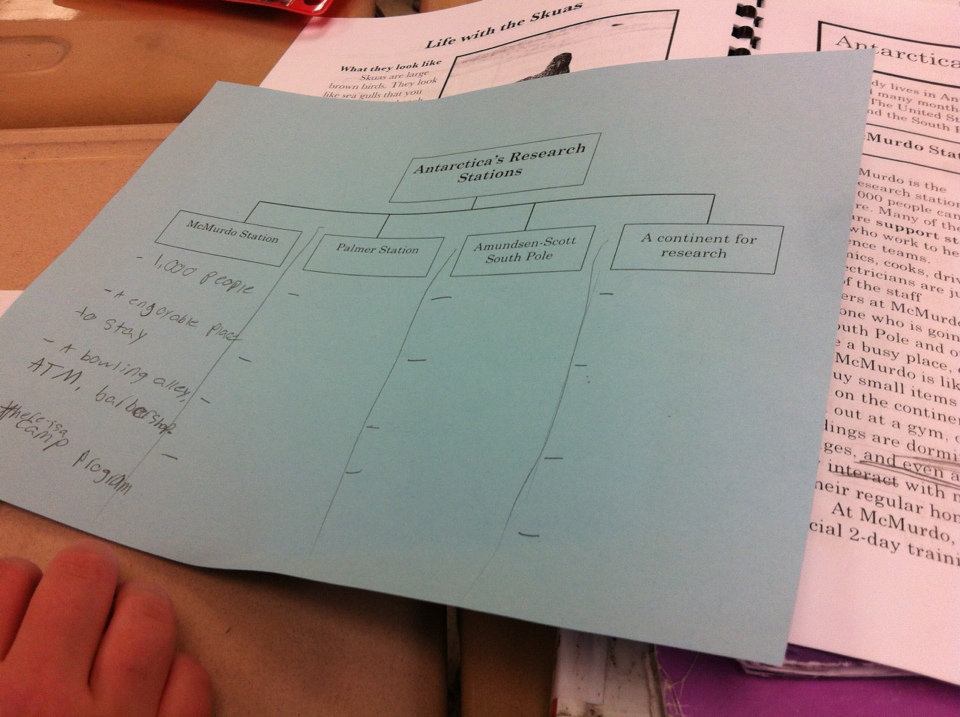
Later that afternoon, in reading class, we looked at another way to model ideas. After finishing our Text Features PPT students had a wonderful assortment of Antarctica books all around the room. I showed them how to quickly make the skeleton of the concept map:


...and then I gave them time to add to the organizer. I made it very open: "This is a way to keep track of some of the things that we learn about Antarctica. As you browse through the books and resources, try to find at least three details to add to the organizer."

This is an example of how the magic and engagement come naturally from books and learning. The kids were excited. I had several copies of Animals Robert Scott Saw (snagged at a discount bookstore!), Antarctica, Scholastic's Penguins, Penguins by Gail Gibbons, maps of Antarctica (available here), Antarctic Seals, and of course the Antarctica booklets that I had prepared for the students.

I walked around to observe how students organized their details. No one made the connection to the outlines they had started in the morning, and that was okay at this point. "Mrs. Kissner! Do leopard seals eat penguins, or do they eat other seals?" a student asked. "How could you find out?" I asked back. "And where would you put that detail, once you have found it?"

One student found the Rigby Antarctic seals book and added to the animals section. (I didn't take photos of the student work, so I'm recreating it here.)  This may not seem like a big deal, but notice: The student recognized a sub-topic that fits into the larger topic of Animals. The student made an arrow to show this relationship, and then added the names of the seals below.

"I could put Robert Scott in Places," another student said. "Mrs. Kissner, how do you spell his name?"
"How could you find out?" I asked, in what was becoming a familiar question.
"From the book we read," she said. "Who has it?"
"I really have no idea," I admitted, and it's true: I am the least likely person to know where any possible object is located in my classroom, at any given time.

On the other side of the room, another student was using the Antarctica map to add to her graphic organizer. I quickly noticed something troubling about her work. Can you see it? What does this show about her thinking?

Another student turned to the Research Stations of Antarctica text in the Antarctica booklet. "The answers are all in here," he said confidently. I stayed by his desk to listen--answers? I was intrigued. "See," he said. "It's here in the headings. These are the research stations, and I can just copy them next to Places." And then he did exactly that--no lines, no arrows, just the names of the research stations. In this little exchange I learned so much--this kid knows text features, and he knows how to quickly get information from the text, but he could probably use some help with how best to represent this information.

Tree Map
Over the next few days we'll be adding to our organizers, and they will get incredibly messy as students start to see connections. Some will be happy with the mess while others will request a new sheet of paper. Still others will abandon this early concept map as we move on to our detailed research and they choose their own focused topic. When this happens, we'll move on to a third way to show ideas: the tree map.

But the tree map will have to wait about a week or two as we work through the outline and the concept map. For me, it will be wonderfully informative to watch students as they make connections and think about how to sort all of the details that they create and learn.

News and Notes
-I've finally put together an assortment of science articles into one bundle: Ecosystems Informational Text Set. This includes a number of articles that are currently scattered across different text sets, plus a few new pieces.

-If you're looking for a set of connected texts with questions and open-ended responses, try Under the Sea: Nonfiction Test Preparation. You'll find four texts about octopuses and cuttlefish, plus an activity in which you can synthesize information from all four texts. I loved writing this so much!

-I'm making my YouTube playlists public, in case you are interested. Here they are:

Cuttlefish and Octopus: To go with the Under the Sea texts
Reading Homework: To go along with my reading homework series (February and January)


Saturday, December 8, 2012

Finding Topics and Main Ideas

Kids have to be able to find topics and main ideas to understand nonfiction text. I look at these lessons as the foundation for all of our nonfiction work in the months to come. This week, I worked on topics and main ideas with several different groups of readers. Here are some thoughts on my experiences.

Do not: Assume that students already know how to find topics and main ideas in text
I've been teaching about this for more than a decade. Many kids are masters of skimming by when it comes to topic and main idea. They've learned to read the teacher, looking for the clues that you are subconsciously giving, instead of reading the text. I often resort to pretending that the text has a different topic to avoid giving these clues. Then the students have to convince me what the topic is!

Do: Look for repeated references in a text
To the adult reader, the topic of the text above just jumps right out: Weddell seals! But younger readers who are still reading word-for-word often do not take in the "whole view" of the text. For these readers, it's important to show them how to underline the repeated words in the text. We found every example of Weddell seal in the text above. As we did this, students saw quickly what the topic was.

Do: Look for multiple referents
Some texts, though, are tricky. Consider the text to the right. The topic, Southern elephant seals, is only mentioned once. The seals are referred to with the pronoun they and the referent these seals. Teaching topics with struggling readers is the perfect time to address multiple referents.

What did one of the readers suggest as the topic of this paragraph? Think about the way that struggling readers scan for words that they know. Yup--she said this paragraph was about elephants. On the one hand, this is a discouraging answer. On the other hand, it shows that she is trying to scan for a topic. She just needs more practice with going back to the text to refine her hypothesis.

Do: Have students work in pairs
Pairing students up to talk about their thinking is a great way to find out misconceptions. It's also a great way to find out new thinking tricks! My on- and above-grade level readers worked to sort cut-apart paragraphs. They had to read each sentence, and then determine the topic and the main idea. Listening in on the conversations was a fantastic way for me to hear what readers were thinking. For example, one pair was discarding the actual main idea sentences because they didn't sound "interesting" enough. (Main ideas often do sound boring, don't they? It's the details that are interesting.) This was a whole new way of looking at the task. I acknowledged their thinking, and then explained that main ideas often do sound boring. This helped them as they worked on their next paragraph.

In another group, I overheard a brilliant reader talking offhandedly as she sorted cards: "Detail, detail, detail, detail." When I asked her what she was doing, she said, "Well, first I just find the sentences that sound detail-y, the ones that have numbers and stuff. Those aren't going to be the main idea, so I set them aside." Again, this provided me with some insight about how students go about the task, and some good student language to use when helping struggling readers.

Do: Take it right back to text
I like to think of nonfiction instruction as following a whole-part-whole model. We look at a text and read it for an initial understanding. Then we look at a part--in this case, topics and main ideas. The next step is to take the idea back to the text.

For my struggling readers, I went right back to the familiar "Welcome to Antarctica" text that we had already read. We looked at the paragraphs and applied the same strategies to finding the topics and main ideas. Doing this with familiar text was helpful for them, as they could focus on the task instead of gaining an initial understanding.

For the other group of readers, we went right on to a new text, with the students applying the idea of topic and main idea to their work on a note-taking sheet. These readers thrive on novelty, so the challenge of a new text and a new concept really engaged them.

This is the first year that I have managed to pull together completely "united" activities, in that everything goes back to the Antarctica topic study we are doing this month. And I love it. The card match activity, the topics and main ideas paragraphs, and our core texts all reinforce one another, leading to great questions and use of vocabulary.

Additional Resources
Finding Topics and Main Ideas: Free Powerpoint from TeachersPayTeachers. (Note: My husband uses this, and always complains about the template that I used...one of these days I'll fix it up! The texts are good, and the sequence of instruction.)

Main Ideas and Details in Nonfiction Text: The Antarctica paragraphs are in here, along with many other items about supporting main ideas. A non-Antarctica version of the sorting sentences is included. (I'll get around to posting all of the Antarctica stuff eventually.)

Summarizing, Paraphrasing, and Retelling: I learned a great deal about main ideas and topics as I researched this book. You'll find more on implicit main ideas, as well as research on how readers process main ideas.

Saturday, November 27, 2010

Teaching Main Ideas

In a way, it was the prospect of teaching students how to find main ideas that first led me to researching journal articles. It was 2000, I was teaching reading for the first time, and I realized that I didn't know enough about what happens when reader meets text. All I could remember were my own experiences with reading the SRA cards as a student and learning how to make good guesses about main ideas. And that wasn't enough to help the sixth and seventh graders I was facing each day.

In the years since, I've learned a great deal about readers and main ideas. But even though I have read the journal articles, worked with hundreds of students, and even written chapters about finding main ideas, each year is still a challenge. Because, in the end, finding main ideas is not about what I know in my head, but about what I can help my readers to experience and learn.

Here are some of the big ideas that I keep in mind as I plan for my classroom:

Start with topics
The topic of a paragraph is the word or phrase to which all of the other ideas refer. Even though I thought that sixth and seventh graders could find the topics of a text with ease, I learned that this was not always the case. Sometimes, readers will circle the most concrete or tangible idea, not necessarily the one that is the topic. If the topic is more abstract--like watersheds, or succession, or forms of government--students will often fail to identify it.

Find paragraphs with the same topic, but different main ideas
When students confuse topic with main idea, this is the best way to show them that there is a real difference. You can do this with two opinion paragraphs that state vastly different opinions, or simply two paragraphs that communicate information about the same topic in different ways. Like the discrepant event in science (an activity that forces students to reconsider their prior knowledge), looking at these two paragraphs can help students to rethink the rules they've formed for what a main idea can be.

The first sentence is not always the topic sentence
My work with the SRA reading packets, back in my student days, taught me one important rule--the first sentence is usually the topic sentence. Right? Well, in real text, this is not always the case. Newer digital texts often have main ideas partially stated in headings (like this list you're reading right now), stated at the end, or even left unstated. Make sure that your examples reflect the real-life world of text, even bad text.

Finding main ideas is hard!
Young readers often read at the "local" level in a text, relating each sentence to the one before it and after it. Older readers often adopt a more global reading habit. Main idea is often a tough concept for third, fourth, fifth, and even sixth graders. As text becomes more complex, so do the main ideas, and a reader's task is even more difficult. Combine this with the fact that there is a great deal of poorly written, incoherent text floating around, and it's easy to see why readers have problems.

While I was gathering together items for my own unit on main ideas, about to begin next week, I put together this collection of texts, worksheets, and Powerpoints.

Saturday, February 6, 2010

Finding main ideas


It's important for students to understand how to find main ideas. With my fourth graders, I am always fighting against their impulsive habits. If I give them paragraphs for practice, they often just circle the very first sentence.

How to change the activity? I've found some success with cutting apart paragraphs. Students have to read each sentence, figure out the topic, find the main idea sentence, and then try to put the paragraph in order. Sorting the cards and putting them in order keeps them more engaged than just reading sentences. As I watch them work with their partners and listen to their conversation, I can figure out what "rules" they're using and clear up any misconceptions. Students who can easily find the main ideas then concentrate more on putting the rest of the sentences in order, which requires them to think carefully about cohesion and how the ideas fit together.

These cut apart sentences are simple to make. For my first set, I just wrote the sentences on a sheet of paper. When I saw how well it worked, I typed the sentences into a Word table and copied them on cardstock. However you do it, this works well as a small group activity, partner activity, or center.

I've uploaded a document with some sentences to Slideshare. Here's the link:

Sentences for finding main ideas