Showing posts with label expository. Show all posts
Saturday, November 4, 2017
Exploring Author's Point of View in Expository Text
Identifying Point of View
I think that many teachers have struggled over the past few years to expand their teaching of "point of view" beyond the traditional first and third person narratives and into identifying an author's perspective. There is a gradient of expository texts, from objective texts in which the author's point of view is faint and difficult to hear, to biased texts dripping with the author's opinions. As I explained to my students, most texts exist in a middle territory in which the generalizations and main ideas of the text do most of the work of conveying the author's point of view.
As we started to identify point of view, I found that my students needed the academic language necessary for this task. I designed this resource to give students help as they work on defending their claims about the author's point of view.
Link to Google Doc
Supporting Point of View
At this point in the year, many of my sixth graders are writing lengthy text quotes as evidence for their claims. I adapted a chart from the EngageNY materials to help them find the best evidence for their assertions. In the photo you can see the chart we filled out together based on the "Columbian Exposition" text from my Paraphrasing and Summarizing materials over on TpT.
This chart worked wonderfully with students, especially the "Word Choice" column. Even students who struggle with identifying the point of view can find the author's words that carry the point of view. A nice way to mix it up is also to show students text evidence and have them infer the author's point of view conveyed by that text evidence.
Link to Author's Point of View chart
Helping students to listen for author's point of view in expository text is important! What successes have you had?
Wednesday, June 29, 2016
Sea Turtle Release
I love teaching because I love learning, and getting out to experience new things is a thrill for me. So when I read that the National Aquarium would be releasing sea turtles at Assateague, I knew that we had to arrange our week to attend!
I never learned about sea turtles as a student. In fact, I don't remember learning much about animals at all--unless you count the sixth grade teacher who made us write notecards about all of the animal groups, working up from sponges. (We never made it past cephalopods.)
Today's students need to learn about sea turtles. Not only are they important in their own right, but sea turtles are so interesting and engaging that they get student attention for larger conversations about ecology, our oceans, and pollution.
Staff from the National Aquarium set up the area for the sea turtle release at one of my favorite places, Assateague National Seashore. (You can find text structure materials that I wrote about Assateague here.) My youngest was so excited to attend--in his words, "I've never seen a wild sea turtle!"
The day was cloudy and threatened rain, but that didn't stop a crowd from gathering. Two green sea turtles that had been rehabilitated by the National Aquarium and ten Kemps ridley turtles from the New England Aquarium were set to be released.
Staff members brought around the turtles for onlookers to see. Everyone got great views! My son was amazed by his chance to see the sea turtles up close.
The turtles were placed down by the surf. Most ambled right in, while a few seemed hesitant. (That water was cold--I'd hesitate too!) For the rest of the day I thought about the sea turtles, out in the vast ocean, and wondered what they were doing. I wonder what they're doing now.
Even though the weather was cold and rain fell as we were leaving the beach, it was a perfect beach day.
See for yourself how students can become engaged in learning about text structure and sea turtles with this Sea Turtles Expository Text Mini-Unit.
Student-friendly videos about sea turtles can be found on this YouTube playlist.
What are you doing to explore and learn this summer?
| My kids check out the sea turtle models before the release. |
Today's students need to learn about sea turtles. Not only are they important in their own right, but sea turtles are so interesting and engaging that they get student attention for larger conversations about ecology, our oceans, and pollution.
Seeing the Release
Staff from the National Aquarium set up the area for the sea turtle release at one of my favorite places, Assateague National Seashore. (You can find text structure materials that I wrote about Assateague here.) My youngest was so excited to attend--in his words, "I've never seen a wild sea turtle!"Staff members brought around the turtles for onlookers to see. Everyone got great views! My son was amazed by his chance to see the sea turtles up close.
The turtles were placed down by the surf. Most ambled right in, while a few seemed hesitant. (That water was cold--I'd hesitate too!) For the rest of the day I thought about the sea turtles, out in the vast ocean, and wondered what they were doing. I wonder what they're doing now.
Even though the weather was cold and rain fell as we were leaving the beach, it was a perfect beach day.
Student-friendly videos about sea turtles can be found on this YouTube playlist.
What are you doing to explore and learn this summer?
Thursday, October 22, 2015
Summarizing Nonfiction...Again and Again and Again
It's been nine years since I wrote a book about summarizing, and I keep feeling like I learn more and more. This year, as I've moved back into sixth grade, I decided to start the year with frequent summarizing tasks. I'm teaching summarizing, but I feel like I'm the one who is learning lessons!
This year's summaries are based on a set of four expository texts about water. Each text has a similar structure and text features. My goal was to build on repeated experiences and frequent feedback to level up my students' summarizing skills.
Here are some of the things that I have learned (and re-learned!) so far this year.
Provide limited space for the summary
Conscientious sixth graders want to do well! In many cases, this means that they write summaries that are almost as long as the original text. There are two different profiles for the writer of the long-winded summary. On the one hand, you'll see kids who are proficient readers and have a large working memory produce these summaries. They just have a big capacity for details, and they understand everything in the text. On the other hand, some kids who are struggling but conscientious will create these summaries. They're not sure of which details are most important, but they want to please the teacher and so they put them all in.
My problem when I get these summaries? I'm too soft-hearted! These kids have obviously worked hard, and at the start of the year it's tough for me to hand them back for the kids to redo.
When I provide limited space for the summary, though, I let the lines do the heavy lifting. "Make sure your summary fits in the space," I say, and when kids ask for extra paper, I give them a small sticky note.
How much space should you provide? A good rule of thumb is to think about how much room it would take to write a sentence for each paragraph, and then add 3 or 4 more. This gives kids with big handwriting enough room to write a good summary without going overboard.
Teach students to chunk the summary process
Some students look at the article and think, "I can never summarize that!" In many texts, though, kids can use the headings to guide them through. This is especially helpful for chunking a summarizing assignment for students with learning disabilities. "Don't worry about the whole thing today," I tell students. "Let's just do this first chunk."
This also helps students who tend to summarize in a knowledge-telling fashion. These students write everything they remember about the text, in the order in which they remember it. A summary written like this tends to sound like a list of random facts instead of an organized summary. By reminding students to go back to the text, you can give them an anchor for their thoughts.
Beware the "about" summary
Around about the third summary I start to see the topic-based summaries creeping in. Students are becoming more efficient with their summarizing and decide to take a shortcut.
These are actually signs of good progress. Usually, I end up writing about twenty times: "Don't say what the article was about--actually include the information!" Once kids see the difference, they realize that the 'about' summary is quite empty of actual facts.
Look for growth over the long haul
The development of summarizing skill is a long process. As readers grapple with more and more complex texts, they need to see how they can wrestle ideas to the page to write a summary. Students won't necessarily become strong summarizers after one lesson, or two, or even three. However, the good news is that repeated summarizing can build comprehension as well. I like to think of teaching summarizing as test-prep I can live with!
Labels:
close reading,
common core,
expository,
summarizing
Friday, April 3, 2015
Teaching Text-Dependent Analysis
This year I've been putting lots of thought into the new text-dependent analysis tasks that students have to complete for our state tests. My fourth graders will have to write not one but two passage-based essays, in which they will be expected to write introductions and conclusions, weave quotes from the text into their essays, and use "sophisticated" transitions. It's an intimidating task!
1. Low-risk, easy experiences in quoting text details.
I decided that the first thing students would need to be able to do is quote text. If you teach older students, quoting from a text may sound like a simple routine. But it's not! Young readers have to figure out which passages support what they are trying to prove and then copy it correctly. On top of that, they have to put quotation marks around it all!
Trying to teach this WHILE making a graphic organizer and writing an essay is just too much. Get kids comfortable with writing quotations, and do it often. And if this is as far as a kid gets, it is still a meaning-making endeavor.
2. Creating a thesis statement.
That's right. A thesis statement.
Fourth graders can learn what this means, and they can learn how to write this. In fact, lots of great nonfiction picture books have beautifully written thesis statements! (I'm deep into the books of Nicola Davies right now, and her picture books have beautifully written thesis statements.) A thesis statement is just a sentence that explains what the essay will uncover. Sometimes a thesis statement is like an answer to a question in the prompt, but this varies depending on the prompt.
Teaching fourth graders to write a thesis statement is challenging, which is why I'm glad that we haven't been working on passage-based essays as our only forms of writing. We just finished our Design-A-Land essays, which include a thesis statement frame. This experience has helped students to transfer their learning about the thesis statement over to passage-based essays.
I have argued with other fourth grade teachers on this issue. Some think that it's not developmentally appropriate for fourth graders to do this; others think that there is no need to learn the terminology. But I think that writing a thesis statement is the heart of all essay writing. If you are going to skip the thesis, what's the point?
3. Identifying the areas of analysis.
This step and creating a thesis statement really overlap. The areas of analysis become the body paragraphs--what students will write about and develop in the essay. How many areas of analysis are there? It depends on the prompt. This flexible thinking is hugely important and essential to the task...and it is what most of the shortcuts and cute acronyms overlook.
In the two prompts that we used this week, Prompt 1 lends itself to two areas of analysis--the author's use of headings and chronological order to organize the piece. Prompt 3, on the other hand, only speaks to one area of analysis. Thinking through these areas of analysis help students to consider how many paragraphs they want to use and what text quotes they want to find.
4. Supporting the writing of introductions and conclusions.
Introductions and conclusions are so hard! I love to use nonfiction picture books as mentor texts for this. This works especially well when students are writing a content-based response, as in Prompt 3 above. When students are writing a structure-based essay, as in Prompt 1, I have choice-based minilessons while students are writing. "Anyone who wants help with a conclusion, please meet me on the carpet," I'll say, and then students come forward and we talk about their issues with conclusions. Sometimes I'll even write up a frame based on our discussion and display it on the Promethean board for the rest of the class. Students like to navigate independently through the flipchart, finding the frames that we've made together and referring back to them.
Students also like to have access to all of the passage-based essays that they've written before. (It's not that many--we're on our third.) I see them folding back the pages, thoughtfully looking at their previous introductions and conclusions. They certainly can't just copy them--the prompts are completely different--but I like to see how students look back to what they did before.
We've had lots of discussions about these paragraphs. "Can an introduction be three sentences?" a student asked.
"What is the job of an introduction?" I replied. Then we talked together about what an introduction does and how much "space" it should take up. Could it be only one sentence? Two? Or three? Of course it depends! Thinking through this question, and trying to judge the purposes of a writing component, is so much more valuable than just providing a formula.
Again, other forms of writing have been useful for us. Introductions and conclusions are always necessary, but how do they look different across different kinds of writing?
We are still on the road to passage-based essays, but students have grown in their use of text quotes and essay components. Fourth graders have an exceptionally hard time of separating content from structure--in fact, I'm beginning to realize that this concept is at the heart of reading instruction for students of this age.
I'm happy, though, because the topics that I have taught are all growing topics--concepts that are important to writing in general, not just writing for this specific task. In fifth grade and beyond students will have to quote text, create areas of analysis, and write introductions and conclusions. We are on our way!
And I love fourth grade because we can move between talking about thesis statements and introductions and playing with pond water and decorating our classroom like a cave. Rigorous thinking and playful experiences within five minutes of each other...just the way I like it.
2016 Update: The wood frog text and prompts, with scaffolded graphic organizers, are included in Close Reading with Chronological Order Texts over at TeachersPayTeachers.
Avoiding shortcuts
I've been thinking carefully about the task because I don't want to use unproductive shortcuts. Too often, hard tasks get reduced to instructional shortcuts. Teachers are worried that a process is too hard for students, break it down into chunks that are as easy as possible, and turn a difficult cognitive process into a formulaic writing response. (Anyone familiar with Four-Square Writing knows what this looks like!) This recipe-making begins with the best of intentions--to make a hard task manageable--but ends with students learning a dead-end "formula" that will not transfer well to new situations.Meaningful lesson parts
So then I had to think--what are the most meaningful parts of this experience? Creating a passage-based essay has its own rewards. I also need to think about how some students will not achieve full proficiency with the passage-based essay this year. But it's important to me that each step along the way, everything that I teach, has its own meaning and importance.1. Low-risk, easy experiences in quoting text details.
![]() |
| Students found sentences with setting details and practiced writing the quotations correctly. |
I decided that the first thing students would need to be able to do is quote text. If you teach older students, quoting from a text may sound like a simple routine. But it's not! Young readers have to figure out which passages support what they are trying to prove and then copy it correctly. On top of that, they have to put quotation marks around it all!
Trying to teach this WHILE making a graphic organizer and writing an essay is just too much. Get kids comfortable with writing quotations, and do it often. And if this is as far as a kid gets, it is still a meaning-making endeavor.
2. Creating a thesis statement.
That's right. A thesis statement.
Fourth graders can learn what this means, and they can learn how to write this. In fact, lots of great nonfiction picture books have beautifully written thesis statements! (I'm deep into the books of Nicola Davies right now, and her picture books have beautifully written thesis statements.) A thesis statement is just a sentence that explains what the essay will uncover. Sometimes a thesis statement is like an answer to a question in the prompt, but this varies depending on the prompt.
Teaching fourth graders to write a thesis statement is challenging, which is why I'm glad that we haven't been working on passage-based essays as our only forms of writing. We just finished our Design-A-Land essays, which include a thesis statement frame. This experience has helped students to transfer their learning about the thesis statement over to passage-based essays.
3. Identifying the areas of analysis.
This step and creating a thesis statement really overlap. The areas of analysis become the body paragraphs--what students will write about and develop in the essay. How many areas of analysis are there? It depends on the prompt. This flexible thinking is hugely important and essential to the task...and it is what most of the shortcuts and cute acronyms overlook.
In the two prompts that we used this week, Prompt 1 lends itself to two areas of analysis--the author's use of headings and chronological order to organize the piece. Prompt 3, on the other hand, only speaks to one area of analysis. Thinking through these areas of analysis help students to consider how many paragraphs they want to use and what text quotes they want to find.
4. Supporting the writing of introductions and conclusions.
Introductions and conclusions are so hard! I love to use nonfiction picture books as mentor texts for this. This works especially well when students are writing a content-based response, as in Prompt 3 above. When students are writing a structure-based essay, as in Prompt 1, I have choice-based minilessons while students are writing. "Anyone who wants help with a conclusion, please meet me on the carpet," I'll say, and then students come forward and we talk about their issues with conclusions. Sometimes I'll even write up a frame based on our discussion and display it on the Promethean board for the rest of the class. Students like to navigate independently through the flipchart, finding the frames that we've made together and referring back to them.
Students also like to have access to all of the passage-based essays that they've written before. (It's not that many--we're on our third.) I see them folding back the pages, thoughtfully looking at their previous introductions and conclusions. They certainly can't just copy them--the prompts are completely different--but I like to see how students look back to what they did before.
We've had lots of discussions about these paragraphs. "Can an introduction be three sentences?" a student asked.
"What is the job of an introduction?" I replied. Then we talked together about what an introduction does and how much "space" it should take up. Could it be only one sentence? Two? Or three? Of course it depends! Thinking through this question, and trying to judge the purposes of a writing component, is so much more valuable than just providing a formula.
Again, other forms of writing have been useful for us. Introductions and conclusions are always necessary, but how do they look different across different kinds of writing?
We are still on the road to passage-based essays, but students have grown in their use of text quotes and essay components. Fourth graders have an exceptionally hard time of separating content from structure--in fact, I'm beginning to realize that this concept is at the heart of reading instruction for students of this age.
![]() |
| Yes, we are making the classroom look like a cave. Don't you love this bear that a student made? |
I'm happy, though, because the topics that I have taught are all growing topics--concepts that are important to writing in general, not just writing for this specific task. In fifth grade and beyond students will have to quote text, create areas of analysis, and write introductions and conclusions. We are on our way!
And I love fourth grade because we can move between talking about thesis statements and introductions and playing with pond water and decorating our classroom like a cave. Rigorous thinking and playful experiences within five minutes of each other...just the way I like it.
2016 Update: The wood frog text and prompts, with scaffolded graphic organizers, are included in Close Reading with Chronological Order Texts over at TeachersPayTeachers.
Monday, February 16, 2015
Questions Lead to Inferences
Helping readers to make inferences in nonfiction can be tough. For narrative texts, inferences about character emotions and traits are easy to see. In expository texts, however, the inferences often operate under the surface. Skilled readers may not realize they are making inferences, while less skilled readers may not even realize that an inference is called for.
To help readers make inferences, I have found that questions are essential. Helping readers to ask questions of a text "wakes up" the inferring process.
No questions = no inferences.
I love to use the Facts-Questions-Response chart from the Comprehension Toolkit. This chart has it all! Readers have to:
-Find and paraphrase details for the Facts column
-Ask questions of the text for the Questions column
-Note their own thinking for the Response column
-Best of all, slow down as they read!
For me, teaching the FQR chart really helps me to see what readers are thinking. I have adapted this chart a bit in recent years. Numbering paragraphs helps us to navigate through the text and share our thinking easily. I also encourage students to put lines under their responses to keep thoughts from each paragraph organized.
The FQR chart is especially beneficial if you have a large class. Teaching 30 readers at once is challenging. When we work on the FQR chart, I can quickly "clipboard cruise" to note who is doing well and who needs some more support. For example, the student who has filled up the entire "Facts" column but has no questions or responses will need some coaching, as will the student who falls back on a question formula.
Not all inferences are as ambitious as this. One student read the sentence, "The Southern Ocean is rough and choppy, and many people get seasick." This student asked the question Why do people get seasick?
I could tell that this reader hadn't connected information from the first part of the sentence with information from the second part. With some coaching, he was able to make this inference and write it in the Response column.
Helping readers to make inferences in nonfiction can be a challenge. Starting out with questions makes the challenge easier!
To help readers make inferences, I have found that questions are essential. Helping readers to ask questions of a text "wakes up" the inferring process.
No questions = no inferences.
Facts-Question-Response Chart
I love to use the Facts-Questions-Response chart from the Comprehension Toolkit. This chart has it all! Readers have to:-Find and paraphrase details for the Facts column
-Ask questions of the text for the Questions column
-Note their own thinking for the Response column
-Best of all, slow down as they read!
For me, teaching the FQR chart really helps me to see what readers are thinking. I have adapted this chart a bit in recent years. Numbering paragraphs helps us to navigate through the text and share our thinking easily. I also encourage students to put lines under their responses to keep thoughts from each paragraph organized.
The FQR chart is especially beneficial if you have a large class. Teaching 30 readers at once is challenging. When we work on the FQR chart, I can quickly "clipboard cruise" to note who is doing well and who needs some more support. For example, the student who has filled up the entire "Facts" column but has no questions or responses will need some coaching, as will the student who falls back on a question formula.
From Questions to Inferences
How does this lead to inferring? After reading a paragraph, we talk about the students' questions and how they can be answered with an inference. In the "Welcome to Antarctica" text, students read that the airport in Antarctica is only open from October to May. This made them wonder--why? Using background information from the "Happy Australia Day" article that they read, students inferred that Antarctica's seasons must follow the same pattern as Australia's--and that the months from October to May are the warmer months.Not all inferences are as ambitious as this. One student read the sentence, "The Southern Ocean is rough and choppy, and many people get seasick." This student asked the question Why do people get seasick?
I could tell that this reader hadn't connected information from the first part of the sentence with information from the second part. With some coaching, he was able to make this inference and write it in the Response column.
The Text
I like to use texts that present new information to students for this activity. Last week, I used "Welcome to Antarctica", which is a text that I wrote as part of our Antarctica unit. You can find the text below.Helping readers to make inferences in nonfiction can be a challenge. Starting out with questions makes the challenge easier!
Thursday, February 12, 2015
Main Ideas, Topics, and...Photographs?
This week, I found that I could build visual skills, questioning, and inferring even with a very traditional topic/main idea activity.
As you can see from these paragraphs, right now we are looking at topics and main ideas. These are not the same at the all. Topics are best expressed in just a few words. Main ideas express a main point about a topic, and are always in complete sentences.
Readers need to see lots of different paragraph examples, with main ideas in different places. Looking at multiple paragraphs with related topics helps students to see how topics and main ideas can be expressed in different ways. In these paragraphs, students also saw how paragraphs can have a sentence that doesn't belong.
Okay, this is all the basic stuff. Kids really do need to have these experiences with paragraphs, and they are meaningful. But the lesson didn't really get exciting until I started showing some skink photos from my personal archive.
"Look carefully at this photograph. Based on evidence from the text, what inference can you make about this skink?" I asked students.
I didn't have to beg or cajole them to look back--they were flipping through their pages, scanning the sentences, eagerly searching for the detail that they remembered. "It must be a young skink!" one student said. "Look, it says here in the text..."
Oh, the explicit text reference--that's totally what I want to see and hear! In the next picture, students first had to use some clues to figure out if the skink was on a wall or on the ground. "As you can clearly see, this is a floor mat," one student said--he definitely has a future as a prosecutor!
We went on to look at more pictures of skinks, talking about how sentences from the text can explain or describe them. In this conversation, students were:
-Using close reading to find details
-Making inferences as they matched text details to visual details
-Asking questions
It all shows how a simple lesson about main ideas and topics can become so much more!
You can easily do this with your own paragraphs and photos. Why not try some paragraphs about your school? Consider the animals that are popular in your classroom right now--or a question that came up in science class.
The skink texts are available as part of this product.
Readers need to see lots of different paragraph examples, with main ideas in different places. Looking at multiple paragraphs with related topics helps students to see how topics and main ideas can be expressed in different ways. In these paragraphs, students also saw how paragraphs can have a sentence that doesn't belong.
Photos, Close Reading, and Details
Okay, this is all the basic stuff. Kids really do need to have these experiences with paragraphs, and they are meaningful. But the lesson didn't really get exciting until I started showing some skink photos from my personal archive."Look carefully at this photograph. Based on evidence from the text, what inference can you make about this skink?" I asked students.
I didn't have to beg or cajole them to look back--they were flipping through their pages, scanning the sentences, eagerly searching for the detail that they remembered. "It must be a young skink!" one student said. "Look, it says here in the text..."Oh, the explicit text reference--that's totally what I want to see and hear! In the next picture, students first had to use some clues to figure out if the skink was on a wall or on the ground. "As you can clearly see, this is a floor mat," one student said--he definitely has a future as a prosecutor!
We went on to look at more pictures of skinks, talking about how sentences from the text can explain or describe them. In this conversation, students were:
-Using close reading to find details
-Making inferences as they matched text details to visual details-Asking questions
It all shows how a simple lesson about main ideas and topics can become so much more!
You can easily do this with your own paragraphs and photos. Why not try some paragraphs about your school? Consider the animals that are popular in your classroom right now--or a question that came up in science class.
The skink texts are available as part of this product.
Labels:
close reading,
comprehension,
expository,
main idea,
skink,
topics
Saturday, January 17, 2015
Engaging Writers with Expository Fiction
I love expository fiction! This kind of writing uses the structures and conventions of expository writing, but with fiction details. For kids of all ages, expository fiction is fun because kids can play with the expository genre while still having complete control over every detail.
Over the years, I've done several different projects with this kind of writing. One of my favorites was "Fashion-A-Fish", based on the Project WILD activity. After creating a fish, students wrote about the adaptations and shared their imaginary creatures in a class guidebook.
Right now students are creating their own imaginary countries. It's so fun because it naturally covers many important topics, like landforms....
"Mrs. Kissner, what's a bay again?"
"Well--it's kind of like the opposite of a peninsula. Think an area of water, surrounded by land on three sides."
and capital letters...
"Remember, you need to capitalize both parts of a proper noun--like Chocolate River, the C and the R are capitalized." (Repeated at least 20 times over the next three days.)
and, next week, writing an outline. We'll be learning about introductions, conclusions, and transitions over the weeks to come. What makes this kind of writing so engaging for readers is that they control the details. Need more information? They just go back to their maps, bounce some ideas off their neighbors, and weave in the interesting details.
There are so many other options for expository fiction. It's a great way to help kids learn about expository writing!
Design A Land Activity Set
Over the years, I've done several different projects with this kind of writing. One of my favorites was "Fashion-A-Fish", based on the Project WILD activity. After creating a fish, students wrote about the adaptations and shared their imaginary creatures in a class guidebook.
| This is my example. So much fun to make! |
Right now students are creating their own imaginary countries. It's so fun because it naturally covers many important topics, like landforms....
"Mrs. Kissner, what's a bay again?"
"Well--it's kind of like the opposite of a peninsula. Think an area of water, surrounded by land on three sides."
and capital letters...
"Remember, you need to capitalize both parts of a proper noun--like Chocolate River, the C and the R are capitalized." (Repeated at least 20 times over the next three days.)
and, next week, writing an outline. We'll be learning about introductions, conclusions, and transitions over the weeks to come. What makes this kind of writing so engaging for readers is that they control the details. Need more information? They just go back to their maps, bounce some ideas off their neighbors, and weave in the interesting details.
There are so many other options for expository fiction. It's a great way to help kids learn about expository writing!
Design A Land Activity Set
Tuesday, December 30, 2014
Passage-Based Essays Aren't Scary
...well, okay. They are a little scary.
This year in Pennsylvania, we get to have an entirely new test in the spring! Instead of the standard open-ended responses of the past, students will have to write passage-based essays. In other documents, this writing has been called a Text-Dependent Analysis.
I have been pretty nervous about this. The first samples that came from the state were awful--the kind of formulaic writing that no thoughtful teacher would want students to produce. "Is this what I'm supposed to do?" I thought. My next thought--"I'm going to have to do much better at TeachersPayTeachers, so that I can still have an income once the inevitable happens."
Well, I couldn't stay pessimistic for long. After all, if I left the classroom, who would identify all of the bugs and the birds around the place? So the easiest path was to figure out how to help kids write good passage-based essays.
Write an essay analyzing Molly’s feelings
about school and how they change over the course of the book. Be sure to
include specific details, including quotations, from the book.
To help me keep everything straight I made prompts, checklists, graphic organizers, and rough draft pages on different colors of paper for each text.
I feel very strongly that my modeling needs to show a sophisticated version of the product--the piece of writing that I can produce as an adult. Kids need to see the real thing. And I did show my real, true, crazy revising process, beginning each session by rereading what I had so far and smoothing out the wording.
I felt a little Grinch-y as we worked on passage based essays two days before holiday vacation. After I modeled writing a conclusion, students settled around the room to work on their essays. One student said, in that contented way that fourth graders have, "This is fun."
Trust me, nothing could have surprised me more. Fun? But this student wasn't trying to butter me up or make a joke. The work of creating, the work of weaving an author's words with her own thoughts to make something completely new--that can be fun. And it took a fourth grader to help me realize that passage-based essays aren't scary.
Copies of the passage-based essay prompt, graphic organizer, and rough draft page can be found in this unit.
This year in Pennsylvania, we get to have an entirely new test in the spring! Instead of the standard open-ended responses of the past, students will have to write passage-based essays. In other documents, this writing has been called a Text-Dependent Analysis.
I have been pretty nervous about this. The first samples that came from the state were awful--the kind of formulaic writing that no thoughtful teacher would want students to produce. "Is this what I'm supposed to do?" I thought. My next thought--"I'm going to have to do much better at TeachersPayTeachers, so that I can still have an income once the inevitable happens."
Well, I couldn't stay pessimistic for long. After all, if I left the classroom, who would identify all of the bugs and the birds around the place? So the easiest path was to figure out how to help kids write good passage-based essays.
Step 1: Teach students how to quote from the text
Teachers who haven't worked with 9 and 10 year olds might be surprised at how challenging students find the process of quoting from text. They don't know how to choose the sentences to support their thinking; they don't know where to put the quotation marks; they get confused about whether to switch from first-person to third-person pronouns. Teaching students how to quote from the text in short, low-stress activities early in the year makes the passage-based essay process much easier.Step 2: Create a high-quality prompt to go along with a really great text.
My students were working in three different texts in late November, so I made a prompt for each. The prompts were all similar--each one had two areas for analysis.
In the story Molly’s Pilgrim, Molly’s
feelings about school change. In the beginning of the story, Molly feels as if
she doesn’t belong at school. By the end, her feelings have changed.
Write an essay analyzing Molly’s feelings
about school and how they change over the course of the book. Be sure to
include specific details, including quotations, from the book.To help me keep everything straight I made prompts, checklists, graphic organizers, and rough draft pages on different colors of paper for each text.
Step 3: Model, model, model!
I decided to work through the process along with the students. I wrote a fourth prompt, this one for Santa Calls by William Joyce, and I modeled each step of the writing process, from dissecting the prompt to finding text evidence to putting it all together. It worked quite well to model-do--kids didn't have to sit and watch me for very long as I was just showing them the next chunk of what they would do.I feel very strongly that my modeling needs to show a sophisticated version of the product--the piece of writing that I can produce as an adult. Kids need to see the real thing. And I did show my real, true, crazy revising process, beginning each session by rereading what I had so far and smoothing out the wording.
Step 4: Make it collaborative
In my first reading class, students had read the books as literature circle groups. It was only natural, then, for them to continue to work in their groups as they moved into essay writing. Some groups worked cohesively together, while others chose to do parallel writing and only consult with each other as needed. (In my other class, which I co-teach, students did not work in groups--which I came to regret when I saw how nicely the collaboration unfolded in the first class.) There is so much in this picture that I love--the students sitting together on the yoga mat by the library, books open as they refer to the words and pictures to grapple with the ideas.Step 5: Don't worry about the time
I had estimated that it would take us a week to write the essays. Well, with discussion of reading homework and vocabulary, independent reading, and holiday schedule changes, it has stretched out longer. I feel a little bit panicked as I think about all that is before me, but I don't regret spending the time on these essays. Students have to do so much thinking as they consider the prompt, select text evidence, explain how the text evidence supports their statements, and write an introduction and conclusion!I felt a little Grinch-y as we worked on passage based essays two days before holiday vacation. After I modeled writing a conclusion, students settled around the room to work on their essays. One student said, in that contented way that fourth graders have, "This is fun."
Trust me, nothing could have surprised me more. Fun? But this student wasn't trying to butter me up or make a joke. The work of creating, the work of weaving an author's words with her own thoughts to make something completely new--that can be fun. And it took a fourth grader to help me realize that passage-based essays aren't scary.
Resources
Books I used: Molly's Pilgrim by Barbara Cohen, Weslandia by Paul Fleischman, and The Memory Coat by Elvira WoodruffCopies of the passage-based essay prompt, graphic organizer, and rough draft page can be found in this unit.
Tuesday, December 9, 2014
You can do better than a generic summary frame
This week, Pinterest has repeatedly coughed up a pin with a generic summary frame. "Use with any informational text!" the caption reads. This generic summary frame has lots of color and a bright, cheerful font. Basically it looks like this: "I read the text ____________. First ______________. Then I learned that ________________. Finally I found out ____________________."
I wince every time I see it. If there is one thing that I know about teaching summarizing, it is that one frame cannot be used with every informational text.
And there is so much to learn about summarizing! A teacher can learn so much about a student's reading processes by looking at a student summary. Some summaries are too long. Others do not reflect the main ideas of the text. Other students use the "copy and delete" strategy, copying some ideas from the text and leaving out others.
This is not a good summary! Notice how it just discusses the topics, but not the main ideas. When I have students who write these summaries (and usually they are strong readers), I know that we need to discuss the difference between topics and main ideas. These topic summaries can often be written by just running down through the headings of the text. But do they show a deep and rich understanding of the content? Not at all.
Another problem with the topic summary is that it uses chronological order transitions instead of reflecting the structure of the text. In fact, a topic summary reads more like an account of the reader's experience of the text instead of showing the author's ideas.
Teaching readers how to summarize is hard. But we need to acknowledge and embrace this difficulty instead of looking for a simple fix. Generic summary frames attempt to circumvent the real cognitive work of crafting a summary and boil it down into something simple. Getting really good at this kind of writing will not naturally lead into being able to write sophisticated summaries.
Blank stares
If they don't have any clue of how to begin, this tells you to start with some model summaries. Use short, familiar texts to show students what a good summary looks like.
Scattered summaries
When students have a shaky understanding of a text, they produce oddly scattered summaries. This represents students' attempts to play the game of summarizing--they pick out ideas from here and there, without understanding how the whole text hangs together.
Techniques that focus on basic comprehension really help students who are writing these summaries. Try retelling nonfiction texts. When kids put ideas into their own words, they have to wrestle with the language and pin down the meaning. Next, show students how authors signal main ideas in a text with headings and topic sentences.
Long summaries
If students write really long summaries with the main ideas of the text, they are probably comprehending well. Start by telling students, "Okay, cross out one sentence from your summary." Expect some resistance--"It's all important," or "I can't decide!" After some time, though, students will probably find at least one sentence to take out. Repeat, repeat, repeat! Eventually students will bring you their work and say, "Don't tell me to take out a sentence, because I already thought about everything that was most important and I only wrote that."
Making a scaffolded summary
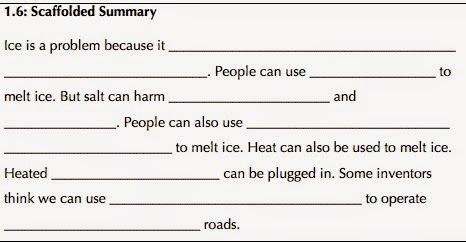
All students can benefit from a scaffolded summary. Simply write a good summary of a text, and then decide which parts to give to students, and which parts to leave out.
In a scaffolded summary, you can decide how much support to give to students. The scaffolded summary at the right is a very supportive frame, which gives students a great deal of language. It can become easy for kids to think of this kind of task as simply "fill in the blanks", so be sure to connect this to meaningful summarizing. (This particular summary is from Daily Warm-Up Activities, Grade 3).
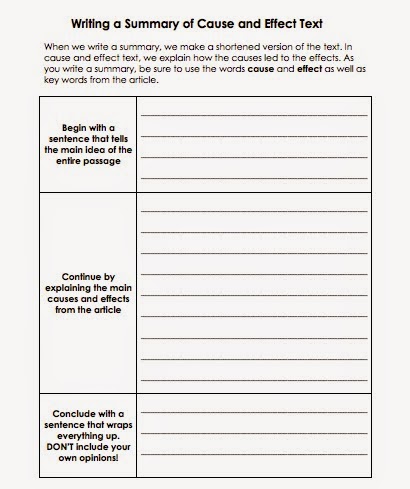
A scaffolded summary with less support can be seen here. Notice that this frame does not give any language specific to the text, but gives suggestions based on the text structure. It's different from a generic summary frame because it does not claim to be suitable for all passages--in fact, it only works for cause and effect text.
Lately I've found that teaching summarizing as I teach each text structure yields great benefits. This page is from Cause and Effect Activity and Texts.
Teaching students how to summarize is hard. Anyone who says differently is selling something...probably a generic summarizing frame.
I wince every time I see it. If there is one thing that I know about teaching summarizing, it is that one frame cannot be used with every informational text.
Summarizing
I first learned this more than 10 years ago, as I researched my first book, Summarizing, Paraphrasing, and Retelling. Intrigued by what I was observing in my classroom, I read scores of articles about summarizing, reading about how readers develop summarizing skills and how teachers can support this process.And there is so much to learn about summarizing! A teacher can learn so much about a student's reading processes by looking at a student summary. Some summaries are too long. Others do not reflect the main ideas of the text. Other students use the "copy and delete" strategy, copying some ideas from the text and leaving out others.
Topic Summaries
One kind of summary that is particularly thorny for intermediate readers is what I call the "topic summary". This summary just gives a run-down of the main topics in a text: "I read about mummies. First the author explained how mummies are made. Then the author described why mummies are important. Finally the author told about mummies today."This is not a good summary! Notice how it just discusses the topics, but not the main ideas. When I have students who write these summaries (and usually they are strong readers), I know that we need to discuss the difference between topics and main ideas. These topic summaries can often be written by just running down through the headings of the text. But do they show a deep and rich understanding of the content? Not at all.
Another problem with the topic summary is that it uses chronological order transitions instead of reflecting the structure of the text. In fact, a topic summary reads more like an account of the reader's experience of the text instead of showing the author's ideas.
Generic Summary Frames
...but what does a generic summary frame lead kids into writing? Yup. A topic summary.Teaching readers how to summarize is hard. But we need to acknowledge and embrace this difficulty instead of looking for a simple fix. Generic summary frames attempt to circumvent the real cognitive work of crafting a summary and boil it down into something simple. Getting really good at this kind of writing will not naturally lead into being able to write sophisticated summaries.
What to do instead?
Lots of things! The first step is to figure out what students can do independently. Give them an appropriately leveled text and have them write a summary.Blank stares
If they don't have any clue of how to begin, this tells you to start with some model summaries. Use short, familiar texts to show students what a good summary looks like.
Scattered summaries
When students have a shaky understanding of a text, they produce oddly scattered summaries. This represents students' attempts to play the game of summarizing--they pick out ideas from here and there, without understanding how the whole text hangs together.
Techniques that focus on basic comprehension really help students who are writing these summaries. Try retelling nonfiction texts. When kids put ideas into their own words, they have to wrestle with the language and pin down the meaning. Next, show students how authors signal main ideas in a text with headings and topic sentences.
Long summaries
If students write really long summaries with the main ideas of the text, they are probably comprehending well. Start by telling students, "Okay, cross out one sentence from your summary." Expect some resistance--"It's all important," or "I can't decide!" After some time, though, students will probably find at least one sentence to take out. Repeat, repeat, repeat! Eventually students will bring you their work and say, "Don't tell me to take out a sentence, because I already thought about everything that was most important and I only wrote that."
Making a scaffolded summary
All students can benefit from a scaffolded summary. Simply write a good summary of a text, and then decide which parts to give to students, and which parts to leave out.
A scaffolded summary with less support can be seen here. Notice that this frame does not give any language specific to the text, but gives suggestions based on the text structure. It's different from a generic summary frame because it does not claim to be suitable for all passages--in fact, it only works for cause and effect text.
Lately I've found that teaching summarizing as I teach each text structure yields great benefits. This page is from Cause and Effect Activity and Texts.
Teaching students how to summarize is hard. Anyone who says differently is selling something...probably a generic summarizing frame.
Monday, June 9, 2014
Summer School Reading Resources
Working with summer school this summer? I remember the days of wanting to plan high-interest, engaging activities...but not wanting to spend all day creating new materials. Here are some resources that I have created that might save you time and get you back by the pool!
Reading Intervention
This intervention includes six high-interest nonfiction texts with summer themes, all written at a 4-5 grade reading level. You could use the entire 30-day program, or just use some parts. My students have always enjoyed reading "Leaves of Three, Let It Be" and then walking around the schoolyard to look at (but not touch) poison ivy! Other texts include caverns, thunderstorms, and bluebirds, all of which lend themselves to fun outdoor extensions.
May Reading Homework
My students loved the recipe for s'mores that I wrote for this series of texts. It would be fun to compare and contrast the classic s'mores with the indoor s'more recipe!
Also included is a fable, a problem/solution text about cheetahs, and a readers theatre selection about Memorial Day. Each text includes vocabulary, comprehension questions, an extension focusing on complex text, and an open-ended response.
Roman Readers Theatre
Readers theatre scripts are a great way to engage students in practicing fluency. They are happy to do repeated reading when they get to perform! These scripts are funny little plays that introduce students to aspects of Roman culture. You could do multiple scripts with a large group, or have the same group of students do several scripts over a period of days or weeks. Students can then compare the information in the readers theatre scripts to the information in the included article.
Under the Sea Nonfiction Texts
Four texts with comprehension questions and open-ended responses. I wrote these when my students were fascinated by octopuses. (Yes, it's octopuses and not octopi!) I became fascinated too! The culminating activity included with these texts would be lots of fun for summer school and could lead right into an aquarium visit.
Frolyc.com
If you have access to iPads, check out Frolyc.com. You can create activities and publish them to student iPads, have students create activities, or use activities that other teachers have created. (Search my name to find some of my activities.) This is a great time to play around with a great tool for the upcoming school year.
Updates
-I am working on Part 2 of the Daily Sentence Writing. By the time I am finished, there will be more than 20 weeks of sentence activities to help students compose, imitate, and chunk sentences.
-Other plans for the summer include updating the Visualizing activities, adding a new unit on analyzing stories, and finishing a reading intervention that incorporates United States geography. Leave a comment if you would like something to be a priority!
Reading InterventionThis intervention includes six high-interest nonfiction texts with summer themes, all written at a 4-5 grade reading level. You could use the entire 30-day program, or just use some parts. My students have always enjoyed reading "Leaves of Three, Let It Be" and then walking around the schoolyard to look at (but not touch) poison ivy! Other texts include caverns, thunderstorms, and bluebirds, all of which lend themselves to fun outdoor extensions.
May Reading Homework
My students loved the recipe for s'mores that I wrote for this series of texts. It would be fun to compare and contrast the classic s'mores with the indoor s'more recipe!
Also included is a fable, a problem/solution text about cheetahs, and a readers theatre selection about Memorial Day. Each text includes vocabulary, comprehension questions, an extension focusing on complex text, and an open-ended response.
Roman Readers Theatre
Under the Sea Nonfiction Texts
Four texts with comprehension questions and open-ended responses. I wrote these when my students were fascinated by octopuses. (Yes, it's octopuses and not octopi!) I became fascinated too! The culminating activity included with these texts would be lots of fun for summer school and could lead right into an aquarium visit.
Frolyc.com
If you have access to iPads, check out Frolyc.com. You can create activities and publish them to student iPads, have students create activities, or use activities that other teachers have created. (Search my name to find some of my activities.) This is a great time to play around with a great tool for the upcoming school year.
Updates
-I am working on Part 2 of the Daily Sentence Writing. By the time I am finished, there will be more than 20 weeks of sentence activities to help students compose, imitate, and chunk sentences.
-Other plans for the summer include updating the Visualizing activities, adding a new unit on analyzing stories, and finishing a reading intervention that incorporates United States geography. Leave a comment if you would like something to be a priority!
Labels:
expository,
nonfiction,
summer reading,
summer school
Thursday, May 22, 2014
Reading, Visual Imagery, and STEM
I'm fascinated by exploring how readers tie together words on a page and images in their heads. Drawings really help to show a teacher what students are imagining as they read and how they are building mental models. (You can see this Visualizing Assessment for an example.) Sketch-to-stretch is one of my favorite content area reading strategies.
In his chapter in the book Literacy in the Arts Gary Woolley writes, "Imagining story ideas during reading links information in working memory and makes the encoding and recall of information more efficient." I've seen this with my students as they read both narrative and expository texts--drawing pictures and attaching new vocabulary to concepts help students to go beyond shallow surface processing.

It's interesting to see how this plays out in the real classroom. To get ready for our cavern field trip, we read a text about caverns. Students first drew what they thought caverns look like. This picture is pretty typical--a few cave features, lots of lovely artwork, but nothing that shows how caverns form or what they might be like inside.
Then students read a text about caverns. Interestingly, they did not spontaneously go back to their original drawings to add more. It took a great deal of prompting on my part to encourage the groups of students to go back to their pictures: "Do you know the names of some of the cavern features now? What could you add to your cavern picture?"
On Monday, we went on our field trip to the cavern. I felt the power of the preparation when students gasped as they went in: "Oh, Mrs. Kissner! It's beautiful!"
The words that had been lacking after the reading selection were being used now, even before they were introduced by the tour guide. "Is that flowstone? I think it is."
"Mrs. Kissner, where is the limestone?"
"I feel the water! I'm going to grow rocks on me!"
"Oh, which are the ones that grow down? Stalac somethings."
It was a really neat experience and really enhanced by the students' interest. When we returned to school on Wednesday, then, I wanted to take the time to process what we had done.
"Let's go back to our cavern drawings," I started to say. But then something changed. Maybe it's seeing all the awesome projects in my Twitter feed, maybe it's my experience with STEM club--I changed the task from "Let's draw a cavern" to "Let's find a way to create a cavern."
Kids started to collaborate, forming loose groups. Some students did created drawings, but they were rich, multi-layered affairs, with keys to symbols and labels. Other students turned to paper engineering. How could you make a cavern out of construction paper? It became quite the engineering challenge as students experimented with rulers and cardboard to create three-dimensional scenes. Luckily I had a parent volunteer in for the morning, so she helped as I pulled out more materials (aluminum foil! wax paper! rubber bands! Playmobil people!) and engaged students in conversation about what they were doing.
Here are some products:
The second cave experienced a real-life sinkhole, as the house caused the whole thing to sink in at first. "Mrs. Kissner! It fell apart!" This was a great connection to sinkholes, which I was going to teach about anyway, so it was a very productive setback. I pulled everyone together for a few minutes after music class to talk about the sinkhole and show some videos of how they look in the real world.
On the other side of the room, I was worried about one group that had a cup of water. Then they explained: "The cave that we went to had a room that was carved by water and an underground lake, so we're putting an underground river in ours."
It was interesting to see how they dealt with the task of creating a cave in three dimensions, and how this task allowed them to explore the concept in new ways. Their creations were different from the typical "class project" in that their products were not uniformly beautiful, but all showed some learning.
I'm wondering:
-What details about this task will stick with kids in 3 weeks, 3 months, 3 years? What big ideas will they remember about caverns?
-What STEM concepts did they learn while working on their caverns?
-How did the real life experience and the reading interact?
-Luckily, I had started packing away some books for the end of the year, and so I had some empty shelf space for temporary cave display. But what will I need to do next year to make room for these kinds of projects?
Tweet
In his chapter in the book Literacy in the Arts Gary Woolley writes, "Imagining story ideas during reading links information in working memory and makes the encoding and recall of information more efficient." I've seen this with my students as they read both narrative and expository texts--drawing pictures and attaching new vocabulary to concepts help students to go beyond shallow surface processing.

It's interesting to see how this plays out in the real classroom. To get ready for our cavern field trip, we read a text about caverns. Students first drew what they thought caverns look like. This picture is pretty typical--a few cave features, lots of lovely artwork, but nothing that shows how caverns form or what they might be like inside.
Then students read a text about caverns. Interestingly, they did not spontaneously go back to their original drawings to add more. It took a great deal of prompting on my part to encourage the groups of students to go back to their pictures: "Do you know the names of some of the cavern features now? What could you add to your cavern picture?"
On Monday, we went on our field trip to the cavern. I felt the power of the preparation when students gasped as they went in: "Oh, Mrs. Kissner! It's beautiful!"
The words that had been lacking after the reading selection were being used now, even before they were introduced by the tour guide. "Is that flowstone? I think it is."
"Mrs. Kissner, where is the limestone?"
"I feel the water! I'm going to grow rocks on me!"
"Oh, which are the ones that grow down? Stalac somethings."
It was a really neat experience and really enhanced by the students' interest. When we returned to school on Wednesday, then, I wanted to take the time to process what we had done.
"Let's go back to our cavern drawings," I started to say. But then something changed. Maybe it's seeing all the awesome projects in my Twitter feed, maybe it's my experience with STEM club--I changed the task from "Let's draw a cavern" to "Let's find a way to create a cavern."
Kids started to collaborate, forming loose groups. Some students did created drawings, but they were rich, multi-layered affairs, with keys to symbols and labels. Other students turned to paper engineering. How could you make a cavern out of construction paper? It became quite the engineering challenge as students experimented with rulers and cardboard to create three-dimensional scenes. Luckily I had a parent volunteer in for the morning, so she helped as I pulled out more materials (aluminum foil! wax paper! rubber bands! Playmobil people!) and engaged students in conversation about what they were doing.
Here are some products:
The second cave experienced a real-life sinkhole, as the house caused the whole thing to sink in at first. "Mrs. Kissner! It fell apart!" This was a great connection to sinkholes, which I was going to teach about anyway, so it was a very productive setback. I pulled everyone together for a few minutes after music class to talk about the sinkhole and show some videos of how they look in the real world.
On the other side of the room, I was worried about one group that had a cup of water. Then they explained: "The cave that we went to had a room that was carved by water and an underground lake, so we're putting an underground river in ours."
It was interesting to see how they dealt with the task of creating a cave in three dimensions, and how this task allowed them to explore the concept in new ways. Their creations were different from the typical "class project" in that their products were not uniformly beautiful, but all showed some learning.
I'm wondering:
-What details about this task will stick with kids in 3 weeks, 3 months, 3 years? What big ideas will they remember about caverns?
-What STEM concepts did they learn while working on their caverns?
-How did the real life experience and the reading interact?
-Luckily, I had started packing away some books for the end of the year, and so I had some empty shelf space for temporary cave display. But what will I need to do next year to make room for these kinds of projects?
Tweet
Saturday, May 17, 2014
Formal Academic Writing + Student Creativity
The Common Core expectations are high for student writing. Students in third, fourth, and fifth grades are expected to write formal informational and persuasive pieces, using introduction and conclusion paragraphs. As a teacher, I appreciate the need to help students write longer and more complex pieces...but I also want to help them expand their creativity! To teach some of the basics of formal essays, I love to use the genre of expository fiction.
Expository Fiction
Expository fiction is text written using expository text structures, but with fictional details. Your students are probably reading these books without even realizing it! Star Wars: Epic Battles is one common example--this book explains the epic battles from the Star Wars universe in an informational way. Fictional battles, expository structure. Many of the Pokemon handbooks are the same way, as are books like The Care and Feeding of Sprites.
Expository fiction is fun. The details are interesting and imaginary, but the structure is real-world and businesslike. What better way to introduce the conventions of academic writing?
Design A Land
I first started doing this project years and years ago, and I've refined it over time. The basics are simple: Students create their own imaginary country, and then write an essay to describe it.
But this simple description can't capture what really happens during the experience. Students go deeper with their details, collaborating with each other to dream up new ideas. Students try out different genres, writing narratives to tell stories about their lands and travel brochures to invite tourists. Students learn new vocabulary words as they describe the features of their lands and how they came to be. It is the perfect extension of early childhood play into middle childhood academics.
Even better, this project also helped to integrate some important skills and concepts into language arts. Middle level writers are still struggling with capitalization of place names (for example, Chocolate river is a common transcription) and this project lends itself to repeated practice with this skill. Students write the place name on their maps, on their outlines, and in their rough drafts...I remind them to capitalize both words over and over and they get instant feedback.
This also helped students to become more interested in landforms. During the mapmaking process I walked around with copies of United States maps to demonstrate landforms. "What is a bay, really?" was a common question, and I showed bays on the map. I also spotted a major misconception about rivers--students thought that they went from ocean to ocean--and we were able to look at some maps and talk about how rivers flow.
Fashion-A-Fish
This activity from Project WILD (you can find one version of the lesson plans here, although there are many others if you search) is another fun project for expository fiction. Students create their own fish by combining characteristics. Different characteristics are best suited for different habitats and habits, and students then dream up more details to describe their fish. When I did this project several years ago, students pretended that they were biologists who had discovered a new species of fish and wanted to share their discovery with the world.
The Writing Lessons
Throughout the entire process, my lessons focused on aspects of expository writing, such as topic sentences, transitions, and introductions. Because students had a deep understanding of their topic (it was their own creation!), they had more processing power to focus on these aspects of writing. Of course, they were motivated to write a strong piece of writing. I told them, "You are the only expert on your land! If you don't write about this, no one will ever know these details."
Expository fiction is a wonderful way to engage young writers in formal writing. They can experiment with the forms and conventions of this kind of writing in a fun and engaging way.
Design-A-Land: Introducing Formal Essay Writing with Creativity is available from TeachersPayTeachers. It includes lesson plans, troubleshooting guides, and handouts to help students write strong essays.
Tweet
Expository Fiction
Expository fiction is text written using expository text structures, but with fictional details. Your students are probably reading these books without even realizing it! Star Wars: Epic Battles is one common example--this book explains the epic battles from the Star Wars universe in an informational way. Fictional battles, expository structure. Many of the Pokemon handbooks are the same way, as are books like The Care and Feeding of Sprites.
Expository fiction is fun. The details are interesting and imaginary, but the structure is real-world and businesslike. What better way to introduce the conventions of academic writing?
Design A Land
I first started doing this project years and years ago, and I've refined it over time. The basics are simple: Students create their own imaginary country, and then write an essay to describe it.
But this simple description can't capture what really happens during the experience. Students go deeper with their details, collaborating with each other to dream up new ideas. Students try out different genres, writing narratives to tell stories about their lands and travel brochures to invite tourists. Students learn new vocabulary words as they describe the features of their lands and how they came to be. It is the perfect extension of early childhood play into middle childhood academics.
Even better, this project also helped to integrate some important skills and concepts into language arts. Middle level writers are still struggling with capitalization of place names (for example, Chocolate river is a common transcription) and this project lends itself to repeated practice with this skill. Students write the place name on their maps, on their outlines, and in their rough drafts...I remind them to capitalize both words over and over and they get instant feedback.
This also helped students to become more interested in landforms. During the mapmaking process I walked around with copies of United States maps to demonstrate landforms. "What is a bay, really?" was a common question, and I showed bays on the map. I also spotted a major misconception about rivers--students thought that they went from ocean to ocean--and we were able to look at some maps and talk about how rivers flow.
Fashion-A-Fish
The Writing Lessons
Throughout the entire process, my lessons focused on aspects of expository writing, such as topic sentences, transitions, and introductions. Because students had a deep understanding of their topic (it was their own creation!), they had more processing power to focus on these aspects of writing. Of course, they were motivated to write a strong piece of writing. I told them, "You are the only expert on your land! If you don't write about this, no one will ever know these details."
Expository fiction is a wonderful way to engage young writers in formal writing. They can experiment with the forms and conventions of this kind of writing in a fun and engaging way.
Design-A-Land: Introducing Formal Essay Writing with Creativity is available from TeachersPayTeachers. It includes lesson plans, troubleshooting guides, and handouts to help students write strong essays.
Tweet
Labels:
common core,
essays,
expository,
writing,
writing process
Subscribe to:
Posts (Atom)