As I was planning for this week, I realized that I need to change my approach with multiple meaning words. In the past, I've looked at teaching multiple meaning words as teaching kids how to use the context of a text to figure out which meaning of a word is being used. In this way of teaching, I've assumed that the kids know the multiple meanings--what I'm teaching them is how to tell them apart.
With this year's students, however, I need to do more. These students really need work on understanding the different meanings of words. Just matching definitions to sentences isn't enough. I need to build their vocabularies by adding new words. To this end, I created this graphic organizer:
The idea is that I'll take a multiple meaning word that has an easy-to-visualize core meaning--for an easy example, run. The core meaning of run is to move quickly over the ground. Students will write this meaning and illustrate it. Then, I'll introduce 3 other meanings: run as in to compete in an election, run as in to flow over the ground, and run as in the name for a stream. Students will write sentences to show these different meanings.
My plan is to teach a new word each week. Words that I plan to use in the future include many words that cross our content areas:
-space
-line
-environment
-revolution
-source
-contract
If you're planning to try this with your students, make sure that you choose multiple meaning words that come from a common source. For example, the meanings of revolution are all related. However, the meanings of wind/wind are not. If you use an online dictionary, you can find the etymology to see if the different meanings come from the same source.
We'll see how it works! I'm looking forward to helping students to see how different meanings of words can be related.

Showing posts with label multiple meaning words. Show all posts
Showing posts with label multiple meaning words. Show all posts
Tuesday, October 11, 2011

Sunday, October 9, 2011
Thoughts on Multiple Meaning Words
I've been working on multiple meaning words with my students. For struggling readers, multiple meaning words can be very difficult. I wish that I could just buy a book or show a Powerpoint and have it all make sense. (I have bought the book, and I have shown the Powerpoint.)
But confusions remain. I've realized that this is because understanding multiple meaning words goes deeper than just matching definitions. In fact, I'm beginning to realize that this problem with multiple meaning words is linked to why my readers are struggling in the first place.
What are multiple meaning words?
Multiple meaning words look the same, but have different meanings. Sometimes this occurs when 2 words enter the language from different paths. For example, the bat used in baseball comes from the Middle English bateren, which meant to hit. The word for the flying mammal bat, however, came from Scandinavia. These two words look the same, but have completely different meanings. Knowing one won't help you figure out the other.
Polysemous words, on the other hand, share a common core meaning. Take the word spring. Its core sense is an old, old word meaning "to leap". The other meanings of spring all relate to this core meaning--the season spring, the water spring, even the coiled piece of metal. Knowing one helps you to know them all.
Visualizing and multiple meaning words
 When I ask students to do common tasks with multiple meaning words--match the way that a word is used in one sentence to another sentence, for example--they often resort to guessing. What's going on? For one thing, these activities often happen outside of a connected text. Readers who are used to sucking up information from pictures or previous pages have little to pull from. So these activities bring out a very real problem that these readers have with creating visual images.
When I changed my instruction to have students draw a picture of each sentence before they tried to do the matching task, I saw a huge improvement. The simple step of adding boxes spurred readers to visualize, which helped them to see how the words showed different meanings. Readers who are spontaneously visualizing probably don't need this step. However, this experience showed me that my readers are not spontaneously visualizing--definitely a useful piece of information! The problems with multiple meaning words only served to highlight a deeper reading issue.
Teaching Core Meanings
An interesting journal article by Marjolijn Verspoor and Wander Lowie found that L2 learners do better when they are taught the core meanings of words. One of the examples in the article is the word nugget. The core meaning is the kind of nugget as in a gold nugget. An understanding of this meaning helps a reader to understand the figurative uses of nugget as in a chicken nugget or a nugget of information.
Since I have many ELL students in my reading class, I found this very interesting. Now, I try to help students see how the core sense of a word relates to the other uses. How do the different meanings of wild relate? What about the multiple meanings of shop? Often, these students have trouble with the uses of a word that are within one part of speech, such as the meanings of bold.
It's a process! Hopefully, helping readers to visualize sentences and build their awareness of core senses of words will help them to better understand multiple meaning words.
Here's a funny story about Aidan and multiple meaning words.
But confusions remain. I've realized that this is because understanding multiple meaning words goes deeper than just matching definitions. In fact, I'm beginning to realize that this problem with multiple meaning words is linked to why my readers are struggling in the first place.
What are multiple meaning words?
Multiple meaning words look the same, but have different meanings. Sometimes this occurs when 2 words enter the language from different paths. For example, the bat used in baseball comes from the Middle English bateren, which meant to hit. The word for the flying mammal bat, however, came from Scandinavia. These two words look the same, but have completely different meanings. Knowing one won't help you figure out the other.
Polysemous words, on the other hand, share a common core meaning. Take the word spring. Its core sense is an old, old word meaning "to leap". The other meanings of spring all relate to this core meaning--the season spring, the water spring, even the coiled piece of metal. Knowing one helps you to know them all.
Visualizing and multiple meaning words
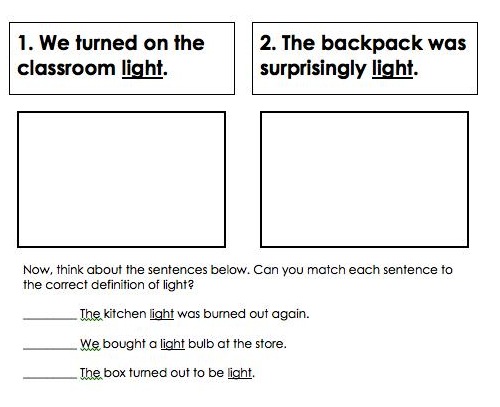
When I changed my instruction to have students draw a picture of each sentence before they tried to do the matching task, I saw a huge improvement. The simple step of adding boxes spurred readers to visualize, which helped them to see how the words showed different meanings. Readers who are spontaneously visualizing probably don't need this step. However, this experience showed me that my readers are not spontaneously visualizing--definitely a useful piece of information! The problems with multiple meaning words only served to highlight a deeper reading issue.
Teaching Core Meanings
An interesting journal article by Marjolijn Verspoor and Wander Lowie found that L2 learners do better when they are taught the core meanings of words. One of the examples in the article is the word nugget. The core meaning is the kind of nugget as in a gold nugget. An understanding of this meaning helps a reader to understand the figurative uses of nugget as in a chicken nugget or a nugget of information.
Since I have many ELL students in my reading class, I found this very interesting. Now, I try to help students see how the core sense of a word relates to the other uses. How do the different meanings of wild relate? What about the multiple meanings of shop? Often, these students have trouble with the uses of a word that are within one part of speech, such as the meanings of bold.
It's a process! Hopefully, helping readers to visualize sentences and build their awareness of core senses of words will help them to better understand multiple meaning words.
Here's a funny story about Aidan and multiple meaning words.
Wednesday, February 23, 2011
Vocabulary Work: Looking at Related Words
For a period of time, my youngest son thought that "chicken" was a multiple meaning word. There was the chicken that was the animal, and the chicken in chicken nuggets. In his little toddler brain, these obviously were not the same things! At around 3, he inquired, "Why are they called chicken nuggets?" He thought for a moment, and then said, "Do the chickens help to make them?"
I thought of this last week as I prepared to teach students about the word relationship. This is an important academic word, and kids have a lot of knowledge about it. But they don't always connect their knowledge in ways that make sense. For example, the most common idea that kids have about the word relationship is that it's a romance. (Giggle, giggle.) But this won't really help them to answer a reading question about the relationships between ideas, or the relationship between two numbers in math.
In order for kids to realize that they know many words that are related to relationship, I used a multiple meaning word web. We looked at how the word "relate" has many different meanings, and they are--heh--related! (Some of the kids found this meta-talk very funny!) We looked at the word relative and talked about their relatives. Then, we practiced relating to one another by listening and trying to understand one another. We talked about how ideas can be related, and finished by sorting words that could describe relationships between people. (This sort was made by my fabulous fourth grade colleague, Colleen.)

Hopefully, my students now have a better idea of how the words relative, relate, and relationship are connected. Instead of seeing them as isolated words that happen to have similar sounds, they see them as a word family.
And my youngest son? I worried about how to break the news to him that there only was one kind of chicken. But he figured it out for himself as we were eating rotisserie chicken one night. "Is this the animal chicken?" he asked.
"Um...yes?" I replied, worried that he would be upset, or refuse to eat it. But I had underestimated his zeal. He pumped his fist, chortled, and crowed, "Yeah! I'm eatin' chickens!" The multiple meanings of chicken, united at last.
Subscribe to:
Posts (Atom)