Showing posts with label comparing. Show all posts

Wednesday, June 26, 2024

Comparing Poems: A Look Back

 Time Warp: I originally wrote this blog post more than 10 years ago! As I was looking over past posts, I realized that I worked with the ideas in this post over this past year.

---------------------------------------------------------------

As the last part of our quick unit on figurative language and poetry, the students and I spent the last week looking at how to compare poems and write paragraphs to share our comparisons.

Whew. It's a difficult process for students. On the one hand, students often spontaneous make comparisons as we move through poems--"That one reminds of me of..." or "This is just like..." However, to write successful comparison paragraphs, students need to learn how to do more thoughtful, thorough comparisons.

Using a chart
A chart is essential for helping students to compare poems. Sometimes people try to use Venn diagrams for this purpose. Venn diagrams are great for set theory and fun visual gags...but terrible for planning writing! A chart sets up the important criteria for what is to be compared. Because testing season is coming up, I told students that they won't be able to use a prepared chart for our state tests, but that they can make their own comparison charts.

It's interesting to watch students use the chart. When I model this for struggling readers, I work with one poem at a time. This kind of careful reading and analysis takes a lot of concentration, and struggling readers often have trouble with the attentional shifts needed to go back and forth between texts. On the other hand, strong readers often prefer to work in the opposite way. They thrive on the extra challenge of going back and forth between texts and often create strong insights, seeing differences in the ways that the author developed the topics. (2024 update: As I work with gifted and enrichment students, I now see how much our strong readers love to work on topics like this! It's an easy way to add differentiation.)

Do we have to fill out the whole thing? That's the beauty of it--I tell students that we only need to fill in 4 or 5 blocks. We look for the criteria that are the most interesting for the poems that we have. Interestingly, kids always like to fill in the block for figurative language and sound devices!

Scaffolded response frame
A scaffolded response frame is useful for students who are still learning compare and contrast structure. Let's face it--this describes just about every elementary school writer! A nice middle level of scaffolding is to project the scaffolded response, but have students write their own responses.

Is it formulaic? Yup. Does it lead to scripted, formulaic writing? Some of the responses on the last assessment were the best that I've seen. Helping students with the topic sentence and the transitions freed up some processing space for them to do some deeper thinking about the texts. Kids used quotation marks to show where they were quoting from poems, using specific details, coming up with similarities that I hadn't considered. These are good things! (2024 update: When I did a similar activity with a group of gifted students, I expected that they would chafe against the formula of the frame. Nope! They wanted the frame even more than other students.)

Choosing Poems
This is the hardest part. It's tempting to stick with poems that have the same topic. But even poems with the same topic don't always make the best comparisons. Last week I chose two hawk poems. The whole lesson fell kind of flat--besides the same topic, the poems didn't really have anything interesting or compelling enough about them to spend a great deal of time talking about.

Two poems that worked very well were "Hello, Moon!" by Patricia Hubbell (found in Hey, You!: Poems to Skyscrapers, Mosquitoes, and Other Fun Things) and "The Moon's the North Wind's Cooky" by Vachel Lindsay. These poems both explored the changes in the moon in an interesting way, with lots of differences in the use of figurative language and structure to talk about.

(2024 note: To differentiate this for my enrichment students, I gave them poetry books and let them choose the poems to compare. This gave them a purpose to strategically read many poems and talk about them together.)

Comparing poems was an interesting and rigorous way to end our study of poetry...but I do think that we are all ready to go on to text structure next week!

Thursday, February 7, 2019

Introducing a Poetry Unit


This week I started teaching my poetry unit, which is both exciting and scary! It's exciting because I love poetry, and I love the chance to immerse my students in poems. It's scary because each year is so different from the last and I never know how students will react.

Prepare or find a poetry collection

To immerse students in poems, it's good to have a collection of poetry that they can refer back to, again and again. I have one put together in Figurative Language PowerPoint and Activities. This year, I added two sonnets (available here) to my existing collection.

Putting together a poetry collection can be as simple as gathering poems that you want to teach! By adding poems with similar themes, you can invite natural comparisons. Some of my favorites that are in the public domain include:
-The Wind, Robert Louis Stevenson
-Who Has Seen the Wind? Christina Rossetti
-The Moon's the North Wind's Cookie, Vachel Lindsay
-Perhaps You'd Like to Buy a Flower? Emily Dickinson
-Where Go the Boats? Robert Louis Stevenson
-Paper Boats, Rabindranath Tagore

In addition to the poetry collection (mostly made up of public domain poems), I also have shelves full of diverse poetry, picture books that I've picked up from prowling used book sales and the reduced price sections at discount bookstores. These poems give students windows into worlds beyond.


Find out what students already know

It's important to get an idea of what experiences students are bringing with them to the poetry experience. This year, I learned about their prior experiences with a carousel activity. I made six small posters with topics:
-Famous Poets
-Figurative Language
-How I Feel About Poetry
-Poems I Know
-Speaker in Poetry
-Poetic Structure

Then, students moved from poster to poster in small groups. Let me tell you, I learned so much from watching students and listening to their conversations! From the "Figurative Language" poster I observed that students can generate names of some kinds of figurative language, but that there is some confusion between figurative language and other literary devices. From the "Poets We Know" poster I saw that students couldn't really generate a list of poets, but that my name was on there. :)

Use visuals

Animated and illustrated versions of poems are so engaging! On the first day, we looked at "Ozymandias" and watched this amazing version.


Then we talked about what the poem might mean. First conversations with big poems need to be open and nonthreatening, focused less on getting right answers and more on talking about what big ideas might be lurking beneath the words. Don't worry if you don't know what meanings are lurking beneath the words! It can be a joint voyage of discovery.

On a less dramatic note, I also shared this poem that I read aloud. We talked about how the poem makes us feel calm and peaceful...a great entry into deeper discussions of tone and mood.


Give students the words to discuss

Great conversations need lots of words! This Poetry Help Sheet (available in Comparing Texts 2) is a quick and easy tool for students to use to have discussions. As an end to our second day of poetry,
students read the help sheet and used words from the page to talk about one of the poems in their collection. What is so important is that students are in control of choosing the poems and deciding how to talk about them.

Of course students had questions about these words and topics, which led to even more interesting conversations...for example, what does whimsical mean, anyway?

First experiences with poetry can make all the difference in whether students enjoy poems or look at poetry as a chore. By making your first lessons open-ended and engaging, you can help students love poetry!


Thursday, March 31, 2016

Comparing Texts: New Passages!


This year I've been working on new Article Response sets to use as ongoing practice and homework with sixth graders. They have worked wonderfully all year and I'm thrilled to share them.

All of the response sets are set up in a similar pattern: cover sheet, summarizing prompt, response prompt, and text. Each also has a comprehension quiz.

At the start of the year, I planned to send these home as homework. As the year has progressed I've changed my thinking! We start class with ten minutes of independent reading followed by ten minutes of working on the texts and responses. Some days I do a mini-lesson about summarizing or writing a response, while on other days students partner read. A two-week span for each packet gives us enough time to have thoughtful conversations without feeling pressured to produce.

"Damon and Pythias" and "The Two Travelers"

The latest two sets have been focused on comparing narratives. I think that comparing texts is such a meaningful, authentic purpose for close reading. When kids read two texts and spontaneously offer comparisons, I know that good things are happening!


This text set pairs a retelling of "Damon and Pythias" with a version of the fable by Aesop "The Two Travelers". Both of these stories examine the meaning of loyalty and friendship, but in very different ways! For students dealing with sixth grade drama, the concept of loyalty is fascinating to discuss.

We acted out both stories in class. Acting out stories helps readers to grasp the action and better understand the events. When it came time to summarize "Damon and Pythias", students really were able to consider which events were important to the outcome of the story and which were not! The fable "The Two Travelers" teaches a lesson about friendship through a non-example, and raises an interesting question for students--did the bear in the story really talk?

"Damon and Pythias" is also the basis for the 2003 film Sinbad: Legend of the Seven Seas. If you are working on comparing texts, this is a great opportunity to compare a story to a film.

"The Elves and the Shoemaker" and "The Magical Cyber Elf"


This text set has been perfect for reviewing key content for standardized testing! I started with thinking about the classic fairy tale "The Elves and the Shoemaker". How could this story be translated for modern times? Because I am currently up to my ears in yearbook work the modern story "The Magical Cyber Elf" came to mind.

There have been so many great concepts to review with this text set. We used "The Elves and the Shoemaker" to review the parts of a plot diagram and talk about theme. Then, we used "The Magical Cyber Elf" to discuss point of view and how a shifting point of view can influence the unfolding of events in a story. We had some great conversations about how the themes of the two stories are very similar, even though the settings and conflicts differ.

If you try these text sets, let me know what your students think!


Saturday, January 16, 2016

Close Reading Tip: Connect Images to Text Evidence

    I just love this quick routine for building student skill with finding text evidence. Yesterday, as we were reading the classic "The Land of Counterpane" by Robert Louis Stevenson, I showed students classic illustrations of the poem. Here is one of my favorites, a 1907 illustration by Jessie Wilcox Smith.

   Not only does the illustration help to give students crucial context for the poem, but it gives us a quick, engaging task for finding text evidence. "Can anyone find a line in the poem that connects to this image?"

   Suddenly students had a real reason to go back into the text, and they loved scanning the illustration for tiny details. They eagerly plunged back into the text to find the lines that connect directly to the image.

    A quick image search yielded other illustrations, as this poem has been heavily anthologized. We looked at the similarities and differences, always going back to the text--how does this connect to specific lines in the poem? Because we were also working with a companion expository text (found in my Comparing Texts 2 bundle), our next step was to broaden our comparison to see if sentences from the expository text could be connected to the poem. And they could!

   Matching images to texts is highly motivating for readers, and it's fun to do. Even better, though, it builds connections for learners. What are your favorites for this kind of activity?


Friday, March 13, 2015

Teaching Compare and Contrast Text

This week I decided to turn text structure on its head and and start with compare and contrast! I made this decision to provide some additional continuity with our texts, and compare and contrast was the perfect bridge between our Antarctica theme set and text structure.


In the past, I've always started text structure with chronological order. This is the easiest text structure for many students to understand, as it is the structure of narratives and everyday living. But of course there is no rule for where to start, and I have to admit that I thought it would be fun to try things differently.

The teaching is much different, too, when compare and contrast is the first structure for careful examination. Here are some things that I've (re)discovered this week.

1. Not all transition words show similarities and differences.
Compare and contrast text is the perfect place to explore this! Teaching guides for text structure include lists of transition words...but these words often serve multiple purposes. Is the word while showing a similarity or a difference? Or is the author using it to connect two ideas? What about the word like? Even struggling readers can find looking for clue words and analyzing their use to be very meaningful and engaging.

2. Move to student-made charts as quickly as possible.

Beautiful graphic organizers just look so nice, don't they? But I've learned to get kids into making their own charts as quickly as possible. For looking at compare and contrast text, I prefer charts to Venn diagrams. This helps students to think more carefully about how information is organized in the text. Generating criteria for comparison gets readers looking more deeply at what aspects of the topics are being compared.

Student-made charts are gloriously messy. Kids think and rethink and change their columns. And that is all part of the process. When students decide, "I don't like the way I represented these ideas--I'm going to change it," major thinking has occurred! 

3. Connect, connect, connect!
Complex texts reflect complex thinking. Showing connections to the wider world helps students to see how ideas are reflected in the text.

After we read "Peregrine Falcons and Red-Tailed Hawks", we watched the peregrine falcon cam live from Harrisburg. This is always a student favorite. (I love it too!) Then we looked for sentences in the text to support what we were seeing. This got students diving once more back into the text, looking for connections between the live video view and the words on the page.

Our next text, "Vernal Pool or Puddle?", is the foundation text for a short text set about vernal pools. Students will read about vernal pools across several different text structures, hopefully helping them to see how content and organization connect.

Looking back
Teaching the text structure of compare and contrast turned out to be a great introduction to text structure. 

Have you tried changing up the order of any topics in your classroom? What have you noticed?

Texts mentioned
"Peregrine Falcons and Red-Tailed Hawks" is included in Introduction to Text Structure
"Vernal Pool or Puddle?" is included in Compare and Contrast Texts for Teaching Text Structure

Sunday, February 2, 2014

Comparing Poems: An Invitation to Close Reading

  I am finally wrapping up poetry. In November, I foolishly thought that I could squeeze the unit into the fourteen days between Thanksgiving. Hahahahahah! Between days off for school and extra time to let ideas percolate, the unit has stretched into thirty days. I don't regret it. Looking back, I don't see any lessons that were blind alleys or unproductive tangents.

  Our culminating activity is a little project to compare poems. Over the years I have collected a decent collection of poetry books for my classroom, augmented by strategic bookroom purchases. (All of the books can be found on my Figurative Language Pinterest board.) My dream was for students to dive into the books and read a variety of poems by different authors.

Step 1: Read at least 5 poems from 2 different books

Step 2: Choose two poems to compare
After students read and explored the poems, they had to choose two to compare. Luckily a grandparent volunteer was in the room with me on this day to help! We ran back and forth to the copier to make copies of the selected poems so that students could trade books around and still keep the poems they wanted. (Why make copies? If I had had students write out the copies by hand, some would have tried to find the shortest poems possible. Life in fourth grade.)

Step 3: Use a chart to compare the poems
Fourth graders really need some guidance in comparing poems. This chart helps students to focus on some key criteria to consider.

As students worked, I went around the room...partly to answer questions, and partly to read all of the great poems! Students did find some neat parallels. "Takeout" in Pieces and "Regurgitate" in Antarctic Antics share a topic, while another student found that "Spring Wind" in The Great Frog Race compares nicely with "Windy Nights" by Robert Louis Stevenson.

The best part, of course, is how the activity led students to ask questions and really consider aspects of the poems. Of course, I didn't answer all of the questions for students; in most cases, we went back to the poem together to try to think through them.
-Do you think this is a simile?
-Is this poem saying what I think it's saying?
-What is the theme of this poem?

...and my favorite question:
-What is an artichoke, anyway?

Getting fourth graders to slow down and really read a poem carefully is not an easy task. In this activity, the act of comparing led students to dive deeply into the poems. How are they different? How are they similar?

Step 4: Write a paragraph to compare the poems
We've written several of these paragraphs together, and I've given students feedback on their work so far. I used the feedback only process instead of feedback + grade, underlining great topic sentences, marking transition words ("Use these words again! They really help the reader to see how ideas connect!"), and circling specific text details. Some students asked to get their previous paragraphs from their folders so that they could refer to them as they wrote again.

Step 5: Create an illustration that shows aspects of both poems
Students are really excited about this step, and are thinking through their illustrations with care. This seems quite easy, but depending on the poems, it can be more tricky. Students are really looking forward to this step and keep coming up to me to show me all of the details they've included.


July 2014 Update
-You can find an iPad activity for students to use to compare poems here.
-This Frolyc activity invites readers to compare three texts: a poem, a video, and an informational text.

Friday, January 17, 2014

Comparing Poems to Other Texts

  I love comparing texts as it always helps us to notice something new about texts and our world. As we have gone on with learning about figurative language, students read the poem "Wake Up". I put it in a recorded form to make it easy for students to read:


We talked about how the simile in the poem compares the call of the cardinal to an alarm clock. Unfortunately, spring is still so far away from us here in Pennsylvania that we don't hear any cardinals in the early mornings! Instead, I found this video to share with students:


What is so interesting is how the video really highlights some of the information from the poem. What a great way to help students compare multimedia texts. Some questions to discuss:
-How do the images enhance the words?
-How are the purposes of the videos different?
-Which text might you choose to learn specific facts?

...and, even more interesting to consider:
-How do these two texts enhance each other?

In the end, both texts together really create a new kind of synthesis. They work together well to present an idea about cardinals and spring time. So much of current text comparisons have us analyzing the texts separately--what does this text do? What about this one? But now I am thinking that it is almost better to consider new questions. How do they work together? Which texts should be paired, and why?

After we worked with the poem, I put on the Cornell Feeder Cam to fill up some transition time. I haven't used the bird cams much this year and I was interested to see how students would react. They loved it! I found two bird books that had been languishing on the shelves and the students eagerly leafed through the pages, trying to identify the birds that we were seeing. Even more surprisingly, some students were spontaneously making similes: "Mrs. Kissner, that bird is as fat as a truck!" (It was quite a plump evening grosbeak.) While no cardinals came to the feeder, we did get to see several woodpeckers and a nuthatch. It was a lovely way to bring nature into the classroom on cold and frosty days.

Notes
-You can find the Comparing Poetry activity on Frolyc. It is ready to publish to your students' iPads!
-The cardinal poem and an informational text are also available in my Figurative Language pack. Great for RL 4.7 or 5.7!

Sunday, November 18, 2012

Comparing Texts with Pop-Up Books

Just as I like to work on summarizing throughout the year, I also like to work on comparing texts. Kids naturally enjoy finding connections between texts. If I model this early in the year, we can make strong connections all year long.

I decided to start with two quick pop-up books. The first reason for my choice was a practical one--I wanted really short texts that we could read in five minutes or less. But the second reason was a little deeper. I wanted to show students how even very short texts can communicate a theme in words and pictures.

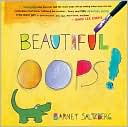
Book 1: Beautiful Oops
This was an impulse purchase a few weeks ago...and it has now become a classroom favorite! As we read it, we talked about several details:
-The author's use of intentional mistakes
-The playful illustrations and bright colors
-The theme that is expressed
-How the text and pictures support the theme


Book 2: Big Frog Can't Fit In
Of course, my students love the books of Mo Willems, so this has already been passed around the classroom on free-reading Fridays. As we read this, we talked about:
-The problem and solution expressed in the book
-The use of pictures and pop-up elements
-The theme that is expressed
-How the text and pictures support the theme

After we read the books, we completed a chart to compare them, looking at the themes, the illustrations, and the text. One student added a new detail: "Both books show a problem that has to be solved!" When we used the chart to write a paragraph, I modeled starting with the heart of the comparison--why these books are being compared.

Beautiful Oops and Big Frog Can't Fit both express deep ideas through playful words and pictures.

Using my new Elmo wireless tablet (okay, it is really awesome to be able to write on the board from across the room!), we developed the rest of the paragraph by explaining how both books are similar and different. I made a big deal out of the phrase "on the other hand", talking about how sophisticated and grown-up it sounds. :)  

After we did this together, students worked in clock buddy pairs to compare the books Molly's Pilgrim and Weslandia. At this point in the year, I give them a chart with criteria to consider. For these books, the criteria included the themes, how the characters are bullied, how the conflicts are resolved, and so forth. When students went to write their paragraphs, they chose the details from the chart that they wanted to develop. As a result, every pair's paragraph had a different focus. But most were solid and interesting, not bad for early in the fourth grade year! (Ten groups did experiment with "on the other hand", showing me that making a big deal out of the phrase must have made an impact.)

Pop-up books often don't have much of a place in intermediate classrooms...but these books are so engaging that they can really be useful tools.


Friday, June 17, 2011

Intertextuality

This is a term that I've been hearing more and more of lately. At first I discounted it as something that is beyond my students. But the more that I learned about intertextuality, the more that I realized that it is relevant and important for all readers--and pretty fun, also.

What is intertextuality? Simply put, it's the way that readers can make connections between texts. But intertextuality is more than making a chart to compare texts. When we think intertextually, we look for components that go across texts. When my youngest son looks at the Elephant and Piggie books to find the pigeon that Mo Willems puts on the last pages, that's intertextual thinking. When my older son talks about the differences between Egyptian and Greek mythology (as expressed in Rick Riordan's books), that's intertextual thinking. Intertextual thinking can also be looking at patterns of events across stories, or looking at how authors have chosen to convey ideas about the same topic in different ways.

Here is a more exhaustive description of intertextuality:
http://thinkingtesolteacher.wikispaces.com/Intertextuality

If you prefer learning through video, you may enjoy this:
http://www.youtube.com/watch?v=P6BFeVWb8vc

Intertextuality is really nothing new--it's just giving a name to what's been there all along. But the importance of intertextual thinking means that our readers need to have access to some of the big stories and themes. This year, I'll be thinking about how to equip students with the background knowledge they need to make these intertextual connections.

In the Common Core Standards, fourth graders are expected to "Compare and contrast the treatment of similar themes and topics (e.g., opposition of good and evil) and patterns of events (e.g., the quest) in stories, myths, and traditional literature from different cultures." This is a lot different from the "find one similarity and two differences"  that has been the expectation up to now. I'll be doing a lot of thinking about how to build this into my next school year!

Other posts about comparing texts and intertextual thinking:

Comparing Texts

Comparing Texts: Narrative and Blog

Wednesday, May 4, 2011

Comparing Texts

As the year draws to a close, I find myself teaching more and more about comparing texts. This is the perfect topic for the end of the year, as we have so much shared history and shared readings.

Why do we compare texts? Sometimes the process of comparing helps us to think more deeply about texts, finding details that we didn't know were there. And sometimes the process helps us to see how texts that seem quite different have many things in common, and how there are common themes and ideas that come up again and again in literature. For my fourth graders, just starting to think at a higher level, comparing texts is a great way to open up their thinking about the great world of literature.

Here are some things that I've learned can really help kids to compare texts effectively.


Share lots of high quality books: The books that I read over the last few weeks for inferring work perfectly for comparing. When kids have read a variety of books that share common themes, the task of comparing is easier--and lots more fun.


Teach students to generate criteria: I started my lesson by showing kids a terribly written paragraph that compared two stories based on insignificant criteria--the number of words in the title, the number of letters in the character's names, etc. Students recognized right away that this paragraph was pretty silly! Then, I gave students cards with different criteria written on them. They sorted the cards based on "significant" or "not significant". For example, "genre" is significant, while "use of the letter r" is not. (Kids appreciated this one!) Some, like "animals in the text" could go either way--it depends on what is being compared.


We ended up sorting the cards three times over the next week, reviewing what made the different criteria significant or not. The students had so many experiences with looking at how texts can be compared that they easily came up with significant criteria on their own.


Make it a game! If you use a Texts We've Shared Wall, start off a conversation by asking kids to browse the wall and look for two texts that would be easy to compare. Why? Then, look for two texts that would be very hard to compare. Why are these two so different? Can anyone find any significant similarities? This task helps kids to think more flexibly about comparing texts, looking at it as a fun challenge instead of a chore.

Put transition words in front of students: Give students the words they need to write compare and contrast text. Words like on the other hand, however, both, also, similar, and different...these words make comparing and contrasting infinitely easier. A page with different compare and contrast transition words will help students to write better paragraphs.

Weave in the editing: This is the perfect time to address finer points of which titles get quotation marks and which get underlined. Because students will be going back and forth between talking about the different texts, they have a real reason to use this punctuation.


Comparing texts is a great end of year activity...and it can be lots of fun!

Saturday, April 2, 2011

Text Set for Making Inferences

Don't you love it when everything just comes together? This week, as I reached for good picture books for teaching inferences, my choices happened to come together in a way that helped students to think about broader issues.

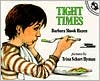
I picked up Tight Times at our library's used book store. I remembered it from watching Reading Rainbow as a child (ah, Reading Rainbow!), and I knew that it was a bargain at $.50. Even though it is meant for younger readers, it worked nicely for making inferences. We stopped and talked about what "tight times" means, how we could use the illustrations to make inferences about the parents' feelings, and what we could figure out about the narrator. (The narrator of this book, who is not named, wants a dog, but his parents tell him he cannot have one because of tight times. Things get worse when the father loses his job. But then the boy finds a kitten in a trash can, and the boy's parents decide that he can keep him.)

"But I didn't like the ending," Mandy said. "The book was so sad at parts, and then it just ended with something funny. I didn't like that." What a great observation! I turned back to the last page and we talked about the ending. (In a way, I have to agree with Mandy.)

When we looked more closely at the last few pages, though, we saw that the illustrator was telling us a little more to the story. "Look! The dad is looking at the newspaper!" Michael noticed.

"What do you think he's doing?" I asked.

There was some puzzlement as students talked about this with their partners. Some students obviously knew about want ads and the classifieds; others did not. "Maybe he's just reading a comic to cheer up?" Keith guessed. This is a classic example of how inferences depend on background knowledge. Luckily, other kids spoke up. "There are lists of jobs in the newspaper," Favia said confidently. "He's probably looking for a job."

On the next page, students noticed that the parents looked happier, and guessed that maybe things were better. "Sometimes the illustrator tells you things that the author does not," I said.

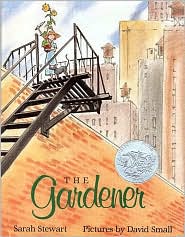
The Gardener by Sarah Stewart, a perfect book for teaching inferencing, worked beautifully with Tight Times. I explained that it was told in letter form (I love stories told this way) and asked students to talk with their partners about these words:

Lydia Grace
1935
Mama and Papa
train
Uncle Jim
windowboxes
bakery
the gardener

"Which words might relate to the setting?" I asked. We talked about the bakery, and the train, and students' guesses about who the gardener might be. "What's a windowbox?" asked Luke. We talked about what a windowbox is and how it related to the story.

This book leads to some great opportunities for making inferences. I was modeling an inference chart (three columns--inference, story clues, background knowledge) and this book was perfect. We weren't three pages in before students started buzzing about how this book was similar to Tight Times. I know that things are working when they start naturally comparing texts--without questions, without probing, without my intervention. "Yes, but the boy in Tight Times didn't have to go live somewhere else," I overheard. "I'd hate to do that!" someone else whispered.

My class this year is very visual, and they helped me to notice some new details in The Gardener--like the way that Lydia is always shown in the light, and how that matches her character so perfectly. "There were things like that in the pictures in Tight Times, too," Maura said. "Like how the dad was looking in the newspaper. And there are cats in both of the books."

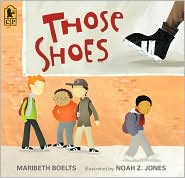
Next week I'm going to expand the inferring into theme, and I've already picked out Those Shoes as a good read aloud for this. What has worked out so well is that, even though I've been officially working on making inferences, these books have given us a chance to dive deeper into making connections and looking for broader themes in text.

Thursday, November 25, 2010

Text Structure: Compare and Contrast

As part of a project for a children's literature class, I'm working on compiling a list of high quality picture books that show different text structures.  But I've run into a problem with one particular structure--compare and contrast.

Many of the compare and contrast books that I've tracked down have been ones comparing similar animals. What's the Difference Between an Alligator and a Crocodile? is a good example of this kind of book.The author tells about alligators and crocodiles, how they are similar, and how they are different. What's the Difference Between a Frog and a Toad?, by the same publisher, approaches the topic in the same way. (A problem with the frog and toad book, however, is that toads really are frogs, in a technical sense, and the author throws this idea into the middle of the text in a somewhat confusing way.)

Which--okay, it is useful to see how these animals are similar and different. But aside from these, there are not many other books that exclusively use the text structure of compare and contrast. Why not?

I think it's because compare and contrast is a difficult structure to maintain over a whole text. In the real world of text, a reader is much more likely to see compare and contrast used in small amounts throughout a longer text. In a book about habitat loss, for example, a writer might use a bit of compare and contrast to show how a forest has changed over time. In a book about an invention, an author might compare and contrast previous attempts to solve a problem. In both of these situations, the compare and contrast text would help to explain the bigger point or structure of the text.

One nice example of this is in the book Sea Soup: Phytoplankton by Mary Cerullo.The overall structure of the text is a question and answer format. However, within the answers, the author uses the text structure that fits the information. An answer to the question "Are they plants or are they animals?" leads to a section in which phytoplankton is compared with plants and animals. The comparison is somewhat implicit, signaled by the sentence, "Some phytoplankton behave like plants, some like animals, and some like both." This is the case with a great deal of real-life compare and contrast text--although we teach students to look for compare and contrast cue words, many authors use a more implicit style.

What does this mean for classroom instruction? Well, I definitely will be checking out my library's copy of What's the Difference...? when I am working on the compare and contrast text structure. But I will also help students to find examples of this structure in longer texts, and to look for less obvious examples of compare and contrast.

Sunday, September 19, 2010

Comparing Texts: Narrative and Blog

Over the summer, my two sons and I loved finding out about mole crabs. When I went looking for information about them, I found that some of the main hits from the search engine turned out to be blogs.

Which got me to thinking--kids are going to be reading blogs much more often in the years to come. (Until blogs are replaced by something else, that is!) What do kids need to know to read a blog? What features should they look for?

I decided that it would be fun to write a story that connects to a blog. You can download the story and the instructional materials from Teachers Pay Teachers:

http://www.teacherspayteachers.com/Product/Comparing-Texts-Fictional-Narrative-and-Blog-Post

The blog post, of course, is over on the Kids Guide to Exploring Nature blog. I know that this is not a totally authentic blog. I'm going to avoid linking to other websites too much, because I want to have a very safe place with as little outward traffic as possible. But I'm hoping that it will at least get kids started with looking at some of the basic features of blogs--the posts, the reverse-time order, and the archives.

Wednesday, March 24, 2010

Text Structure: Compare and Contrast


Teaching the text structure of comparison and contrast can be tricky. If kids don't understand what either of these words mean, or if they don't know the words compare, contrast, similarity, and difference, they will have trouble with this text structure. "Introduction to Comparing" is an easy introduction to finding similarities and differences.

It's often helpful to give kids texts that have the clue words highlighted. When readers see these words, they often can figure out what the text is trying to say. Many less experienced readers have a habit of sliding right past transition words. When these words are highlighted, readers can't help but look at them and figure out what they mean.

Some compare and contrast texts don't use the clue words at all. This is often seen in texts that use the "clustered" style of compare and contrast--giving all of the information about one topic, and then giving all of the information from the other. The "Times Change" series from Heinemann-Raintree is an example of this. On one side of the page the reader finds details about the past; on the other, the reader finds details about the present. These texts are often more challenging for readers. All of the similarities and differences are left implicit for the reader to open up and consider.

If you are teaching compare and contrast as a text structure, it's helpful to show readers examples of both clustered paragraphs and alternated paragraphs. It's very effective to do this on the overhead. I used one of the Antarctica paragraphs from "Text Structure Resources" to show students what an alternated paragraph looks like. The South Pole is being compared to Pennsylvania. We underlined everything about the South Pole in blue, and everything about Pennsylvania in green. It quickly became clear that the paragraph was alternated!

Once students understand the basic format of compare and contrast, it's helpful to have them work with a graphic organizer. I like to teach students a comparison matrix to use as an alternative to the Venn diagram. (I've never been good at drawing circles!) For most texts, it's three columns: Criteria, Topic 1, and Topic 2.

The most difficult part of the comparison matrix is coming up with the "criteria" . Resist the urge to do this for your students. Model it once, and then give them a nice and easy text to try it for themselves. Experience with looking at the criteria that other authors use will help students when they start to write their own comparison and contrast paragraphs.

Wednesday, July 22, 2009

New presentations to share


I started making Powerpoints last fall, when I inherited a (slightly) broken LCD projector. I figured out the secret to making it work, and I haven't looked back. With two children and a somewhat hectic lifestyle, I find that Powerpoints help me to keep my teaching points organized and my brain in order.

One of my first presentations, "Understanding Text Structure" is nearing 3000 downloads at TeachersPayTeachers.com. It's available for free at http://www.teacherspayteachers.com/Product/Understanding-Text-Structure-Powerpoint. It's an overview of the different common text structures, with examples and explanations.

Lately I've started making some presentations for younger readers. Instead of emailing them to workshop participants, I've been experimenting with posting over at Slideshare.net. The latest one is called "Comparing is a Kind of Thiknking" and shows students how to compare. Here is the link: http://www.slideshare.net/elkissn/comparing-is-a-kind-of-thinking. Downloads are quick and easy.

And, in between cross-posting and blogging and getting into Web 2.0, I've also squeezed in visits to our local state parks...the frog picture on this post is from Kings Gap State Park, where Zachary counted 33 frogs from one location. Pretty neat!