As I looked ahead at the story elements unit, I realized that I had to do some work on making inferences. After all, telling kids to make inferences about the setting of a story won't make much sense if students don't know how to infer!
But where to begin? With this group of readers, I want some quick success to build their confidence. I decided to start with text-based inferences, taught along with some visualizing. As I wrote about in The Forest and the Trees, text-based inferences are those that depend on a knowledge of how text works. Finding the speaker in dialogue, matching pronouns with antecedents, and using specific clues from a text are all examples of text-based inferences.
Visualizing, on the other hand, is a form of reader-based inference, which depends on a reader's background knowledge. Why is visualizing a form of inference? No author ever tells every detail about a passage. Instead, a reader needs to bring some background knowledge to the text in order to form a visual image.
Critical Facts and Rules
As I researched The Forest and the Trees, I came across an interesting journal article. This article, authored by Philip Winne, Lorraine Graham, and Leone Prock, explains how struggling readers learned to make text-based inferences with the help of some carefully written texts and immediate feedback. The study is on the older side (1993), but I couldn't help but see how the methods described could help my students. Readers don't need a whole lot of background knowledge to make these inferences. And the process forces them to look closely at the details in the text to explain how they make their inferences. Great stuff for my students!
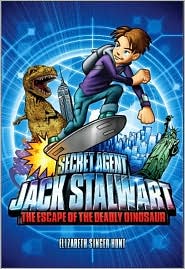
Sadly, the journal article only included one example text. So I wrote a set of my own texts to use with students next week. I chose a spy theme, since the Jack Stalwart books are popular with my readers right now. (If you haven't read these books, they are lots of fun for transitional readers--great gadgets and action, all in a supportive text.)
The texts that I wrote (on a sunny Saturday, when I should have been doing math plans) set readers up to make text-based inferences. A rule is presented early in the text. Then, the character is faced with choices, along with a good deal of distracting information and a hidden critical fact. The reader needs to match the rule with the critical fact to make an inference.
I plan to teach Mission #1 on the whiteboard, showing students how to make the inference using the rule and the critical fact from the text. Then, they'll work on Missions 2 and 3 with a partner, with a lot of supervision. Finally, they'll work on Mission 4 on their own.
This kind of inferencing is a great first step for transitional readers. Once students get good at finding these text-based inferences, they'll be ready for the next step into more open, reader-based inferences. And--hopefully--ready to have some brilliant discussions about finding the setting in a story!
If you try these mission files with your class, I'd love to hear how they work!
Showing posts with label forest and the trees. Show all posts
Saturday, October 15, 2011
Thursday, July 7, 2011
Teaching Visualizing
I love to teach visualizing. After all, there is a whole chapter about it in my book The Forest AND the Trees! It doesn't really work to tell nine-year-olds, "You need to read at the level of your situation model." But when I tell them, "Let's try to use the details to make a picture in our minds," something clicks. They understand how to make mental models. This gets them to that deeper level of reading that's so hard to describe for young readers.
But not all readers visualize in the same way. This makes teaching visualizing even more fascinating--when we talk about what we visualize, we realize how dependent we are on our background knowledge and experiences. As a teacher, I have come to a new appreciation of how the texts and stories I share become situated in students' schemas. Consider what happened last week when I asked a student to visualize "a green tractor in a birthday hat."
"I thought of the book we read yesterday," the student said. "The one with the robin."
This threw me for a loop. How would a book about a robin relate to a mental image of "a green tractor in a birthday hat"? But then the student reached behind me to get the book I Am Going! by Mo Willems. He turned to the page that had Elephant wearing a funny hat--a hat that happened to have a picture of the ubiquitous Pigeon from Don't Let the Pigeon Ride the Bus.
"See?" he said. "I pictured the tractor wearing a hat like that. It was funny."
This is the power of talking about visualizing--this student was able to trace how he used a mental image from a previous book to create a new mental image. This is also the power of sharing great books and background experiences with children on a regular basis! The experiences we share today will become the visualizations of tomorrow.
Here are some resources for teaching visualizing:
Visualizing Activities and Powerpoint
Available from TeachersPayTeachers ($3, because it took me so long to write the three stories that are included!)
Visualizing blog post (6/25/11)
But not all readers visualize in the same way. This makes teaching visualizing even more fascinating--when we talk about what we visualize, we realize how dependent we are on our background knowledge and experiences. As a teacher, I have come to a new appreciation of how the texts and stories I share become situated in students' schemas. Consider what happened last week when I asked a student to visualize "a green tractor in a birthday hat."
"I thought of the book we read yesterday," the student said. "The one with the robin."
This threw me for a loop. How would a book about a robin relate to a mental image of "a green tractor in a birthday hat"? But then the student reached behind me to get the book I Am Going! by Mo Willems. He turned to the page that had Elephant wearing a funny hat--a hat that happened to have a picture of the ubiquitous Pigeon from Don't Let the Pigeon Ride the Bus.
"See?" he said. "I pictured the tractor wearing a hat like that. It was funny."
This is the power of talking about visualizing--this student was able to trace how he used a mental image from a previous book to create a new mental image. This is also the power of sharing great books and background experiences with children on a regular basis! The experiences we share today will become the visualizations of tomorrow.
Here are some resources for teaching visualizing:
Visualizing Activities and Powerpoint
Available from TeachersPayTeachers ($3, because it took me so long to write the three stories that are included!)
Visualizing blog post (6/25/11)
Thursday, June 23, 2011
Open-Ended Responses
Today I had the privilege of presenting a workshop about helping students write open-ended responses. What an amazing group of teachers! I enjoyed meeting everyone and hearing about your classrooms and your schools.
When helping students to craft open-ended responses, it helps to look at the problems that students are having, and plan instruction from there.
Question-Answer-Relationships
For students who are having trouble answering the questions that are given, QARs can help. Here are some nice resources:
QAR posters and instructional materials
This is a great site with nicely formatted materials to print out and use right away.
QAR with pictures
I love this ReadWriteThink lesson that uses Question-Answer-Relationships with wordless books. Two of my favorites are used in the lesson plan--Zoom by Istvan Banyai and Tuesday by David Wiesner. By helping kids to find the answers to questions about pictures, this lesson helps students who may be struggling with finding answers in text.
Students who misinterpret text
These students are trying to make inferences and judgments about text, but are having difficulty. Often, it's helpful to work with these students on the skills of making inferences.
Using Schema to Make Inferences Powerpoint
I wrote this to guide students through the inference process.
Making Inferences
This is a presentation that I created for KSRA last year--it unpacks the skill of inferencing for teachers.
Inference Unit
This web page has many lessons and resources for teaching inferring.
Past Blog Posts about inferences
I write about inferences a lot!
Text Set for Making Inferences
Text-Based Inferences: Who's Talking?
Poetry Picture Books for Making Inferences
Literature Discussion Groups
Discussion groups can help kids of all ability levels to improve with answering questions and finding text details.
Literature Discussion Group Pack
This is a set of resources that I have on Slideshare.
Blog Posts
Lessons from Literature Circles
Discussion Groups: Getting Started
More information about inferences and helping kids to write open-ended responses--including sample texts--can be found in my book The Forest and the Trees.
I hope that these links are helpful! Please drop a comment about something that you like or plan to use.
When helping students to craft open-ended responses, it helps to look at the problems that students are having, and plan instruction from there.
Question-Answer-Relationships
For students who are having trouble answering the questions that are given, QARs can help. Here are some nice resources:
QAR posters and instructional materials
This is a great site with nicely formatted materials to print out and use right away.
QAR with pictures
I love this ReadWriteThink lesson that uses Question-Answer-Relationships with wordless books. Two of my favorites are used in the lesson plan--Zoom by Istvan Banyai and Tuesday by David Wiesner. By helping kids to find the answers to questions about pictures, this lesson helps students who may be struggling with finding answers in text.
Students who misinterpret text
These students are trying to make inferences and judgments about text, but are having difficulty. Often, it's helpful to work with these students on the skills of making inferences.
Using Schema to Make Inferences Powerpoint
I wrote this to guide students through the inference process.
Making Inferences
This is a presentation that I created for KSRA last year--it unpacks the skill of inferencing for teachers.
Inference Unit
This web page has many lessons and resources for teaching inferring.
Past Blog Posts about inferences
I write about inferences a lot!
Text Set for Making Inferences
Text-Based Inferences: Who's Talking?
Poetry Picture Books for Making Inferences
Literature Discussion Groups
Discussion groups can help kids of all ability levels to improve with answering questions and finding text details.
Literature Discussion Group Pack
This is a set of resources that I have on Slideshare.
Blog Posts
Lessons from Literature Circles
Discussion Groups: Getting Started
More information about inferences and helping kids to write open-ended responses--including sample texts--can be found in my book The Forest and the Trees.
I hope that these links are helpful! Please drop a comment about something that you like or plan to use.
Thursday, February 3, 2011
Building a Mental Model: Help for Reading Comprehension
Sometimes I dive into the depths of ERIC to find new information and new ideas. I have a folder full of journal articles! Some I just look over briefly, others I read slowly, and still others help me to understand my classroom in a new way.
My latest find is this article by Gary Woolley. Woolley looks at past research and explains a variety of strategies that can be used to help students who read with fluency, but don't seem to comprehend as well as they should.
I'm so interested in this because it explores helping readers to build a mental model. A mental model is a reader's impression of the text, synthesizing what is in the text with the reader's prior knowledge. Successful readers build elaborate, complex mental models, pulling on many ideas. Less successful readers...well, we can't go inside their heads to see what their mental models look like, but we can guess that they are underdeveloped.
Drawing
Drawing ideas from the text can help students to build better mental models. As students try to portray the details, they might need to go back to the text to fill in the details. Drawing helps students to understand how they need to combine the words in the text with the ideas and images from their minds. (You can find more on visualizing in The Forest and the Trees. Here is a free visualizing practice page that can help readers to see how they need to change their mental models.)
Using manipulatives
Another way to help readers build a mental model is through the use of manipulatives. When students have concrete pictures or toys to move around, they can better imagine how characters and objects move through space. In this retelling nonfiction activity, for instance, students move around baby turtles to show how they hibernate in the winter.
For example, today I helped students read a text about the Great Chicago Fire. (This was one of the groups in the chronological order centers.) It quickly became obvious that the students were not building a developed mental model. Oh dear! For tomorrow's groups, I'm going to give students a map of the city and some markers to help them track the progress of the fire through the text. By giving them a concrete visual, I hope to help them build a stronger mental model.
Helping students to build mental models--and understanding how the process works--is the task of a lifetime. I'm fascinated by the chance to watch it happen!
My latest find is this article by Gary Woolley. Woolley looks at past research and explains a variety of strategies that can be used to help students who read with fluency, but don't seem to comprehend as well as they should.
I'm so interested in this because it explores helping readers to build a mental model. A mental model is a reader's impression of the text, synthesizing what is in the text with the reader's prior knowledge. Successful readers build elaborate, complex mental models, pulling on many ideas. Less successful readers...well, we can't go inside their heads to see what their mental models look like, but we can guess that they are underdeveloped.
Drawing
Drawing ideas from the text can help students to build better mental models. As students try to portray the details, they might need to go back to the text to fill in the details. Drawing helps students to understand how they need to combine the words in the text with the ideas and images from their minds. (You can find more on visualizing in The Forest and the Trees. Here is a free visualizing practice page that can help readers to see how they need to change their mental models.)
Using manipulatives
Another way to help readers build a mental model is through the use of manipulatives. When students have concrete pictures or toys to move around, they can better imagine how characters and objects move through space. In this retelling nonfiction activity, for instance, students move around baby turtles to show how they hibernate in the winter.
For example, today I helped students read a text about the Great Chicago Fire. (This was one of the groups in the chronological order centers.) It quickly became obvious that the students were not building a developed mental model. Oh dear! For tomorrow's groups, I'm going to give students a map of the city and some markers to help them track the progress of the fire through the text. By giving them a concrete visual, I hope to help them build a stronger mental model.
Helping students to build mental models--and understanding how the process works--is the task of a lifetime. I'm fascinated by the chance to watch it happen!
Labels:
forest and the trees,
retelling,
visualzing
Sunday, December 12, 2010
Reading Nonfiction: Dealing with Faulty Prior Knowledge
Reading about Antarctica creates the perfect situation to help students learn more about how to change their prior knowledge. In general, readers don't like to change their ideas. With students, this means that they often cling to faulty prior knowledge.
Kids have many faulty ideas about Antarctica. Most of them think that polar bears do eat penguins, that lots of snow falls in Antarctica, and that there's no need for sunglasses or sunscreen. How do I help them to change these ideas while reading nonfiction?
Back when I was doing research for The Forest and the Trees, I came across the work of Graham Nuthall. He was an amazing researcher, taking hours of classroom footage, coding it, and interviewing students weeks and months later to find out what they remembered and why. In a 1999 article, he explained the kinds of activities that students need to engage in to make rich connections:
"This evidence suggests that tasks need to be set up that model and give students practice in activities that involve making connections between related pieces of information and identifying implications and potential differences and contradictions. As students practice these activities and become expert in the habits of mind involved in the activities, these habits become internalized and an unconscious but automatic part of the ways their minds deal with new experiences." (Nuthall 1999)
So I can't just sit the kids down and say, "Hey, kids. Guess what? Polar bears don't eat penguins." Instead, I need to build situations that create an internal mismatch in students' schemas, so that they experience the feeling of resolving this conflict. Our Antarctica readings are perfect for this.
Is it working? Listen to what a student said on Friday: "I know that there aren't any plants at the South Pole. And if there are no plants, there can't be any animals, right? So why is there a research station there? What would they study*?"
This student was putting together related bits of information and identifying the conflict. What great thinking! This is the payoff from reading multiple texts on the same topic--kids have the time and space to think about what fits, and what doesn't.
*We'll be reading about the South Pole this week. While there aren't any animals, there is some interesting research...
Kids have many faulty ideas about Antarctica. Most of them think that polar bears do eat penguins, that lots of snow falls in Antarctica, and that there's no need for sunglasses or sunscreen. How do I help them to change these ideas while reading nonfiction?
Back when I was doing research for The Forest and the Trees, I came across the work of Graham Nuthall. He was an amazing researcher, taking hours of classroom footage, coding it, and interviewing students weeks and months later to find out what they remembered and why. In a 1999 article, he explained the kinds of activities that students need to engage in to make rich connections:
"This evidence suggests that tasks need to be set up that model and give students practice in activities that involve making connections between related pieces of information and identifying implications and potential differences and contradictions. As students practice these activities and become expert in the habits of mind involved in the activities, these habits become internalized and an unconscious but automatic part of the ways their minds deal with new experiences." (Nuthall 1999)
So I can't just sit the kids down and say, "Hey, kids. Guess what? Polar bears don't eat penguins." Instead, I need to build situations that create an internal mismatch in students' schemas, so that they experience the feeling of resolving this conflict. Our Antarctica readings are perfect for this.
Is it working? Listen to what a student said on Friday: "I know that there aren't any plants at the South Pole. And if there are no plants, there can't be any animals, right? So why is there a research station there? What would they study*?"
This student was putting together related bits of information and identifying the conflict. What great thinking! This is the payoff from reading multiple texts on the same topic--kids have the time and space to think about what fits, and what doesn't.
*We'll be reading about the South Pole this week. While there aren't any animals, there is some interesting research...
Saturday, August 21, 2010
The First Day!
Three more days...and then the students will arrive. While I'm sad to see the end of summer, I am starting to feel a little bit of excitement for the new school year. (Thank heavens!) I can't help but think about what I'm going to do the first day, scribbling down notes on whatever paper I can find.
My focus for the first few days of school will be to help students realize how they can be great learners. Most of my fourth graders are a little anxious about the challenges of the new grade. I want them to get learning and feel successful right from the start.
I've already planned to do the What's Missing game from the Think-ets set, probably during my first few science sessions. While my first day's schedule is not entirely finished, here are two things that I know I'll be doing.
Distraction (from The Forest and the Trees): Too often, students don't realize that they have control over their attention. They allow themselves to be distracted by all of the little things going on in the room. I have to get students to realize their role in paying attention right from the start. After all, in my room, we can have two fans blowing, classes walking by in the hallway, birds chirping outdoors, and even the town's volunteer fire siren going off right down the hill. If students allow each little noise to be a distraction, they will have a very fractured learning experience.
The game of Distraction is simple. A student reads aloud from an informational book. During the reading, I zoom around the room, trying to be as distracting as possible. The kids think that this is really funny! After the reading is over, I ask students five simple questions based on the reading. Their success depends on how well they were able to tune out the distractions and focus on the reading. Then we talk about how they were successful or not. Invariably, some students are good at this, and can explain their strategies to others. We try it a few more times so that students can try out the strategies and see success.
Schema Maps: One of the tasks for the first day of school is a school tour. My fourth graders are new to the school, so a tour is definitely needed. This year, I'm going to combine the tour with a discussion of schema.
Early in the morning, I'm going to ask students to try to create a map of our school, labeling as many features as they know. They will probably find this challenging! Then, we'll walk around the school with our original maps on clipboards. Students will be able to make changes as we go. When we return to the room, we'll make new maps to show what we have learned. This will be an introduction to schema. Students will have a concrete example of how they can add to and change their schema. And our school tour--one of my least favorite first day chores--will have an added dimension of learning.
My focus for the first few days of school will be to help students realize how they can be great learners. Most of my fourth graders are a little anxious about the challenges of the new grade. I want them to get learning and feel successful right from the start.
I've already planned to do the What's Missing game from the Think-ets set, probably during my first few science sessions. While my first day's schedule is not entirely finished, here are two things that I know I'll be doing.
Distraction (from The Forest and the Trees): Too often, students don't realize that they have control over their attention. They allow themselves to be distracted by all of the little things going on in the room. I have to get students to realize their role in paying attention right from the start. After all, in my room, we can have two fans blowing, classes walking by in the hallway, birds chirping outdoors, and even the town's volunteer fire siren going off right down the hill. If students allow each little noise to be a distraction, they will have a very fractured learning experience.
The game of Distraction is simple. A student reads aloud from an informational book. During the reading, I zoom around the room, trying to be as distracting as possible. The kids think that this is really funny! After the reading is over, I ask students five simple questions based on the reading. Their success depends on how well they were able to tune out the distractions and focus on the reading. Then we talk about how they were successful or not. Invariably, some students are good at this, and can explain their strategies to others. We try it a few more times so that students can try out the strategies and see success.
Schema Maps: One of the tasks for the first day of school is a school tour. My fourth graders are new to the school, so a tour is definitely needed. This year, I'm going to combine the tour with a discussion of schema.
Early in the morning, I'm going to ask students to try to create a map of our school, labeling as many features as they know. They will probably find this challenging! Then, we'll walk around the school with our original maps on clipboards. Students will be able to make changes as we go. When we return to the room, we'll make new maps to show what we have learned. This will be an introduction to schema. Students will have a concrete example of how they can add to and change their schema. And our school tour--one of my least favorite first day chores--will have an added dimension of learning.
Subscribe to:
Comments (Atom)