Monday, January 19, 2015

From Centers to Contracts

This year, I've been experimenting with doing more open-ended, engaging play with my fourth graders.

It's not easy to do this in the face of increasing test pressure. Every day I wonder, "Should I put away the hands-on materials and get out the test prep?" This thought is usually accompanied by an increasing heart rate and a tightness in my chest as I think about my value-added scores for next year.

But I know that my students deserve more than the narrow band of learning the tests represent. They deserve a real place of learning and collaboration. Or--really--a place where they can play at the sink, where they can keep a stinkbug as a pet, where they can build with the Erector set--"Mrs. Kissner, we don't have a piece that we need but we'll improvise. We're good at that"--where they can start a business making bracelets and have time to write down the stories that they are thinking of and use Google maps to find where they went on that last vacation their whole family was together. They deserve to be able to use the science materials again and again, not just on one day, and to explore and immerse themselves in lots of different kinds of activities.

As you can probably guess I feel passionately about this!

I spent a great deal of time thinking about centers over the holiday break, considering where I wanted students to go. One concern that I have felt is that kids flit from activity to activity, and don't slow down to really explore a topic in depth. As 9 year olds mature into worldly 10 year olds, many of them are ready for deeper investigations.

Last week, I introduced learning contracts to students. These contracts are basically classroom agreements for an individualized activity. As you can see, there are places for the student and teacher to record when students will work, whether they will need to work on the project at home, and what specific steps they will need to complete.

...And students were very enthusiastic! Many students are writing reports about topics they have studied in the past. One student is making a periscope. Two students are writing a play together, and another went home and found an essay he had written in third grade and wants to type and revise.

The free exploration of centers is naturally settling in to some more focused, sustained exploration--just what fourth graders need developmentally.


Saturday, January 17, 2015

Engaging Writers with Expository Fiction

I love expository fiction! This kind of writing uses the structures and conventions of expository writing, but with fiction details. For kids of all ages, expository fiction is fun because kids can play with the expository genre while still having complete control over every detail.

Over the years, I've done several different projects with this kind of writing. One of my favorites was "Fashion-A-Fish", based on the Project WILD activity. After creating a fish, students wrote about the adaptations and shared their imaginary creatures in a class guidebook.
This is my example. So much fun to make!

Right now students are creating their own imaginary countries. It's so fun because it naturally covers many important topics, like landforms....

"Mrs. Kissner, what's a bay again?"
"Well--it's kind of like the opposite of a peninsula. Think an area of water, surrounded by land on three sides."

and capital letters...

"Remember, you need to capitalize both parts of a proper noun--like Chocolate River, the C and the R are capitalized." (Repeated at least 20 times over the next three days.)

and, next week, writing an outline. We'll be learning about introductions, conclusions, and transitions over the weeks to come. What makes this kind of writing so engaging for readers is that they control the details. Need more information? They just go back to their maps, bounce some ideas off their neighbors, and weave in the interesting details.

There are so many other options for expository fiction. It's a great way to help kids learn about expository writing!

Design A Land Activity Set

Tuesday, January 13, 2015

Improving story summaries by summarizing dialogue

When it comes time to summarize stories, many intermediate readers just don't know what to do with the dialogue. They know that dialogue is important, and that it carries information. But they also know that they shouldn't include too much dialogue in a summary.

The great news is that teaching readers how to summarize dialogue is pretty fun. "Don't include dialogue in a summary" is easy to say. But what should readers do instead?

This is what we practice! Short, funny skits are the ideal tool for this.

Here is one that students read in small groups after they finished their passage-based essays. You can imagine the laughter that spread through the room as students progressed further into the script!

So then students perform the script, and we talk about how to summarize the dialogue. What happened? With imaginary rewind buttons we can have the performers repeat parts of the script as necessary--very fun--and we have been known to mute them on occasion.

A list of words to summarize dialogue is helpful. I love word lists in general because they are such an efficient way to build word knowledge quickly. Many readers will return to word lists weeks and months after a lesson to find just the right word for an activity.

If you have students struggling with summarizing stories, try spending some time on summarizing dialogue. You'll hear some interesting insights and have great conversations!

Links
Summarizing Stories  includes more activities for summarizing dialogue, as well as the script and word list included here.


Monday, January 12, 2015

Behind the Scenes: A Classroom Economy

I write a lot about individual lessons and activities, but sometimes I forget to talk about the deep routines in the classroom. One thing that I love is a classroom economy! It runs totally in the background of the classroom (well, usually) and solves many daily problems. Basically, kids earn tickets in various ways and then can use those tickets for different purposes.

How do kids get tickets?

The basic way to get tickets is to do a classroom job. For other ways, the answer differs as the year goes on. Early in the year I would give kids tickets if I accidentally called them by a sibling's name--much to the delight of my younger son! Sometimes I also give tickets for random tasks, like stapling book orders or cleaning up from a science experiment.

As the year has gone on,  students also get tickets when they remove 5 vocabulary cards (you can read about the vocabulary system here).  But most students earn tickets through contracts. How do they get the contract? Students see a problem in the classroom and write a contract to fix it. Right now students are passing out reading binders, doing the lunch count, taking care of the bird observations and bird feeder, erasing the whiteboard, and, yes, keeping track of all of the contracts!

Kids write the contracts themselves, which makes for interesting conversations and an authentic reason for writing. What do you intend to do? How often will you do it? Once their contract work is complete, they fill out an "invoice" that I sign.

How do kids use tickets?

So here are the things on our class poster:
-Switch seats for the day: 2
-Special chair: 3 (I have an old teacher's chair that they can borrow for the day)
-Stool: 2
-Stuffed animal for the day: 2
-Extra copy of a paper: 1
-Returning to class to get a forgotten item: 1
-First choice of recess equipment: 1
-Laptop use (kids have assigned days, so this is for extra): 3
-Popcorn Party for the class: 50 (kids can donate into an envelope)

I also auction things off once or twice a cycle. These things include donated little toys, books and bookmarks, school supplies, and other randomness. Such a great way to get those odds and ends into good hands!

What else happens?
A student wrote a contract for making the
morning message.


Well--it's different every year. It's always interesting to see how kids make the system theirs. I don't allow students to bring things from home to sell for tickets, although kids do try to do this every year. Sometimes kids start businesses. Right now, some students are making friendship bracelets and "selling" them during indoor recess. Another student is selling drawings. One student purchased the rights to a fancy set of fine line markers, and rents them during recess.

When students kept forgetting to move their lunch cards in the mornings, the student in charge of the closets proposed a win-win solution: If you don't move your lunch card by announcements, you have to donate to ticket to the Popcorn Party envelope.

During indoor recess, we found that we were going through construction paper at an alarming rate. A student came up with a tiered payment system. Now, using recycled classroom paper is free, while construction paper has a ticket cost.

The area by the door to my classroom is covered with student-created posters, advertising their various goods and services. Students are even considering marketing and how to connect with customers. After the Hour of Code, one student even offered computer programming lessons!

Potential problems

...are not actually a big deal. I say to students early on--this is supposed to be fun. And students really treat it as such. We talk about safe places to keep tickets and the need to be responsible. There are minor problems with dropping tickets here and there, but nothing major so far. And I've done versions of this for four years.

Some fun

All in all, our classroom economy is a great routine to have going on in the background. Lots of fun and room for discussion and growth!

News and notes
-I finally finished Exploring Point of View! This includes two original stories--one written in a shifting point of view, and the other written in first person point of view.


Friday, January 2, 2015

Multimedia Texts and Activities


Over the past two years, I've been working with Frolyc to create activities for student iPads. It has been a wonderful experience to see the Activity Spot app grow and change.

Now, teachers can add text, pictures, web links, and video. Students can respond with drawings, open-ended responses, fill in the blank responses, and drag and drop organizers. Teachers can see student responses in real time.

Over the break, I spent time cataloguing the activities that I have created. Wow--I have created and posted 130 different activities! At first, much of my work focused on learning the affordances of the app--what could I do with it? What could kids do with it? What regular classroom tasks could the app encompass?

In the past few months, I've become much more strategic, trying to put together sets of activities to complement units of study or classroom topics. And all of this has been happening at a time when I have been learning all that I can about digital literacy and multimedia in the classroom.

Activity Spot is the perfect tool to help students transition into critical thinking about multimedia. Texts, videos, pictures, and web links are right there for students to explore.

Here are some of my favorite activities! Some are premium activities, while others are free.

Activities for grades 2-3
The A-10 Thunderbolt:  This informational text describes the A-10 Thunderbolt, and is a favorite with reluctant readers. Students read the text and complete a scaffolded summary. (Also included in paper form in Paraphrasing and Summarizing Lessons for Nonfiction Reading.)

The Flooded City: Venice: This informational text shows the text structure of problem and solution. (Also included in paper form in Problem and Solution Texts for Teaching Text Structure.)

Black Bears and People: This is another problem and solution text. I love looking at the pictures that readers create to go along with the text!

Activities for grades 4-5
The Painted Turtle: This is one of my newest activities and I am so pleased with it. My home beta tester (my fourth grade son!) enjoyed it. With this activity, I really used the capabilities of Activity Spot to create something that cannot be duplicated in a traditional text--students read the cause and effect text, and then compare it to a video on the same topic. (You can find the Painted Turtle text in Cause and Effect Activity and Texts for Teaching Text Structure.)

What is Mass?: This activity is an example of how Activity Spot can be used for science instruction. Students read about the difference between mass and weight, and then think about which tools are used for measuring these properties.

Energy Flow in Ecosystems: Picture the scene--a holiday party with grown-ups, kids dressed in their best clothes, surrounded by breakable Christmas collectibles. How can I amuse 8 and 10 year old cousins? With learning, of course! This picture shows what my son and nephew created after they read about energy flow in ecosystems. They used the camera roll on the iPad, found the awesome praying mantis picture, and labeled it. My proudest moment.

Activities for grades 6-8
Steel: From Swords to Skyscrapers: This chronological order informational text is so appealing to kids who like Minecraft! Multiple choice questions and a sequencing activity challenge students to use the text structure of chronological order. (Also available in paper form in Chronological Texts for Teaching Text Structure)

Emily Dickinson: I really like how this activity uses the capabilities of Activity Spot. Students learn about Emily Dickinson's life, and then view a video that highlights her use of imagery. Finally, they look at a commercial for "Emily Dickinson's Garden" to consider elements of author's purpose.

Endangered Species: The web features some fantastic writing, and with Activity Spot, you don't have to print and copy digital texts. This activity includes a link to an article from the US Fish and Wildlife Service highlighting lesser-known endangered species. After reading the article, students compare the text to a video, making this a great activity to help readers compare different kinds of text.

Looking forward
This is only a small sampling of the texts and activities that are available. Other teachers are creating and sharing as well. In the next few weeks, I hope to add even more informational texts. If there are activities you would like to see, fee free to request them here or on the Frolyc site.

Do you have lesson ideas that you'd like to add? You can create your own free and premium activities on Activity Spot! Visit Frolyc.com to learn how.


Tuesday, December 30, 2014

Passage-Based Essays Aren't Scary

...well, okay. They are a little scary.

This year in Pennsylvania, we get to have an entirely new test in the spring! Instead of the standard open-ended responses of the past, students will have to write passage-based essays. In other documents, this writing has been called a Text-Dependent Analysis.

I have been pretty nervous about this. The first samples that came from the state were awful--the kind of formulaic writing that no thoughtful teacher would want students to produce. "Is this what I'm supposed to do?" I thought. My next thought--"I'm going to have to do much better at TeachersPayTeachers, so that I can still have an income once the inevitable happens."

Well, I couldn't stay pessimistic for long. After all, if I left the classroom, who would identify all of the bugs and the birds around the place? So the easiest path was to figure out how to help kids write good passage-based essays.

Step 1: Teach students how to quote from the text

Teachers who haven't worked with 9 and 10 year olds might be surprised at how challenging students find the process of quoting from text. They don't know how to choose the sentences to support their thinking; they don't know where to put the quotation marks; they get confused about whether to switch from first-person to third-person pronouns. Teaching students how to quote from the text in short, low-stress activities early in the year makes the passage-based essay process much easier.

Step 2: Create a high-quality prompt to go along with a really great text.

My students were working in three different texts in late November, so I made a prompt for each. The prompts were all similar--each one had two areas for analysis.

     In the story Molly’s Pilgrim, Molly’s feelings about school change. In the beginning of the story, Molly feels as if she doesn’t belong at school. By the end, her feelings have changed.

graphic organizerWrite an essay analyzing Molly’s feelings about school and how they change over the course of the book. Be sure to include specific details, including quotations, from the book.

To help me keep everything straight I made prompts, checklists, graphic organizers, and rough draft pages on different colors of paper for each text.

Step 3: Model, model, model!

I decided to work through the process along with the students. I wrote a fourth prompt, this one for Santa Calls by William Joyce, and I modeled each step of the writing process, from dissecting the prompt to finding text evidence to putting it all together. It worked quite well to model-do--kids didn't have to sit and watch me for very long as I was just showing them the next chunk of what they would do.

I feel very strongly that my modeling needs to show a sophisticated version of the product--the piece of writing that I can produce as an adult. Kids need to see the real thing. And I did show my real, true, crazy revising process, beginning each session by rereading what I had so far and smoothing out the wording.

Step 4: Make it collaborative

In my first reading class, students had read the books as literature circle groups. It was only natural, then, for them to continue to work in their groups as they moved into essay writing. Some groups worked cohesively together, while others chose to do parallel writing and only consult with each other as needed. (In my other class, which I co-teach, students did not work in groups--which I came to regret when I saw how nicely the collaboration unfolded in the first class.) There is so much in this picture that I love--the students sitting together on the yoga mat by the library, books open as they refer to the words and pictures to grapple with the ideas.

Step 5: Don't worry about the time

I had estimated that it would take us a week to write the essays. Well, with discussion of reading homework and vocabulary, independent reading, and holiday schedule changes, it has stretched out longer. I feel a little bit panicked as I think about all that is before me, but I don't regret spending the time on these essays. Students have to do so much thinking as they consider the prompt, select text evidence, explain how the text evidence supports their statements, and write an introduction and conclusion!

I felt a little Grinch-y as we worked on passage based essays two days before holiday vacation. After I modeled writing a conclusion, students settled around the room to work on their essays. One student said, in that contented way that fourth graders have, "This is fun."

Trust me, nothing could have surprised me more. Fun? But this student wasn't trying to butter me up or make a joke. The work of creating, the work of weaving an author's words with her own thoughts to make something completely new--that can be fun. And it took a fourth grader to help me realize that passage-based essays aren't scary.

Resources

Books I used: Molly's Pilgrim by Barbara Cohen, Weslandia by Paul Fleischman, and The Memory Coat by Elvira Woodruff

Copies of the passage-based essay prompt, graphic organizer, and rough draft page can be found in this unit.

Tuesday, December 9, 2014

You can do better than a generic summary frame

   This week, Pinterest has repeatedly coughed up a pin with a generic summary frame. "Use with any informational text!" the caption reads. This generic summary frame has lots of color and a bright, cheerful font. Basically it looks like this: "I read the text ____________. First ______________. Then I learned that ________________. Finally I found out ____________________."
   I wince every time I see it. If there is one thing that I know about teaching summarizing, it is that one frame cannot be used with every informational text.

Summarizing

   I first learned this more than 10 years ago, as I researched my first book, Summarizing, Paraphrasing, and Retelling. Intrigued by what I was observing in my classroom, I read scores of articles about summarizing, reading about how readers develop summarizing skills and how teachers can support this process.
    And there is so much to learn about summarizing! A teacher can learn so much about a student's reading processes by looking at a student summary. Some summaries are too long. Others do not reflect the main ideas of the text. Other students use the "copy and delete" strategy, copying some ideas from the text and leaving out others.

Topic Summaries

   One kind of summary that is particularly thorny for intermediate readers is what I call the "topic summary". This summary just gives a run-down of the main topics in a text: "I read about mummies. First the author explained how mummies are made. Then the author described why mummies are important. Finally the author told about mummies today."
    This is not a good summary! Notice how it just discusses the topics, but not the main ideas. When I have students who write these summaries (and usually they are strong readers), I know that we need to discuss the difference between topics and main ideas. These topic summaries can often be written by just running down through the headings of the text. But do they show a deep and rich understanding of the content? Not at all.
    Another problem with the topic summary is that it uses chronological order transitions instead of reflecting the structure of the text. In fact, a topic summary reads more like an account of the reader's experience of the text instead of showing the author's ideas.

Generic Summary Frames

    ...but what does a generic summary frame lead kids into writing? Yup. A topic summary.
    Teaching readers how to summarize is hard. But we need to acknowledge and embrace this difficulty instead of looking for a simple fix. Generic summary frames attempt to circumvent the real cognitive work of crafting a summary and boil it down into something simple. Getting really good at this kind of writing will not naturally lead into being able to write sophisticated summaries.

What to do instead?

    Lots of things! The first step is to figure out what students can do independently. Give them an appropriately leveled text and have them write a summary.

Blank stares
   If they don't have any clue of how to begin, this tells you to start with some model summaries. Use short, familiar texts to show students what a good summary looks like.

Scattered summaries
    When students have a shaky understanding of a text, they produce oddly scattered summaries. This represents students' attempts to play the game of summarizing--they pick out ideas from here and there, without understanding how the whole text hangs together.
     Techniques that focus on basic comprehension really help students who are writing these summaries. Try retelling nonfiction texts. When kids put ideas into their own words, they have to wrestle with the language and pin down the meaning. Next, show students how authors signal main ideas in a text with headings and topic sentences.

Long summaries
    If students write really long summaries with the main ideas of the text, they are probably comprehending well. Start by telling students, "Okay, cross out one sentence from your summary." Expect some resistance--"It's all important," or "I can't decide!" After some time, though, students will probably find at least one sentence to take out. Repeat, repeat, repeat! Eventually students will bring you their work and say, "Don't tell me to take out a sentence, because I already thought about everything that was most important and I only wrote that."

Making a scaffolded summary
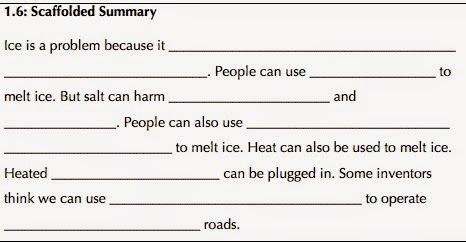
    All students can benefit from a scaffolded summary. Simply write a good summary of a text, and then decide which parts to give to students, and which parts to leave out.
    In a scaffolded summary, you can decide how much support to give to students. The scaffolded summary at the right is a very supportive frame, which gives students a great deal of language. It can become easy for kids to think of this kind of task as simply "fill in the blanks", so be sure to connect this to meaningful summarizing. (This particular summary is from Daily Warm-Up Activities, Grade 3).
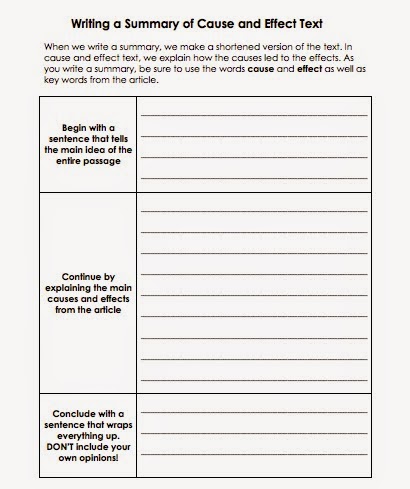
    A scaffolded summary with less support can be seen here. Notice that this frame does not give any language specific to the text, but gives suggestions based on the text structure. It's different from a generic summary frame because it does not claim to be suitable for all passages--in fact, it only works for cause and effect text.
    Lately I've found that teaching summarizing as I teach each text structure yields great benefits. This page is from Cause and Effect Activity and Texts.


    Teaching students how to summarize is hard. Anyone who says differently is selling something...probably a generic summarizing frame.