After we say our final goodbyes to students next week, my team is coming right back to school to work on some curriculum writing. We have to make some updates for the Common Core and examine our common assessments.
Seeing our curriculum map evolve has been an interesting experience. We started the process in the 2008-2009 school year, which feels like an educational lifetime ago. Of the 5 of us who worked on the original order of units, only 2 of us are still in fourth grade.
It's great to work with our new colleagues to examine what we've done through new eyes. Why did we choose this order and not that one? Is there a better way to arrange things? Sometimes we have a good answer to these questions. For example, story elements are a great topic for early in the year. As students read independently in the rest of the school year, they can find natural review and reinforcement of these concepts. But sometimes even the 2 of us who worked on the original order can't remember why we chose to arrange something in a particular way.
As I've tinkered with things here and there, I have learned that there is no one right way to order units. It's like a butterfly effect of curriculum. I might think that one topic fits better in October, after we have studied x, y, and z. But then it displaces something else, and makes many small changes over the course of the rest of the year. I am generally a random and chaotic person myself, so I don't mind these small changes. But I've learned to work with people who do mind these changes, and (hopefully!) I've become more sensitive to their desires for an orderly arrangement of topics.
Here are some questions that we have started to ask ourselves as we plan for the order of topics:
Is this a good match for the developmental level of our students?
Over the course of the year, fourth graders become capable of higher levels of abstract thought. Theme is a great example of this. We teach theme briefly as part of the story elements unit at the beginning of the year. At the end of the year, we look at theme in more depth, as part of a "Going Deeper into Fiction" unit. Some students who did not understand theme clearly in September just fly with the concept in April. As you think about your content, try to consider what would be a stretch for students, and what you'd like to front-load at the beginning of the year.
Are there connections that we can make to other content areas?
In science class, we learn about the skill of "classifying" as part of our introduction to inquiry unit. It just makes sense to classify texts at this time, looking at the differences between narrative, expository, poetic, and persuasive text. This helps them to see how this idea of classifying cuts across content areas and is a huge skill for all areas.
Will this be a building block for other topics?
The skill of making inferences has been one that we have played around with a lot. Where do we put it? On the one hand, we want to teach it early in the year, so that we can refer back to it frequently. On the other hand, we want to have plenty of time to practice inferring, and spending three weeks on making inferences early in the year displaces other topics. We've compromised by putting an introduction/review of inferencing as part of our introductory unit, and then adding a longer examination of inferencing later in the year.
What do students need to know for testing?
Our state testing is in March. We know that there are some topics that we must cover before the test. As my husband says, it's like trying to fit 10 pounds of sugar into a 5 pound bag. So many things to teach, and so little time!
Our big units have evolved under these general headings. This is not to say that they are exceptionally brilliant, or that I wouldn't redo them all given the chance. (That's the random and chaotic side of me speaking.) But they are something that we have all agreed upon, and that we have all collected resources and texts to teach.
-Becoming an independent reader (routines for the year, review of reading strategies, introduction to kinds of text)
-Story elements
-Nonfiction introduction (We study Antarctica in depth, making connections across texts and exploring paraphrasing, main idea/details, and synthesizing)
-Text structure
-Poetry
-Nonfiction inferences
-Deeper Into Fiction/Literature Circles
A note about themes
I know that it is becoming fashionable again to teach thematically. If I had an unlimited budget, it's what I might choose. On a tight budget, though, it's exceedingly difficult to amass enough texts to maintain an entire school year of themes. I am quite choosy about texts, and sometimes I cringe when I see collections of texts that might all reflect a certain theme or topic, but aren't good matches for readers or the standards that are being taught. Because our curriculum map is for 2 different schools, the only theme we could really put together at this time is the Antarctica unit.

Showing posts sorted by relevance for query inferencing. Sort by date Show all posts
Showing posts sorted by relevance for query inferencing. Sort by date Show all posts
Saturday, June 2, 2012

Saturday, February 28, 2015
Making Inferences in Nonfiction
 |
| It sure has felt like Antarctica at school this week! |
 I created a new text with embedded questions to help readers get to this level of inferencing. Embedded questions are great for helping readers to notice key details in texts. The text is chunked so that it looks less intimidating, and readers know where they will find the clues they need to devise answers.
Visualizing
Visualizing is a kind of inference! After all, authors never explain all of their details in a description. Authors depend on readers to fill in critical details from their own prior knowledge. In turn, those details help readers to fill in other gaps in a text.
Consider the text at the right. How did people try to find a southern land mass? The word "sailors" is a key here.
- Read the text aloud with students.
- Ask students, "Can you find the sentence that helps you to visualize how people tried to find a southern land mass?" Some will be able to; others may be confused by the mention of Greeks at the beginning of the passage.
- Demonstrate underlining the sentence.
- Think aloud: If sailors tried to find Antarctica, what would they be using? Ships! Would they have modern ships? Why or why not? Students may recognize The Age of Exploration as a clue to the time period, or they may not.
- What other details from the text could we add to our visualizations? Icebergs, sea ice

Pronoun/Antecedent Inferences
Pronoun/antecedent inferences are essential to understanding expository text. Often, students have trouble tracking these, especially when the pronoun is in a different sentence from the antecedent.
In this example, we marked the text with arrows to show the relationship between the pronoun and the antecedent. This helped to prepare students for the inference question: What is the name of one of the three research stations?
If this seems remarkably easy, I assure you that it is not simple for many struggling readers, especially ELLs. We had to discuss whether the station would be "Nathaniel Station" or "Palmer Station", and why!
Making inferences helps readers to put the pieces of a text together. These kinds of inferences need to be explicitly taught and discussed.
To make your own embedded questions, take a look at some informational text that you are sharing with students. Cut it apart and add inference questions--visualizing, pronoun/antecedent, text-based inferences, and reader-based inferences. How do your readers respond?
For more on kinds of inferences, you can see Chapter 4-7 of my book, The Forest AND the Trees: Helping Readers to Use Details in Texts and Tests.
Here is the Antarctica text that I used in my lesson:
Making inferences from Emily Kissner
Notes
Looking for more texts to compare? I just finished Spring Paired Passages, which includes texts about weather sayings and tulips. Great for test prep, but with interesting enrichment and extension possibilities as well!
Notes
Looking for more texts to compare? I just finished Spring Paired Passages, which includes texts about weather sayings and tulips. Great for test prep, but with interesting enrichment and extension possibilities as well!
Saturday, October 15, 2011
Making Inferences
As I looked ahead at the story elements unit, I realized that I had to do some work on making inferences. After all, telling kids to make inferences about the setting of a story won't make much sense if students don't know how to infer!
But where to begin? With this group of readers, I want some quick success to build their confidence. I decided to start with text-based inferences, taught along with some visualizing. As I wrote about in The Forest and the Trees, text-based inferences are those that depend on a knowledge of how text works. Finding the speaker in dialogue, matching pronouns with antecedents, and using specific clues from a text are all examples of text-based inferences.
Visualizing, on the other hand, is a form of reader-based inference, which depends on a reader's background knowledge. Why is visualizing a form of inference? No author ever tells every detail about a passage. Instead, a reader needs to bring some background knowledge to the text in order to form a visual image.
Critical Facts and Rules
As I researched The Forest and the Trees, I came across an interesting journal article. This article, authored by Philip Winne, Lorraine Graham, and Leone Prock, explains how struggling readers learned to make text-based inferences with the help of some carefully written texts and immediate feedback. The study is on the older side (1993), but I couldn't help but see how the methods described could help my students. Readers don't need a whole lot of background knowledge to make these inferences. And the process forces them to look closely at the details in the text to explain how they make their inferences. Great stuff for my students!
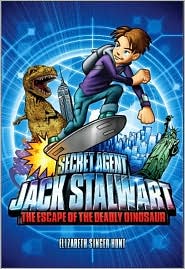
Sadly, the journal article only included one example text. So I wrote a set of my own texts to use with students next week. I chose a spy theme, since the Jack Stalwart books are popular with my readers right now. (If you haven't read these books, they are lots of fun for transitional readers--great gadgets and action, all in a supportive text.)
The texts that I wrote (on a sunny Saturday, when I should have been doing math plans) set readers up to make text-based inferences. A rule is presented early in the text. Then, the character is faced with choices, along with a good deal of distracting information and a hidden critical fact. The reader needs to match the rule with the critical fact to make an inference.
I plan to teach Mission #1 on the whiteboard, showing students how to make the inference using the rule and the critical fact from the text. Then, they'll work on Missions 2 and 3 with a partner, with a lot of supervision. Finally, they'll work on Mission 4 on their own.
This kind of inferencing is a great first step for transitional readers. Once students get good at finding these text-based inferences, they'll be ready for the next step into more open, reader-based inferences. And--hopefully--ready to have some brilliant discussions about finding the setting in a story!
If you try these mission files with your class, I'd love to hear how they work!
But where to begin? With this group of readers, I want some quick success to build their confidence. I decided to start with text-based inferences, taught along with some visualizing. As I wrote about in The Forest and the Trees, text-based inferences are those that depend on a knowledge of how text works. Finding the speaker in dialogue, matching pronouns with antecedents, and using specific clues from a text are all examples of text-based inferences.
Visualizing, on the other hand, is a form of reader-based inference, which depends on a reader's background knowledge. Why is visualizing a form of inference? No author ever tells every detail about a passage. Instead, a reader needs to bring some background knowledge to the text in order to form a visual image.
Critical Facts and Rules
As I researched The Forest and the Trees, I came across an interesting journal article. This article, authored by Philip Winne, Lorraine Graham, and Leone Prock, explains how struggling readers learned to make text-based inferences with the help of some carefully written texts and immediate feedback. The study is on the older side (1993), but I couldn't help but see how the methods described could help my students. Readers don't need a whole lot of background knowledge to make these inferences. And the process forces them to look closely at the details in the text to explain how they make their inferences. Great stuff for my students!
Sadly, the journal article only included one example text. So I wrote a set of my own texts to use with students next week. I chose a spy theme, since the Jack Stalwart books are popular with my readers right now. (If you haven't read these books, they are lots of fun for transitional readers--great gadgets and action, all in a supportive text.)
The texts that I wrote (on a sunny Saturday, when I should have been doing math plans) set readers up to make text-based inferences. A rule is presented early in the text. Then, the character is faced with choices, along with a good deal of distracting information and a hidden critical fact. The reader needs to match the rule with the critical fact to make an inference.
I plan to teach Mission #1 on the whiteboard, showing students how to make the inference using the rule and the critical fact from the text. Then, they'll work on Missions 2 and 3 with a partner, with a lot of supervision. Finally, they'll work on Mission 4 on their own.
This kind of inferencing is a great first step for transitional readers. Once students get good at finding these text-based inferences, they'll be ready for the next step into more open, reader-based inferences. And--hopefully--ready to have some brilliant discussions about finding the setting in a story!
If you try these mission files with your class, I'd love to hear how they work!
Thursday, June 23, 2011
Open-Ended Responses
Today I had the privilege of presenting a workshop about helping students write open-ended responses. What an amazing group of teachers! I enjoyed meeting everyone and hearing about your classrooms and your schools.
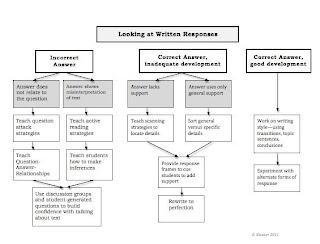
When helping students to craft open-ended responses, it helps to look at the problems that students are having, and plan instruction from there.
Question-Answer-Relationships
For students who are having trouble answering the questions that are given, QARs can help. Here are some nice resources:
QAR posters and instructional materials
This is a great site with nicely formatted materials to print out and use right away.
QAR with pictures
 I love this ReadWriteThink lesson that uses Question-Answer-Relationships with wordless books. Two of my favorites are used in the lesson plan--Zoom by Istvan Banyai and Tuesday by David Wiesner. By helping kids to find the answers to questions about pictures, this lesson helps students who may be struggling with finding answers in text.
Students who misinterpret text
These students are trying to make inferences and judgments about text, but are having difficulty. Often, it's helpful to work with these students on the skills of making inferences.
Using Schema to Make Inferences Powerpoint
I wrote this to guide students through the inference process.
Making Inferences
This is a presentation that I created for KSRA last year--it unpacks the skill of inferencing for teachers.
Inference Unit
This web page has many lessons and resources for teaching inferring.
Past Blog Posts about inferences
I write about inferences a lot!
Text Set for Making Inferences
Text-Based Inferences: Who's Talking?
Poetry Picture Books for Making Inferences
Literature Discussion Groups
Discussion groups can help kids of all ability levels to improve with answering questions and finding text details.
Literature Discussion Group Pack
This is a set of resources that I have on Slideshare.
Blog Posts
Lessons from Literature Circles
Discussion Groups: Getting Started
More information about inferences and helping kids to write open-ended responses--including sample texts--can be found in my book The Forest and the Trees.
I hope that these links are helpful! Please drop a comment about something that you like or plan to use.
When helping students to craft open-ended responses, it helps to look at the problems that students are having, and plan instruction from there.

Question-Answer-Relationships
For students who are having trouble answering the questions that are given, QARs can help. Here are some nice resources:
QAR posters and instructional materials
This is a great site with nicely formatted materials to print out and use right away.
QAR with pictures
Students who misinterpret text
These students are trying to make inferences and judgments about text, but are having difficulty. Often, it's helpful to work with these students on the skills of making inferences.
Using Schema to Make Inferences Powerpoint
I wrote this to guide students through the inference process.
Making Inferences
This is a presentation that I created for KSRA last year--it unpacks the skill of inferencing for teachers.
Inference Unit
This web page has many lessons and resources for teaching inferring.
Past Blog Posts about inferences
I write about inferences a lot!
Text Set for Making Inferences
Text-Based Inferences: Who's Talking?
Poetry Picture Books for Making Inferences
Literature Discussion Groups
Discussion groups can help kids of all ability levels to improve with answering questions and finding text details.
Literature Discussion Group Pack
This is a set of resources that I have on Slideshare.
Blog Posts
Lessons from Literature Circles
Discussion Groups: Getting Started
More information about inferences and helping kids to write open-ended responses--including sample texts--can be found in my book The Forest and the Trees.
I hope that these links are helpful! Please drop a comment about something that you like or plan to use.
Saturday, April 2, 2011
Text Set for Making Inferences
Don't you love it when everything just comes together? This week, as I reached for good picture books for teaching inferences, my choices happened to come together in a way that helped students to think about broader issues.
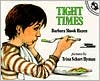 I picked up Tight Times at our library's used book store. I remembered it from watching Reading Rainbow as a child (ah, Reading Rainbow!), and I knew that it was a bargain at $.50. Even though it is meant for younger readers, it worked nicely for making inferences. We stopped and talked about what "tight times" means, how we could use the illustrations to make inferences about the parents' feelings, and what we could figure out about the narrator. (The narrator of this book, who is not named, wants a dog, but his parents tell him he cannot have one because of tight times. Things get worse when the father loses his job. But then the boy finds a kitten in a trash can, and the boy's parents decide that he can keep him.)
"But I didn't like the ending," Mandy said. "The book was so sad at parts, and then it just ended with something funny. I didn't like that." What a great observation! I turned back to the last page and we talked about the ending. (In a way, I have to agree with Mandy.)
When we looked more closely at the last few pages, though, we saw that the illustrator was telling us a little more to the story. "Look! The dad is looking at the newspaper!" Michael noticed.
"What do you think he's doing?" I asked.
There was some puzzlement as students talked about this with their partners. Some students obviously knew about want ads and the classifieds; others did not. "Maybe he's just reading a comic to cheer up?" Keith guessed. This is a classic example of how inferences depend on background knowledge. Luckily, other kids spoke up. "There are lists of jobs in the newspaper," Favia said confidently. "He's probably looking for a job."
On the next page, students noticed that the parents looked happier, and guessed that maybe things were better. "Sometimes the illustrator tells you things that the author does not," I said.
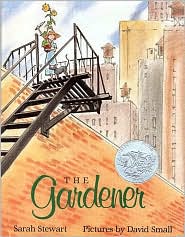 The Gardener by Sarah Stewart, a perfect book for teaching inferencing, worked beautifully with Tight Times. I explained that it was told in letter form (I love stories told this way) and asked students to talk with their partners about these words:
Lydia Grace
1935
Mama and Papa
train
Uncle Jim
windowboxes
bakery
the gardener
"Which words might relate to the setting?" I asked. We talked about the bakery, and the train, and students' guesses about who the gardener might be. "What's a windowbox?" asked Luke. We talked about what a windowbox is and how it related to the story.
This book leads to some great opportunities for making inferences. I was modeling an inference chart (three columns--inference, story clues, background knowledge) and this book was perfect. We weren't three pages in before students started buzzing about how this book was similar to Tight Times. I know that things are working when they start naturally comparing texts--without questions, without probing, without my intervention. "Yes, but the boy in Tight Times didn't have to go live somewhere else," I overheard. "I'd hate to do that!" someone else whispered.
My class this year is very visual, and they helped me to notice some new details in The Gardener--like the way that Lydia is always shown in the light, and how that matches her character so perfectly. "There were things like that in the pictures in Tight Times, too," Maura said. "Like how the dad was looking in the newspaper. And there are cats in both of the books."
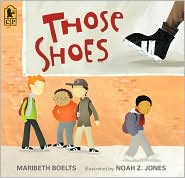 Next week I'm going to expand the inferring into theme, and I've already picked out Those Shoes as a good read aloud for this. What has worked out so well is that, even though I've been officially working on making inferences, these books have given us a chance to dive deeper into making connections and looking for broader themes in text.
"But I didn't like the ending," Mandy said. "The book was so sad at parts, and then it just ended with something funny. I didn't like that." What a great observation! I turned back to the last page and we talked about the ending. (In a way, I have to agree with Mandy.)
When we looked more closely at the last few pages, though, we saw that the illustrator was telling us a little more to the story. "Look! The dad is looking at the newspaper!" Michael noticed.
"What do you think he's doing?" I asked.
There was some puzzlement as students talked about this with their partners. Some students obviously knew about want ads and the classifieds; others did not. "Maybe he's just reading a comic to cheer up?" Keith guessed. This is a classic example of how inferences depend on background knowledge. Luckily, other kids spoke up. "There are lists of jobs in the newspaper," Favia said confidently. "He's probably looking for a job."
On the next page, students noticed that the parents looked happier, and guessed that maybe things were better. "Sometimes the illustrator tells you things that the author does not," I said.
Lydia Grace
1935
Mama and Papa
train
Uncle Jim
windowboxes
bakery
the gardener
"Which words might relate to the setting?" I asked. We talked about the bakery, and the train, and students' guesses about who the gardener might be. "What's a windowbox?" asked Luke. We talked about what a windowbox is and how it related to the story.
This book leads to some great opportunities for making inferences. I was modeling an inference chart (three columns--inference, story clues, background knowledge) and this book was perfect. We weren't three pages in before students started buzzing about how this book was similar to Tight Times. I know that things are working when they start naturally comparing texts--without questions, without probing, without my intervention. "Yes, but the boy in Tight Times didn't have to go live somewhere else," I overheard. "I'd hate to do that!" someone else whispered.
My class this year is very visual, and they helped me to notice some new details in The Gardener--like the way that Lydia is always shown in the light, and how that matches her character so perfectly. "There were things like that in the pictures in Tight Times, too," Maura said. "Like how the dad was looking in the newspaper. And there are cats in both of the books."
Sunday, September 23, 2012
Starting off with struggling readers
One of the hardest things about working with struggling intermediate readers is knowing where to begin. Listening to one running record may suggest five different issues to attack--each separate from the regular curriculum that still must continue to be taught. Students who might be reading at the same level still have very different strengths and needs. But all of them have to be able to cope with grade level text.
It can all seem very overwhelming at times. And it is! Here are some things that I've learned that are helping me to structure my time with these readers.
Mental models
What is the purpose of reading? By the time they reach fourth grade, some students still haven't been able to synthesize decoding the words with building a mental model. It's important to remind students that this is what we're here to do. But mental models can fail for a number of reasons--lack of attention, lack of vocabulary, lack of working memory capacity.
This week, I've started each lesson with some practice in building a mental model. I do this with a quick little imagination game. "Imagine that you are walking down a long aisle," I said. "You are pushing a metal cart. You are taking boxes off a shelf and putting them into the cart. Where are you?"
Of course this is a familiar scene, and most of them told their partners that they were imagining a supermarket or Walmart. I focused them back on their mental models and their use of background knowledge. "Now think about taking that box off the shelf," I said. "Look at the box. What is in it?" Some said cereal--which, of course is what I was thinking of. But listening to their responses was interesting. One student told his partner shoes, while another said chicken nuggets. When they shared, we talked about what words were in the scene that excluded these choices. (Chicken nuggets on a shelf? I'm not shopping there!)
Throughout the week, we did more little scenes, talking about the role that our background knowledge plays in each one. I also used the visualizing assessment texts that you can find here as instructional pieces.
Clicks and clunks
Once students understand building a working model, it's easy to introduce clicks and clunks. In the past, I've started with reviewing reading strategies like inferring, summarizing, synthesizing, and connecting. But the problem with these reading strategies is that they are just more words for the kids to remember. It works fine with on and above-grade level readers. For struggling readers, though, too much terminology can clog up the process.
This is why I love clicks and clunks. A "click" is something that a reader understands. A "clunk" is something that they don't understand. It takes only two minutes for kids to understand the words, and they start using them immediately. I introduced the concept with this graphic organizer and these two sentences:
I have tall yellow flowers growing in my garden.
This was a click for the students. They could imagine it. (In fact, some of them have even seen my garden, as I live next to the middle school!)
I have green basil growing in my garden.
This was a clunk for almost all of the students. When I asked why it was a clunk, they were able to report immediately--they don't know the word basil. But I chose this sentence because I have basil in my garden outside and on the windowsill in my classroom. I directed their attention to look at the basil, and then said the sentence again. This time, the sentence was a click! We talked about how readers can solve problems in many different ways.
Fluency in small groups
Our school has an intervention period. Based on our benchmark assessment data, we have organized the students into small groups for fluency interventions. We have five people working with about 50 kids, which makes our groups a wonderful size. Repeated reading is a proven technique for improving fluency. However, repeated reading in a large class can get very loud. Having smaller groups makes best practices like choral reading, repeated reading, and retelling much easier to manage. And I can listen to kids read frequently without worrying about what the other 25 students are doing.
Carefully selected grade level text in manageable quantities
I have always worked on grade level text with readers of all abilities. (In fact, there is a section about it in the chapter about text-based inferencing in my book, The Forest and the Trees.) With struggling readers, I like to approach grade level text in smaller quantities, and on photocopied pages that students can write on. Even though I have enough copies of this book for my entire group, I've found that struggling readers just do better when they don't see the entire book at once.
After our work with clicks and clunks, we applied the strategy to the first chapter from Toys Go Out. I love this book for early fourth graders. It is a DRA 40, and it has a high inference load, but it is very forgiving. Readers have multiple chances to make an inference, and the story is so concrete that they can build mental models easily. Several students quickly made the connection to Toy Story. As we read the first two pages, we discussed our clicks and clunks
It's important for intermediate readers to know that there are some parts of a story that are meant to be mysterious. The students grew increasingly impatient with the character of Plastic. "What is Plastic?" one boy asked, taking the book from my desk to look at the cover. What's neat about this question is that the author meant for this to be a mystery, and Plastic's identity is revealed in the next chapter.
Have someone to talk you off the ledge
Working with struggling readers is hard. Anyone who says otherwise is selling something. We all want our students to improve quickly. But struggling readers often have unexpected growth patterns. They may improve in one area, but worsen in another. They may flatline for several months. They may do beautifully on a skill with teacher direction, but fail to apply the strategies on their own. It's important to find someone who can talk you through these ups and downs and help you to find the bright spots. At my school, I'm lucky to co-teach with a special educator.
And the brightest of bright spots are often the students themselves. When working with struggling readers, it's most important to get to know the readers themselves. I use the data to help me make plans for my students...but then I try to forget about the data while I'm working with the students. We had so much fun reading the first chapter of Toys Go Out together and laughing about StingRay's mistaken ideas about a vet. Yes, it's hard, but it's also rewarding.
It can all seem very overwhelming at times. And it is! Here are some things that I've learned that are helping me to structure my time with these readers.
Mental models
What is the purpose of reading? By the time they reach fourth grade, some students still haven't been able to synthesize decoding the words with building a mental model. It's important to remind students that this is what we're here to do. But mental models can fail for a number of reasons--lack of attention, lack of vocabulary, lack of working memory capacity.
This week, I've started each lesson with some practice in building a mental model. I do this with a quick little imagination game. "Imagine that you are walking down a long aisle," I said. "You are pushing a metal cart. You are taking boxes off a shelf and putting them into the cart. Where are you?"
Of course this is a familiar scene, and most of them told their partners that they were imagining a supermarket or Walmart. I focused them back on their mental models and their use of background knowledge. "Now think about taking that box off the shelf," I said. "Look at the box. What is in it?" Some said cereal--which, of course is what I was thinking of. But listening to their responses was interesting. One student told his partner shoes, while another said chicken nuggets. When they shared, we talked about what words were in the scene that excluded these choices. (Chicken nuggets on a shelf? I'm not shopping there!)
Throughout the week, we did more little scenes, talking about the role that our background knowledge plays in each one. I also used the visualizing assessment texts that you can find here as instructional pieces.
Clicks and clunks
Once students understand building a working model, it's easy to introduce clicks and clunks. In the past, I've started with reviewing reading strategies like inferring, summarizing, synthesizing, and connecting. But the problem with these reading strategies is that they are just more words for the kids to remember. It works fine with on and above-grade level readers. For struggling readers, though, too much terminology can clog up the process.
This is why I love clicks and clunks. A "click" is something that a reader understands. A "clunk" is something that they don't understand. It takes only two minutes for kids to understand the words, and they start using them immediately. I introduced the concept with this graphic organizer and these two sentences:
I have tall yellow flowers growing in my garden.
This was a click for the students. They could imagine it. (In fact, some of them have even seen my garden, as I live next to the middle school!)
I have green basil growing in my garden.
This was a clunk for almost all of the students. When I asked why it was a clunk, they were able to report immediately--they don't know the word basil. But I chose this sentence because I have basil in my garden outside and on the windowsill in my classroom. I directed their attention to look at the basil, and then said the sentence again. This time, the sentence was a click! We talked about how readers can solve problems in many different ways.
Fluency in small groups
Our school has an intervention period. Based on our benchmark assessment data, we have organized the students into small groups for fluency interventions. We have five people working with about 50 kids, which makes our groups a wonderful size. Repeated reading is a proven technique for improving fluency. However, repeated reading in a large class can get very loud. Having smaller groups makes best practices like choral reading, repeated reading, and retelling much easier to manage. And I can listen to kids read frequently without worrying about what the other 25 students are doing.
Carefully selected grade level text in manageable quantities
I have always worked on grade level text with readers of all abilities. (In fact, there is a section about it in the chapter about text-based inferencing in my book, The Forest and the Trees.) With struggling readers, I like to approach grade level text in smaller quantities, and on photocopied pages that students can write on. Even though I have enough copies of this book for my entire group, I've found that struggling readers just do better when they don't see the entire book at once.
After our work with clicks and clunks, we applied the strategy to the first chapter from Toys Go Out. I love this book for early fourth graders. It is a DRA 40, and it has a high inference load, but it is very forgiving. Readers have multiple chances to make an inference, and the story is so concrete that they can build mental models easily. Several students quickly made the connection to Toy Story. As we read the first two pages, we discussed our clicks and clunks
It's important for intermediate readers to know that there are some parts of a story that are meant to be mysterious. The students grew increasingly impatient with the character of Plastic. "What is Plastic?" one boy asked, taking the book from my desk to look at the cover. What's neat about this question is that the author meant for this to be a mystery, and Plastic's identity is revealed in the next chapter.
Have someone to talk you off the ledge
Working with struggling readers is hard. Anyone who says otherwise is selling something. We all want our students to improve quickly. But struggling readers often have unexpected growth patterns. They may improve in one area, but worsen in another. They may flatline for several months. They may do beautifully on a skill with teacher direction, but fail to apply the strategies on their own. It's important to find someone who can talk you through these ups and downs and help you to find the bright spots. At my school, I'm lucky to co-teach with a special educator.
And the brightest of bright spots are often the students themselves. When working with struggling readers, it's most important to get to know the readers themselves. I use the data to help me make plans for my students...but then I try to forget about the data while I'm working with the students. We had so much fun reading the first chapter of Toys Go Out together and laughing about StingRay's mistaken ideas about a vet. Yes, it's hard, but it's also rewarding.
Subscribe to:
Posts (Atom)